
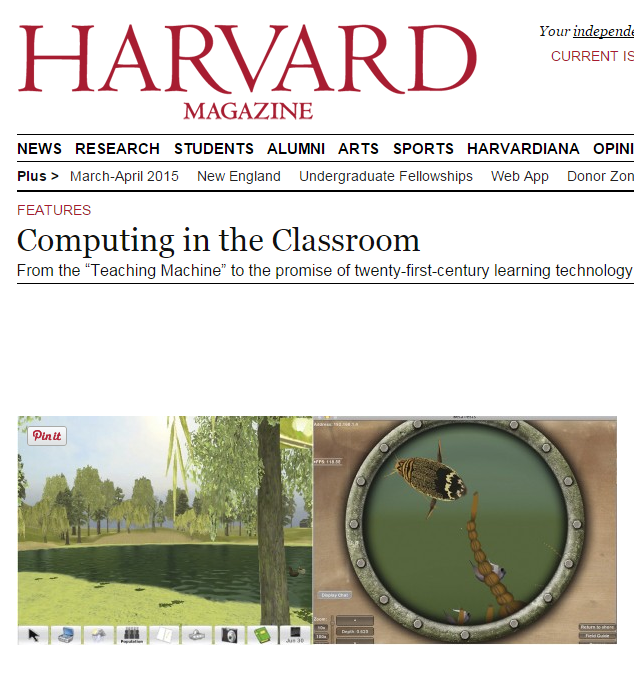
“With tools like augmented reality, games, and coding, it’s possible to imagine a model of schooling that departs from its behaviorist past — creating Ludic Education for a Ludic Age, promoting inquiry, collaboration, experimentation, and play.” Sophia Nguyen
The March/April Harvard Magazine arrived in the mail recently and I finally got around to reading the article, “Computing in the Classroom: From the ‘Teaching Machine’ to the promise of twenty-first-century learning technology” by Sophia Nguyen.
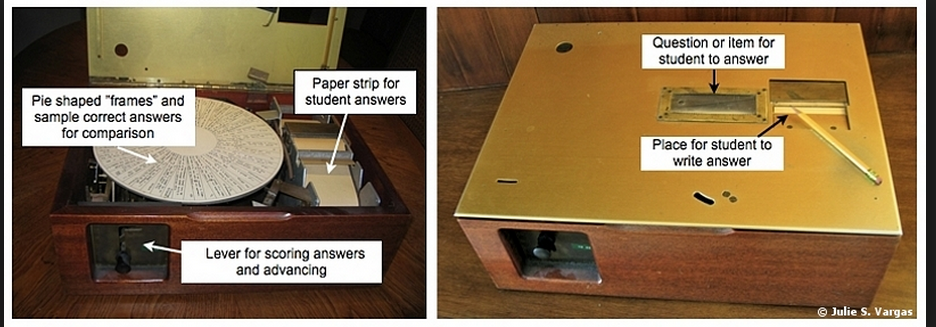
picture from eLearn Magazine article “A Science for e-Learning: Understanding B.F. Skinner’s Work in Today’s Education”
This article entered into the current philosophical fray of whether computers actually improve student learning by providing some historical context for how computers first gained a foothold in the classroom. Interestingly, Nguyen said that B.F. Skinner originated  the idea of having students use a “learning machine” to get immediate reward when they answered correctly. Nguyen basically argues that education has been “tainted” by this initial idea and is still trying to shake free of it.
Perhaps, but this “mechanization” goes back to the founding of public school education which tried to teach the largest numbers of students most efficiently.
How can we shift education so it is more personalized and individuated? Could the integration of technology allow this? In the ideal world, yes!
Remember how Wesley Crusher in Star Trek: The Next Generation basically established his own curriculum based on his interests, questions, knowledge? The computer (and the hidden teachers) established the learning goals and he happily researched, problem-solved and learned in a real environment where what he did had real life application. I think in one episode, one of Wesley’s school experiments saves the Enterprise from destruction.
Personal Retrospective on how Teaching has Changed
Okay, okay. How does this apply to me and teaching at an independent school on the Mainline? When I shifted form college teaching to high school teaching in 2002, no high school student came to class with a computer. Now in 2015, most students bring a lap top (or a smart phone) to class. In 2002, assignments, syllabi, and handouts were all xeroxed; in 2015, the students access these texts through a classroom management website called “Haiku” (there are several different platforms: Blackboard, Alma, etc). Now students can opt to read the text on their computers or smart phones. My teaching has also changed; it is less teacher-centered and more student-centered. I will set the parameters for a class discussion and then let them debate. Or I will teach a hard facts (grammar, historical context, literary analysis techniques) and then the rest of the class is them applying the information and making it their own. Only 1 month ago, I was still handing out lists of vocabulary words for the students, but now they are training on Membean, which is an individuated computer program for learning vocabulary. Even though we have only been using Membean for a month, the students tell me they are not tired of it and love how it feels like a “simulation” (see below for importance of semantics) with goals, statistics for training, and varied hooks for learning each word.
Now
Now when I am not actively in class, I am working on a computer. What do I do all day with this computer?
- update each class’s Haiku page with homework, information, class notes and handouts, links to outside resources
- creating new lessons which are generally presented using smart board software; this means determining substance of the lesson, preparing slides with text information, questions; finding appropriate images to keep their attention
- grading homework and papers on line
- answering emails from students, colleagues, parents
- researching next lesson, unit, text
I am an early adopter. I love my computer and learning to do new things on it. Just yesterday I finally decided to make a little how-to video to show students how to create a subpage on WordPress. I used Jing to create this little 2 minute video. That part was easy but then I had to figure out how to post the video and I wanted to preview it to make sure it worked. Then I learned that Jing saves videos in a special file format that means the video can only be accessed using a webbrowser. Live and learn.
Bottom line: technology has transformed how and what I teach. Therefore the lessons are more tailored to a specific group of students’ needs. I try to prepare lessons which pilot themselves but this requires a great deal of research and time to create a structure and provide resources which support the lesson’s learning goal and yet gives the students a degree of autonomy.
Technology has also made possible the publication of student work to a much larger audience — the entire world! I think this may be one of the most powerful consequences of computer usage in the classroom — at least for me as an English teacher. In 2002, when students wrote a paper, they handed it to me and I was the only one to read it. In 2015, when students write an essay, they can post it on a class website for their peers to read. I think my students in 2015 have much better “voices” when they write because they have a sense of audience. They also take more pride in their work because they know many people will be viewing their product. They also see their work more as a product or something that is consumable (I need to think about this idea more). Another way these students are different is that in general, they write more than ever before — blogs, texts, emails, etc. It is a different type of writing, more casual, informal, ephemeral. But it is writing.
Yet….
…. there are times when I cannot look any longer at the computer screen. When the idea of reading 40 papers on line is too much and I print all the papers out to read sitting on the couch at home. And there are times when I feel I am serving technology instead of technology serving me.
End note: When I typed the quotation at the beginning, the adjective “ludic” was ringing a bell in my mind. I think that title is indebted to a book called Homo Ludens by Johan Huizinga, a Dutch historian and cultural theorist. He published the book in 1938 and it is all about how man is the only creature who creates games with rules and playing fields. I read it a very long time ago while an undergraduate or graduate. I could only remember the title but through the magic of the google found the author’s name!
Terms gleaned from “Computing in the Classroom”
Terms picked up from the article to sound like you know what you mean when talking about technology and education:
- digital fluency — ability to easily use technology
- “gamification” — teaching through games
- deep game experience — game is created in such a way to provide verisimilitude — maybe even richer than the gamer’s immediate environment
- “simulation” — use this word instead of game if you want to avoid criticism for being frivolous
- “learning space” or “learning environment” — the materials, information you gather around yourself to learn
- games — “‘the first designed interactive systems our species invented’ writes Eric Zimmerman, a games designer and professor at New York University” (quoted form article on p. 51)
- constructionism — teaching philosophy from 1960s postulated by Seyour Papert which said students must actively build knowledge when they interact directly with materials
- digital confidence — self explanatory
- digital illiteracy



 Who needs to think?