
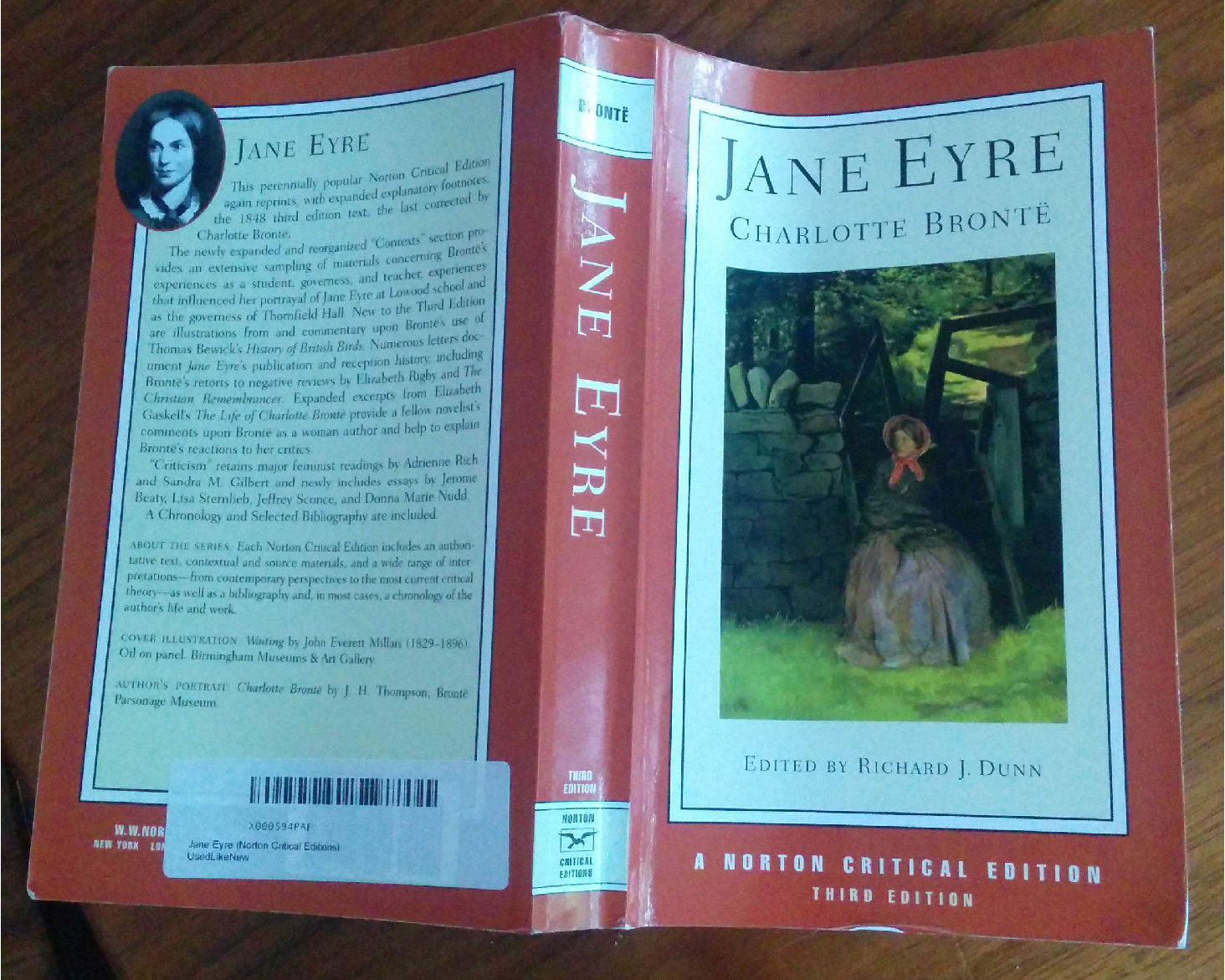
 For the last couple of days, I have been reading Jane Eyre (again) in preparation for teaching it in the fall.
I am reading from the Norton critical edition and before starting the first chapter, read Adrienne Rich’s article “Jane Eyre: The Temptations of a Motherless Woman.” Rich observes that Jane does not long for a man when she walks the roof of Thornfield; she longs for freedom and breadth of experience and richness of life. She also comments on how unusually Bronte put the madwoman on the roof instead of the cellar (subconcious) to symbolize that Jane’s desire for just these things is akin to madness for a Victorian woman.
I regret reading this excellent article because after so many years, here was my chance to come to the novel fresh — almost like a student reading it for the first time. Now my thoughts are tainted and twisted by Rich’s voice.
Often I tell my students to avoid criticism and to read their books with their own open eyes, hearts, and minds and see what strikes them. These girls will have plenty of time to be be tainted by literary criticism. They don’t believe me when I say that their own thoughts are worth more than any random scholar’s thoughts. Only with the fresh eyes will new ideas be brought to these old texts.
I do bitterly regret reading Rich’s article.
Bronte has Eyre refer to the novel as a play in Chapter 11. I do wonder if the novel can be marked into five acts like a play. Bronte must have had Shakespeare in mind. Rochester refers to Macbeth in Chapter 15. He says that he is at the cusp of a great choice and that a spirit is daring him to take his fate in the same way the witches dare Macbeth. That the spirit is daring him to like Thornfield. Rochester seems to have given up a great deal to protect this house — and since I am a repeat reader — I know exactly how much he has sacrificed.
Rochester is such an interesting character — the first real Byronic hero… well, may be Victor Frankenstein is a Byronic hero. No definitely, Frankenstein is Byronic. But Rochester is the prototypical Harlequin Romance hero. The mysterious, older man scarred by a dark past who must be redeemed by the pure love of a young, innocent girl.
Rochester’s latest incarnation is Christian Gray of Fifty Shades of Grey. His Thornfield Hall with the drawing room with white carpets and crimson couches is the Red Room of Pain in Grey’s Seattle penthouse (what a trope). And there comes the great confession that I have read the first book in the dreadful trilogy bur could not read any more — at least for a while — too hackneyed and hyperbolic and unrealistic.
Rereading this book is also an prod to remembering my past since the first time I read this book was as a senior in high school. Some later post will be about what I thought of the book then — in so far as I remember my own thoughts for those many years ago.



 Who needs to think?