The last chapter of Jane Eyre begins with the simple declarative address to the reader: “Reader, I married him.” That is all. No fanfare. No drama — unlike Jane’s last attempted wedding. She describes how various people receive the news. Mary and Diana reply with warm approbation but St. John never replies to the letter which Jane sends announcing her marriage. Jane tells us that all his other correspondence is calm and measured, exhorting her to not live just for the earthly.
Jane says midway through the chapter that “I have been married ten years,” so she writes this autobiography well after the events. The last chapter is really just wrapping up the ends.
Adele she removes from a too strict school and places in a more school “conducted on a more indulgent system.” Jane visits her often and observes: “As she grew up, a sound English education corrected in a great measure her French defects….” Now that overt bias against the French I find hilarious and will explore further on a later post.
Jane tells us that Mary and Diana marry: “Diana’s husband is a captain in the navy; a gallant officer and a good man. Mary’s is a clergyman: a college friend of her brothers; and, from his attainments and principles, worthy of the connection.” These two sisters symbolize two different religious? cultural? moral? influences for Jane. Diana symbolizes the classical goddess of the hunt, preserver of virgins and children. Mary symbolizes Jesus’s mother Mary. In the book, the darker-haired Diana speaks much more frequently than Mary. The almost blonde Mary is described as quiet, retiring, and distant. In chapter 29, when Jane first comes down after being so sick, Mary’s words are summarized, but Diana’s are included in a direct quotation. Jane says, Diana looked and spoke with a certain authority: she had a will, evidently.” Therefore it only makes sense that Diana marries a military man whose orientation is to soldierly, athletic, conscripted violence and that Mary marries a clergyman. Though it is amusing that Jane feels she has to justify the clergyman more than the navy captain!
St. John Rivers is their older, sterner, stricter, brother of classical good looks: “his face rived the eye; it was a like a Greek face, very pure in outline: quite a straight, classic nose; quite an Athenian mouth and chin. It is seldom, indeed, an English face comes so near the antique models as did his.” The description reminds me of a statue by Donatello which I 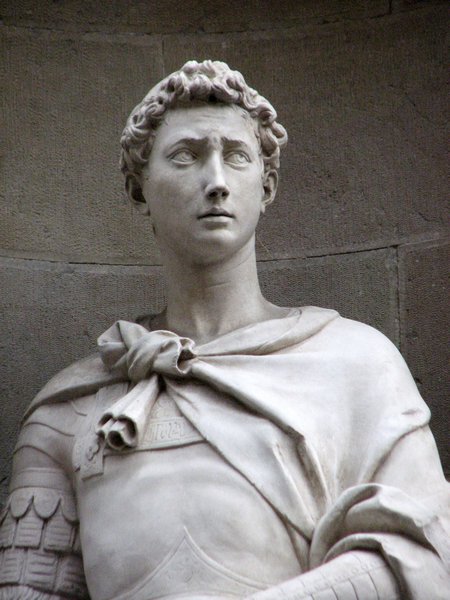 saw in the Florence at the Museo Nazionale del Bargello last March. This statue completed in 1416 shows St. George holding his shield. The classically Greek face possesses a pair of eyes gazing into the far distance and the eyebrows are quirked in concentration. This St. George is beautiful with his sensual mouth, straight nose, round cleft chin, carefully disarranged curls, thoughtfully creased forehead, and muscular neck. This St. George, like St. John, is untouchable.
In the novel, Jane describes St. John with words such as these: “the ice of reserve”; tall figure all white as a glacier”; “like chiseled marble”; “his lofty forehead, still and pale as a white stone”; “a cold, cumbrous column, gloomy and out of place”; “so keen was it [his gaze], and yet so cold”; “there he lay, still as a prostrate column”; “compressing 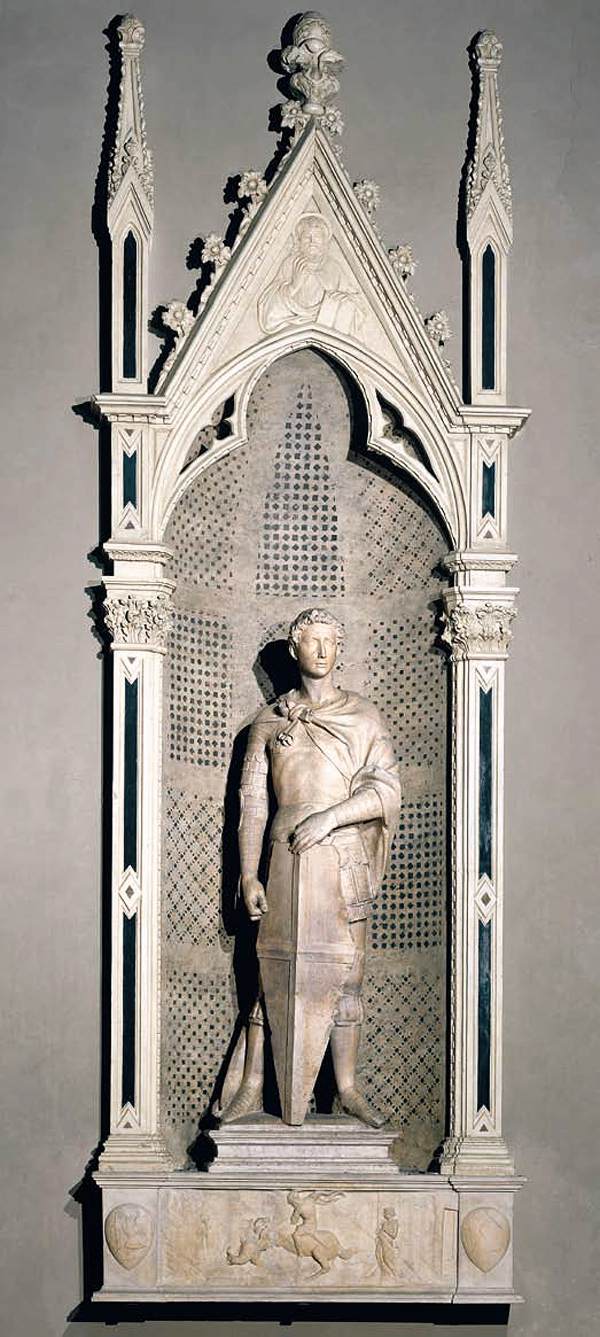 his well-cut lips”; “what terror those cold people can put into the ice of their questions”; “he was in reality become no longer flesh, but marble; his eye was a cold, bright, blue gem; his tongue, a speaking instrument — nothing more.”
Some of the phrases are echoes of how Mr. Brocklehurst in described at the very beginning of the book: “the grim face at the top as like a carved mask, placed above the shaft by way of capital” (ch. 4); “the same black column”; “this piece of architecture”; “looking longer, narrower, and more rigid than ever”; “the black marble clergyman” (ch. 8).
Now that I juxtapose the phrases describing each man, I observe that Mr. Brocklehurst is always described as “black” whereas St. John is always “white.” The colors must symbolize that the two men, while allied in terms of rigidity and sternness, are distinguished because the first is motivated by superficial, hypocritical religiosity and the second is motivated by deep, sincerely, evangelism. Jane’s life is bookended by these two men.
Why, oh why is the last person Jane mentions St. John? Why do we end with an account of his missionary work in India and the fact that he will die soon? Why do end his words that “Amen; even so come, Lord Jesus!”
When I read this ending in twelfth grade honors English, I was puzzled. I remain puzzled. Is Bronte trying to conciliate her more conventional readers who want an affirmation of their Protestant Christian morality and faith? Is she trying to soften the fleshly happiness of Jane, who loves to sit on Rochester’s knee? Is she feebly affirming a patriarchal structure and authority by having the novel end with a man speaking to the Superman?
Up until this point, all the men in the novel have been flawed. Rochester is tamed and symbolically castrated — he even fears Jane won’t love him because he has only “crippled strength” (ch. 37). St. John tyrannizes Jane with his calm rationality. Mr. Brocklehurst is a hypocritical clergyman. John Reed is a despotic, drunken boy who commits suicide. Mr. Mason is weak and cowardly.
Only the women are idealized and perfect — except for the Reed family of Mrs. Reed, Eliza, and Georgiana. The novel really is a paean to women and their power and love and character.
St. John really is the only one besides Mr. Rochester who is given some three-dimensionality.
I really do think he is Bronte’s sop to the expectations of her readership. He is the little moral lesson you get at the end of a fairy tale that allows the reader to enjoy all the other more questionable, ambiguous events, such as the beautiful princess sleeping with a frog on her pillow.
A Side Note
I noticed anew this passage from rather late in the book. It describes a scene when Diana insists that St. John kiss Jane good night in the same what he kisses his sisters good night. Of course it is Diana who orders St. John to perform this action and not Mary!
“…St. John bent his head; his Greek face was brought to a level with mine, his eyes questioned my eyes piercingly — he kissed me. There are not such things as marble kisses, or ice kisses, or I should say my ecclesiastical cousin’s salute belonged to one of these classes; but there may be experiment kisses, and his was an experiment kiss. When given, he viewed me to learn the result; it was not striking: I am sure I did not blush; perhaps I might have turned a little pale, for I felt as if this kiss were a seal affixed to my fetters.” (ch 34)
When St. John kisses Jane, he has to stoop down because she is so much shorter than he. But given the many times he is described as a marble statue, I think of just how hard it must be for him to bend that little bit to kiss her. Even though the kiss is just a kiss, it so much more given how their eyes are described. St. John’s eyes look into Jane’s “piercingly.” I am sorry but that is more than a little Freudian. The entire episode is symbolic of a first sexual encounter. It is not good that Jane thinks St. John’s kiss could be marble or ice. That does not bode well. And worse, it is an experiment! Almost certainly, St. John has not kissed anyone else but his sisters or close relations. He never would have kissed Rosamond Oliver. In this instance, Jane has more experience than the man St. John, since we know she has been thoroughly kissed by Mr. Rochester.



 Who needs to think?