
Royal Mosque
We had two full days in Esfahan. We spent one day in Nawh-e Jahan Square, which was built by Shah Abbas, a Safavid king, when he made Esfahan his capital in 1602. This square is the second largest in the world after Tiananmen Square in Beijing.
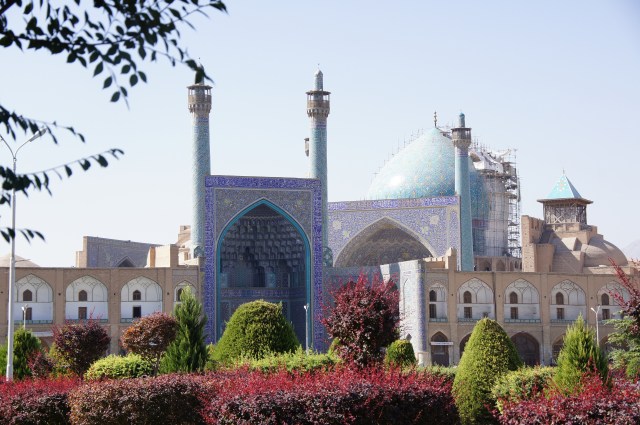
Toward the end of the day, our guide took us to Masjed-e Shah or the Royal Mosque. The entrance to this mosque is one of the narrow ends of the large rectangle of the square (rather misleadingly named). However, as you can see from the picture to the right, the dome of the mosque is at a 45 degree angle to the entrance from the square as indicated by the two flanking minarets. Why? Because the mosque must be oriented in the direction of Mecca. However, Shah Abbas did not want the symmetry of his square spoiled hence the angled walkway to the Royal Mosque.
Our guide told us a story about Shah Abbas and his architect Ali Akbar Esfahani. Apparently, the Shah wanted his mosque finished quickly since when the work began he was 52 years old. But after the walls of the mosque were finished, the architect vanished. No one could find him. The Shah announced all kinds of rewards for anyone who found him. But to no avail.
Then several years later, the architect reappeared, bowing before Shah Abbas. The Shah asked if he had any last words before he was executed.
The architect asked, “How high were the walls built?”
“Twenty meters.*”
“Let us measure the walls now, O Mighty Shah.”
The walls had settled several centimeters and the architect explained that before the domes were built if they were not to crack, time had to pass to allow for this settling.
Shah Abbas let the architect live.
The inner walls of the mosque are ornamented with beautiful blue, white, green and yellow tile work. It is proportioned elegantly. The dome of the mosque is actually double. The peak of the outer dorm measures at 51 meters but the peak of the inner dome is 36.3 meters. This gives this mosque perfect acoustics.
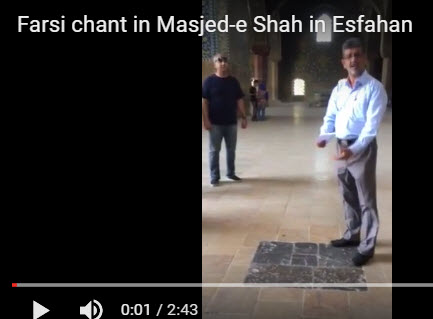
In the center of the floor is a square stone. I watched an Iranian tourist stand on the stone and tear pieces of paper in half. The sound reverberated, bouncing off the interior dome.
Our guide told us to wait. He wanted the tourists tearing paper to leave. Then he took over. He did much more than just tear paper if you watch the video. Notice how the people in the video all have stopped and stand still. One woman has her eyes closed as she listens.
To hear this man chant this poem is to enter another sphere of musical color. Listen after he finishes each line for the echo.
- Disclaimer: 20 meters is my guess.



 Who needs to think?