
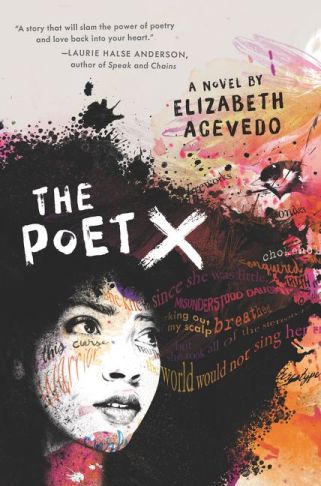
 I read Elizabeth Acevedo’s novel The Poet X in a single evening which does not mean anything at all negative. It means rather that the characters and the plot were compelling, but I was even more interested in the structure and the style of the text. Acevedo is a spoken word poet, and this is her second book. Check out her website!
The book’s narrator is a young Afro-Latina high school girl who chronicles her struggles to define herself against her aggressively Catholic but loving mother, her genius twin brother, societal expectations, and male presumptions about a voluptuous girl. The book also explores issues of hetero- and homosexuality. The narrator is realizing she is attracted to boys, has sexual desire but is a little afraid of actual intercourse (and thus refrains from having sex with her crush), and can give herself sexual pleasure. The narrator’s brother is gay and he hides this from everyone in the family, including his younger twin sister because he knows for his father and especially his very religious mother (she wanted to be a nun before she was forced by her family to marry the father so they both could immigrate to the USA) this is incomprehensible and irredeemably sinful.
Acevedo gives Xiomara Batista has a strong, distinctive voice, combining multiple linguistic registers of spoken and written English and Spanish. She uses multiple poetic forms including haiku and rhymed couplets. In one chapter, she reviews and discards various European poetic forms as not appropriate to her emotions and situations.
It does not hurt that Xiomara has an English teacher how cares and keeps encouraging her to join the Spoek Word Poetry Club.
I also love how Xiomara receives writing assignments and she gives us what she really thinks in the first draft and then she gives us what she actually turned in on safe, acceptable topics. For example, the teacher asks each student to describe the impactful day of her life. In her first poetic draft, Xiomara says it was when she got her period. But then she gives us the prose essay she actually turned in which was about another topic entirely more conventional. Her last essay goes through four or five drafts and Xiomara gives us all of them.
The book ends with an almost Shakespeare like metareflection on the power of words to transform the world and the person by facilitating an alternative interaction and response to reality.
I would really like to pull this book into our summer reading curriculum. But I need to figure out how to present the chapter of obvious self-pleasure. A few years ago influenced by the delicate objections of an older English teacher, we nixed having Jamaica Kincaid’s novel Annie John become a summer read because of paragraph metaphorically describing masturbation. Shakespeare called it “traffic with thyself” in Sonnet 4 as I learned from Chris Cox’s article from 2010 in The Guardian. I think the girls would love the heroine and the realism of this novel.


 Who needs to think?