

Entrance to the Ashmolean Museum
Yesterday morning I headed to the Ashmolean Museum for an appointment to see Pre-Raphelite drawings in the print room. The museum opened at 10 am so I had about 15 minutes to wait and I went and sat down on a stone bench abutting a garden of flowers and trees. I don’t remember if I was reading or just sitting there but one of the men who tend the grounds came up and was inspecting the bed.
“They are awfully dry,” I commented.
“I was looking at the weeds,” he said. “I need to weed that.”
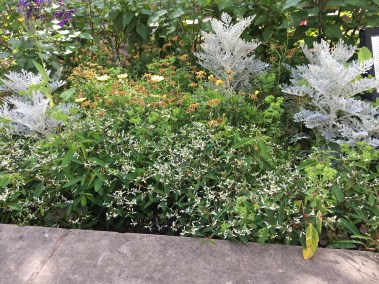
Do you see any weeds?
“It does not look so bad to me.”
“Are you waiting for the Museum to open?”
That was the opening gambit to a 10-minute conversation which moved from my job to his reading and then to poetry and modern prose style. The man was older, maybe in his late 50s, and had the most marvelous silverly beard which curled and looped. He would have been an excellent casting choice for Gandalf.
He told me about his daughter how teaches primary school (that followed after he learned I was a teacher) to his son who works at Blackwell’s in Oxford (the amazingly stocked bookstore) and then to what he reads. Somehow he got onto poetry and he said he loved Basho and his poetry. Then he talked about how his favorite American author is Hemingway because of the spare prose style.
He recommended that I read Cormac McCarthy’s Border Trilogy starting with All the Pretty Horses. He said it was set in the border area between Mexico and the US. I have paused over that book but never picked it up but might have to now.
Funny I looked up Cormac McCarthy and read the summary on Wikipedia on All the Pretty Horses and came across this entry about the style of the book:
All the books of the “Border Trilogy” are written in an unconventional format which omits traditional Western punctuation such as quotation marks and makes use of polysyndetic syntax in a manner similar to that of Ernest Hemingway. (Wikepedia entry)
Now it becomes clear why he connected Hemingway with McCarthy — perhaps.
He also told me that any employee of Oxford University can go to any Oxford library and check out any book they want. He said that he has gone to the library which houses the Japanese books and borrowed translations to read.
It seems that just being in Oxford, being in that atmosphere, in that space which is saturated with learning, that everyone continues an independent, individual scheme of self-education. My vision is so one-sided, but Oxford seems a town of auto-didacts.
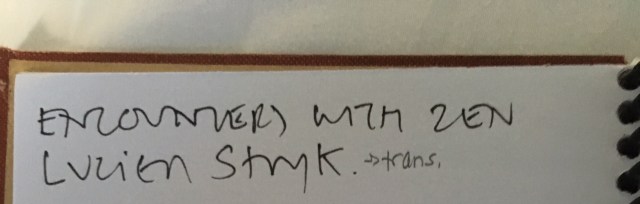
Before he disappeared, he wrote down in my notebook the title of a collection of Japanese poetry and the name of the American translator he likes the best. Look below for visual evidence.


 Who needs to think?