
Said our daughter as she saw me weaving on my rigid heddle loom. Except, thought my pedantic self, Penelope would be weaving on an upright loom. My SH liked this comparison because by extension that made him the wily and intelligent Odysseus.
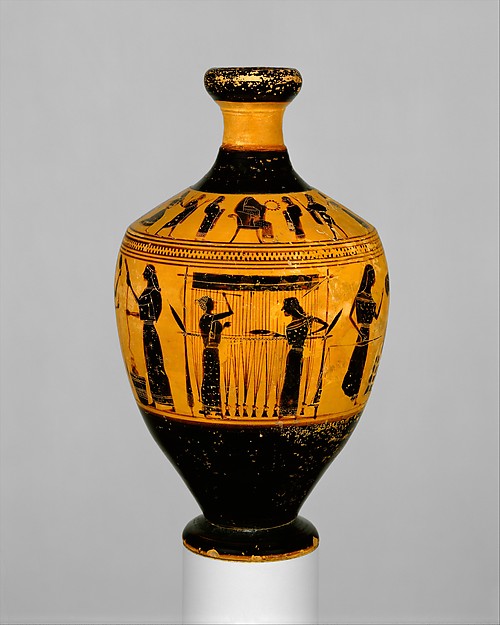 That comment got me thinking. What kind of loom would Penelope have used? I always imagined her sitting down to weave.
But a google image search of Homeric weaving yielded this vase. Look at this depiction of two women weaving. They are standing upright and beating the weft upward into the warp threads. The weights at the back of the loom tensioned the warp threads. Or so I learned by reading Susan T. Edmunds’ article on weaving in the Homeric age. Click here for Susan T. Edmunds article
But now after making numerous weaving mistakes, I have a new appreciation for Penelope’s skill at unweaving. Remember that one of her delay tactics for the amorous (greedy) suitors was that she would choose one of them to be her husband when she had finished the shroud which she was weaving for Odysseus’s father Laertes. She wove the shroud during the day and unwove it at night. For a scholarly discussion of Penelope’s deception and its symbolism, see Steven Lowenstam’s article “The Shroud of Laertes and Penelope’s Guile” from May, 2000 Classical Journal.
Sidenote: Lowenstam has an interesting interpretation of the shroud based upon its description as shining like the sun and moon. I highly recommend reading the third part of the article if you don’t have time to read the whole thing.
So far I have finished two projects, but I have had to unweave several casts of the weft (weavers call these picks) to correct mistakes. These mistakes are created when you don’t press all the weft threads up or down completely. If you cross your weft over the wrong warp thread, you create a “float.” For a plain weave article, a float is a bad thing. In some types of weaving, floats can create designs. Click here for some examples.
See if you can find the mistakes in these two pictures of a plain weave plaid item:


The mistakes are hard to spot until you know what you are looking for. But you have to look for them. Sometimes I did not find the float until I had finished 8 picks!
Undoing the weft takes time, patience, and bright light. If you don’t press down all the threads, when you run the shuttle back, you can create another tangle. Then you have to undo that in order to correct the mistake you spotted originally.
So how on earth did Penelope manage to unweave all those picks at night? She had no candles. She only had torches. Or moonlight. Or maybe Athena gave her special light. She was always helping her favorite Odysseus out so why wouldn’t Athena help out Penelope?
I know from even the little bit of weaving which I have done that unweaving takes more time than weaving. Unweaving is more tedious.
What did Homer know of weaving? When did he see women weaving? Was it something they did in the public rooms? Writing this little blog post makes me ask questions I never would have asked before about life in Ancient Greece.
Here are the mistakes in case you did not spot them!



 Who needs to think?
Pingback: Weaving a plaid — it takes yardage | Who needs to think?