
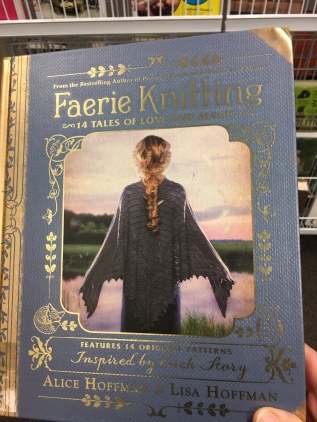
 Yesterday on the new non-fiction shelf of our local public library, I found a book with a pebbled blue cover and gold gilded lettering and design. It was clearly a knitting book as you can see from the front cover and I love shawls so I had to pick it up.
The book Faerie Knitting interweaves fourteen fairy tales with fourteen matched knitting projects. The fairy tales are original ones written by Alice Hoffman and the knitting projects are designed by her cousin Lisa Hoffman.
The book is an interesting amalgam of the printing conventions of fairy tale books and knitting books. The photography has hazy edges, misty forests, medieval cottages, and beautiful, intense women. The models for the knitwear and the heroines of the stories are of several different ethnicities which is the corrective being applied to the Euro-centric stories which normally dominate the shelves of libraries and bookstores. The book is divided into chapters and the chapter titles reflect the stories which proceed the knitting patterns.
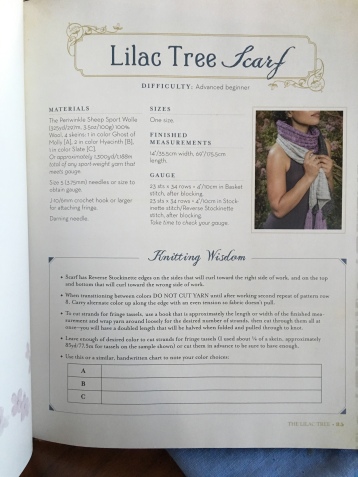 The knitting patterns are set up in the usual way: materials, needles, supplies, finished measurements, gauge. At the bottom though is a box called “Knitting Wisdom” which gives advice for knitting the project. It is almost as though an experienced knitter was whispering secrets into your ear so your project will turn out just right — like Goldilock’s porridge. The patterns include instructions for amulet bags, hats, shawl, gloves, vest, mittens and a baby blanket.
The volume has an introduction written by Alice Hoffman about the connection between fairy tales and knitting. She asserts that writers should be knitters because both activities require patience, redoing, shifting, imagining, and trusting.
I’ve always believed that knitting is a good practice for writers and that anyone writing fiction should be taught how to knit. There’s much to learn from the perseverance of knitters, their readiness to give themselves over to the process, to enjoy the act of knitting without expectation, to always be willing to change and revise, to make do with what they have, using scraps and bits of pieces that, if they’re lucky, may turn out to be glorious. The courage to take apart what you have worked so hard to create is worthy of a fairy tale heroine. (11)
Alice Hoffman’s stories all have women as their heroines. The women are faced troubles such as trying to keep their husband from another woman, or recovering after a spouse dies, or thriving in difficult circumstances, or bravely facing danger confronting an entire community. All of the narration is third person limited, the characters remain nameless (mostly), and the settings vaguely in the distant past. The first story “Amulet” seems like a variant of Little Red Riding Hood where a girl is given an amulet by her grandmother so she can vanquish a beast (wolf) threatening the village. Another story “Seventh Sister” has aspects of Sleeping Beauty and Joseph and his Coat of Many Colors from the Bible because of the confluence of jealous sisters and a long enchanted sleep. Hoffman does seem to like extending the lives of parents, allowing them to live beyond a 100 years unless she kills them off before the story really begins.
I read all of the stories last night before falling asleep. They were pleasantly enjoyable. And the knitting projects are inventive (especially the double sided rose mittens and the blue heron shawl), so I will have to remember to find this book again in the library sometime in the future.


 Who needs to think?