
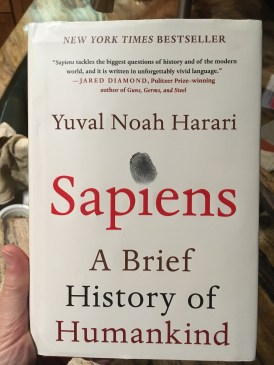
 Yuval Noah Harari wrote his book Sapiens: A Brief History of Humankind in 2015. The book provides an expansive overview of 202,000 years human pre-history and history in under 450 pages (including index). His most provocative tenet is that the ability of humans to create fictions and then believe in those said fictions is what distinguishes us from all other species and might be our doom. This idea does seem somewhat indebted to the argument of Johan Huizinga made in his 1938 book Homo Ludens which argued that humans are unique because of their ability to create imaginary narratives of play.
Harari divides human history into broadly themes epochs:
- the Cognitive Revolution (70,000 years ago)
- the Agricultural Revolution (12,000 years ago)
- the Unification of Mankind through money, politics, and religion (starting approximately 5,000 years ago)
- the Scientific Revolution (500 years ago)
The discussion of the Cognitive Revolution is highly speculative and it must be since our record from this time period consists of material artifacts from archeological sites. However, I did appreciate his rundown of the timelines of the six various human species and how they might or might not have intersected. He does make observe that the extinction of megafauna can be pinpointed on various continents to the spread of Homo sapiens. Here he echoes E.O. Wilson’s argument that human beings, when considered from the perspective of other species living on the planet, is, in fact, a destructive invasive species.
When Harari moves into his survey human behavior based on actual historical records, he makes some interesting propositions such as money as a mode of exchange was a great unifier which surmounted differences of religion (Christian and Islam) and language and culture. He also posits that human beings gift for metathinking and fiction-making enabled the unification of large groups of people (numbering in the thousands and tens of thousands) under shared ideas. Interestingly he groups political ideologies and religions together as types of fiction-making which unify populations and thus liberal secularism becomes as much as thing driving humanity and Catholicism.
Harari also suggests that the reason that Western Europe (as opposed to the peoples of another continent) becomes a leader of economic development, industrial technology, and natural exploitation is that the European scientific revolution first spawned an intense desire to answer all questions and solve all mysteries and later united with imperialistic capitalism. Now that was rather an arresting idea. He talked about how many of the early scientists were financed by capitalists who believed that new discoveries would lead to more opportunities for wealth so the capitalists kept pumping money into the scientists. What an unholy alliance.
In the last chapter of his book, Harari looks into the future when science might replace Homo sapiens with some genetically engineered being or even upload human consciousness into a computer. This seems truly farfetched but there are actual human projects which are researching such possibilities such as the Human Brain project or the Project Gilgamesh.



 Who needs to think?