
 Gabby Rivera’s book Juliet Takes a Breath is about the summer of coming out and self-discovery and intellectual risk-taking by a Puerto-Rican-American girl who has just finished her first year of college.
She lands an internship with the author of her feminist bible Raging Flower and travels to Portland to be a research assistant and (unintended prop) for a book talk.
Narrated from the first person in a fast, colloquial, conversational style, the book presents the culture shock of a girl from the Bronx encountering the hippie culture of Portland. One of the most hilarious scenes is her reaction to the white people on her first bus ride. She is amazed at the BO, the arm-pit stains, the dreadlocks, the boobs hanging free, the bushy, unkempt beards, the ratty hodge-podge of clothing. But what really made me laugh was this description: “Beautiful-hippie-stranger girl reached for the yellow tape to indicate her stop and a chia pet of pit hair popped out from under her arm” (65). Rivera writes this honest, unvarnished, tell-it-like-you-see-it prose that just portrays reality without a filter. Her narrator judges and then we see the narrator recognize her act of judging, stop, reflect and reorient. Mid-way through the bus ride, the aroma on the bus becomes “earthy.”
Juliet gets a whirlwind introduction to a culture and terminology and perspective which includes words like polyamory, primaries and secondaries, PGPs, trans, microaggressions (“little bullshit acts of racism” [157]). As she meets various other women in Portland, she becomes aware of the wide range of feminist and lesbian expression or philosophy or life-choices. With this new awareness, she discovers things about her own family.
One opinion this book communicated clearly is the idea of intersectionality and understanding that the experience of one woman is very different from the experience of another woman of a different race, ethnicity, religion, etc. The author of Raging Flower is an older white woman named Harlowe Brisbane who celebrates the power of the female (a new-age Barbara Walker) and while eager to be a white ally oversteps lines she does not see because of her assumption that having a vagina means all women have the same needs and struggles. In other words, white women sit down, shut up, and listen and don’t assume anything.
That is what I will do since Harlowe Brisbane is me — at least for the rest of this blog post.
But after this next paragraph.
I read this YA book thinking it might work as a summer reading and must decide NO. There is too much underage drinking and smoking of the devil’s lettuce. Other than that it would be an eye-opening book for students.
Click here for Gabby Rivera’s website. She also writes comic books.

 Last Saturday, a beautiful warm but not hot day, we took a bike ride starting at the Herr’s potato chip factory. We were supposed to start at the parking lot of Nottingham Park but that was closed to set up for a fair sponsored by Herr’s.
 My family sometimes does a yarn swap for Christmas. Everyone puts in a skein of yarn in a brown bag. Then the bags are mixed up. Then you draw a name and then you take turns taking a brown bag of mystery yarn. My daughter was supposed to knit up the blue/grey wool which my mother spun for my sister. The project never quite got done and so I took the yarn and decided to make a pair of mitts for my sister to wear when she walks her Samoyeds in Wisconsin.


 Naomi Alderman’s novel The Power was published in 2016, and it certainly responds to the current political times in the guise of fictionalized history as modeled by Margaret Atwood’s The Handmaid’s Tale.
 The first step was to figure out if the inkle loom was in the basement and it was indeed covered with a drycleaning bag. I made new heddles for it. Then I found four different skeins of mohair that would work for a scarf.
 This morning for 4 hours I wove the weft using a creamy colored mohair. At first, I thought I would not be able to advance the warp because of the fuzziness of the mohair going through the heddles but I figured out a way to pull with gentle pressure so I could move the warp 6 inches at a time.

 SH got invited to give a talk on CAR T-cells at a special informational symposium for a private equity fund group called
  told us about his life, his quest for Olympic gold medals, and his fights against cancer. On the second night, we were driven to one of the best restaurants on the island. Toppers is right on the ocean and they have a lovely raised deck near the water where groups go for appetizers and drinks. There I ate my first raw scallops and oysters. Now I wonder why it took me so long to try either one. I think I absorbed that prejudice from my father or mother.
 The highlight of the entire trip was the afternoon we spent sailing on


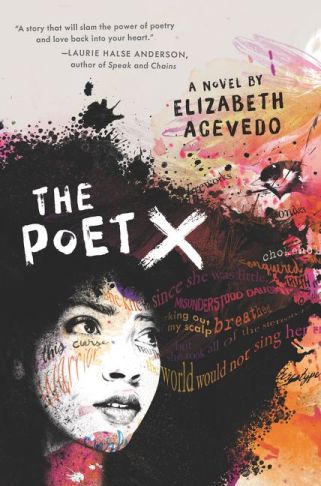 I read Elizabeth Acevedo’s novel The Poet X in a single evening which does not mean anything at all negative. It means rather that the characters and the plot were compelling, but I was even more interested in the structure and the style of the text. Acevedo is a spoken word poet, and this is her second book.


 Yesterday I started reading Anna Marie McLemore’s magical realism book Wild Beauty and today I finished it. The point of view oscillates between a girl named Estrella and a boy named Fel. The girl is one of a generation of five female cousins, all born from different mothers and all those mothers are born from separate grandmothers. The premise is that each woman has one child and that child has a special ability to miraculously grow a unique flower such as a dahlia, azalea, morning glory, or calla lily. Estrella can grow starflowers or borraja.


 Who needs to think?