Help! This Election is Ruining My Marriage

Well, I will say that hyperbole got your attention!

I am kidding but not kidding. SH says I have been distracted and distant. He is right.

The outcome of this election has forced me inward to examine what I believe, what I will tolerate, what I want to do.

If Hillary had won, I would not be suffering this existential crisis about the world and my reality and my purpose in life. I would not by worrying about our global climate entering “run-away” climate change. I would not worry about whether we would remain part of the Paris Agreement  I would not worry my right and my daughter’s right to make our own reproductive decisions. I would not worry about whether we would decide to bomb Iran (more on that in a later post). I would not worry about the Affordable Care Act and the way it provides health care for 20 million previously uninsured people, ensures people cannot be denied coverage for pre-existing conditions, allows us to keep our children on our health insurance until they are 26, and lifts the life-time cap for medical care. I would not worry (as much) about the voting rights of anyone who is not white. I would not worry (as much) about how corporations steamroll over the little people. I would not worry about my first amendment right of free speech. I would not worry about my privacy — but now what will happen when the haters who keep a list of names get access to all our private data?

I have been mulling all this over in the depths of my mind, trying to absorb the enormity of how our nation might change with this new reality.

I am trying to discover how I can have a small part in protesting what is against my moral and ethical core and protecting what I believe to be true and good.

All of us are struggling and we are afraid.

When George W. Bush became the president because of the abuse of power of the Supreme Court, I was in despair. I disagreed with the platform of the Republican Party and all they represented. I thought we were in the hands of careless, thoughtless, unreflective leaders who did not care about our hurts and needs. By their many actions, they proved my worries valid.

Now that this carrot demon has been chosen by a lesser half of the country, we are in the thrall of true forces of rapacious corporate and individual greed and arrogance and self-righteousness.

They say the left is hypocritical. I vehemently disagree. The left, the true left, the true liberal progressives support the dignity of the individual, believe in the right of everyone to work for a true living wage, believe everyone has the right to clean food, water, air and a warm place to live. We believe in the power of the government to improve our lives because we have willingly entered into a covenant with each other to promote the general welfare. We believe that the individual has certain inalienable rights: life, liberty and the pursuit of happiness.

Posted in politics | Leave a comment

Remember Gratitude

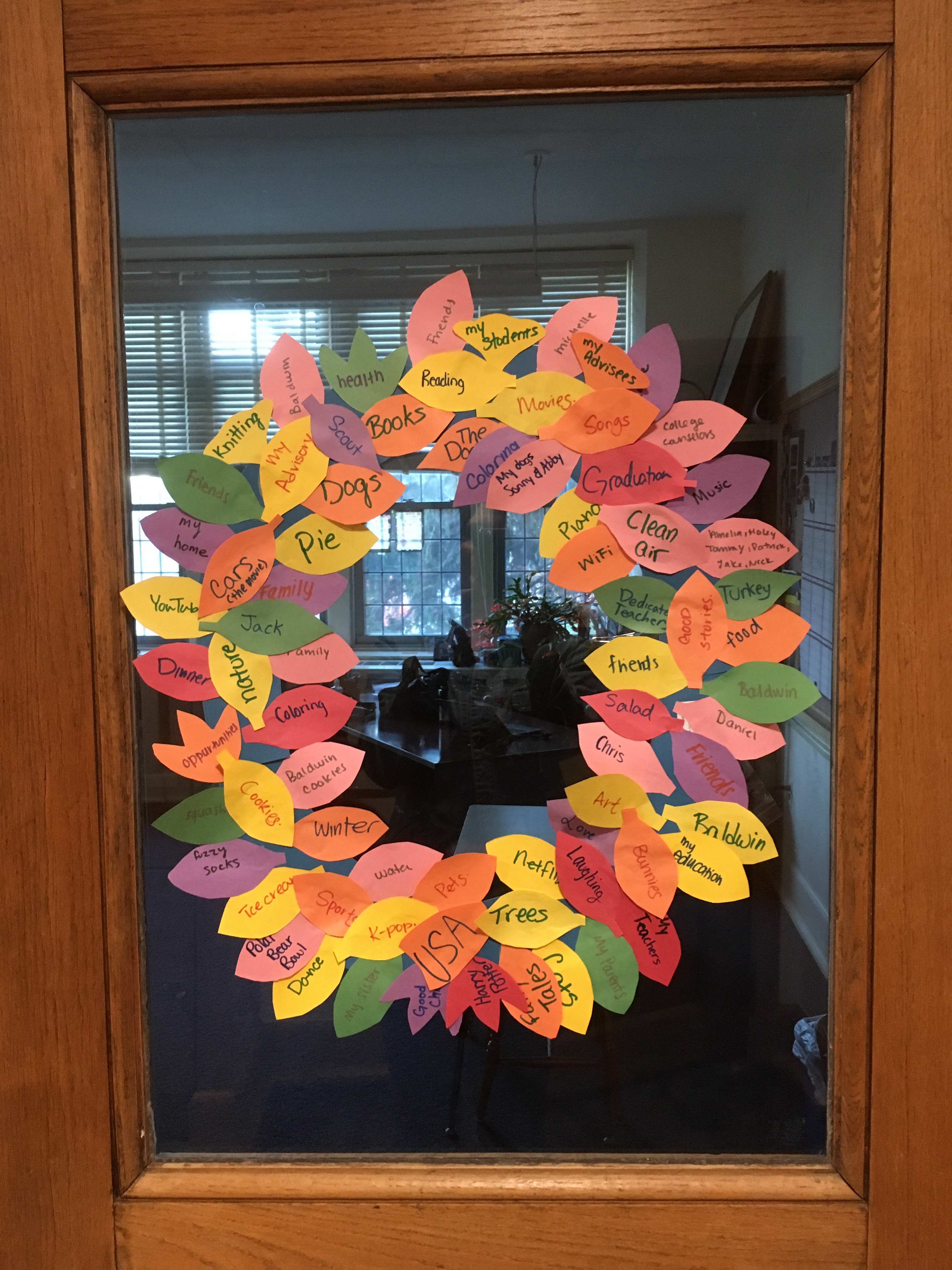
This gratitude wreath was made by my advisory yesterday. It was not my idea. I stole it from a gracious, creative, sharing colleague.

I need to keep all these things in mind these days.

Posted in life in general, teaching | Leave a comment

When Literature Offers Hope against the Times

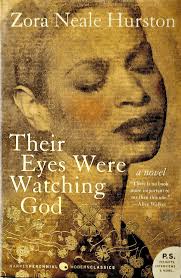
eyes-watching-god-coverSince last Tuesday, I have treated the classroom as my safe zone. For a short while, I focus on the girls in front of me and what they need to learn. But sometimes the literature addresses our times in most unanticipated ways.

The seniors are studying fairy tales, the juniors are reading Charlotte Brontë’s Jane Eyre (generally loving Mr. Rochester), and the tenth graders are reading Zora Neale Hurston’s Their Eyes Were Watching God. 

Today students led discussion of Chapter 6. Chapter 6 is an odd chapter. It begins with a mule and ends with Janie standing up for herself. The mule is of course a symbol of people treated inhumanely and forced to work for the benefit of others.

Earlier in Chapter 2, Nanny calls African-American women the mules of the world, because black men forces them to carry the burden which the white men originally placed on the black men.

In Chapter 6, Jody buys Matt Bonner’s mule and frees it to roam until it dies. Janie praises Joe for his generosity, comparing him to Abraham Lincoln and George Washington.

He scarcely deserves that praise as my students were quick to point out, because he slaps Janie so hard her ear ring and he verbally abuses her. She stands still and he goes back to the store. My students talked about how strange that was — that he would just go back to the store. But then one remarked that he is going back to the place where he feels powerful and where there are lots of other men who feel they too can beat and abuse their women.

The students talked the final episode in the chapter when Mrs. Tony comes to the store to beg Jody to give her a little meat so she can feed her children. Jody gives her a tiny piece of meat and sends her on her way. The men who sit around watching begin to talk about how they would “kill her cemetery dead” or “break her or kill her” for her disrespect as a wife. The girls talked about how Jody likes being with these men, even though earlier he called them trashy, because they affirm his male power. The girls talked about how the men in the store normalized violence against women.

Then I called their attention to what Janie does. Janie breaks into the conversation and tells the men that they don’t know all God’s business:

Janie did what she had never done before, that is, thrust herself into the conversation. “Sometimes God gits familiar wid us womenfolks too and talks His inside business. He told me how surprised He was ’bout y’all turning out so smart after Him makin’ yuh different; and how surprised y’all is goin’ tuh be if you ever find out you don’t know half as much ’bout us as you think you do. It’s so easy to make yo’self out God Almighty when you ain’t got nothin’ tuh strain against but women and chickens.”

Hurston, Zora Neale (2009-03-17). Their Eyes Were Watching God (pp. 88-89). Harper Perennial Modern Classics. Kindle Edition.

The girls talked about how the men use women to make themselves feel more powerful and less helpless. The girls talked about how infuriating it was that women and chickens were equated. The girls observed that Janie assumes the voice of God to gather for herself authority in the face of their misogyny.

Then I asked them why Janie had decided to “thrust herself into the conversation.”

“To protect Mrs. Tony!”

“What does that say about what women should do?”

“Women need to stand up for each other!”

End of lesson.

Posted in literature, teaching | Leave a comment

Election anger channeled 

The results of this election are catastrophic. It is not enough that we lost the presidency but also the Senate and the House.

People are doing plenty of hand wringing and finger pointing. The protests continue in urban centers. But did those protesting vote? Or did they vote for a third party?

We must own this mess. Hillary Clinton and others pleaded with us to volunteer and get out the vote. They warned us about how we would feel the next morning if that man won.

We did not believe it would ever happen. Or at least that we would have the Senate. How deluded.

But I don’t want to come to the middle. I want a strongly left message that supports workers, that protects vulnerable groups, that protects the environment, that promotes justice.

So I am going to take action to bring people into the Democratic Party. I don’t think a third party is viable in the sense that it could not beat the Republicans for years.

Posted in politics | Leave a comment

What would I trade to preserve the Paris Agreement?

This is heresy.

But let’s pretend.

Let’s pretend that I could strike a binding deal with the man who was elected president — and this is like bargaining with the angry djinn released from a bottle after several centuries.

Here is what I would give him if he agreed, promised, swore an unbreakable vow to enact and expand the Paris Agreement:

I would give up Roe vs. Wade. I would give up the Affordable Care Act. I would give up the Lilly Ledbetter Fair Play Act. I would give up the FDA and the Energy Department.

But here is the reality. It does not matter what I would give up.  This man has all the power — both the House of Representative and the Senate and soon the Supreme Court. He is a horrible djinn and can do anything he wants.


Posted in Uncategorized | Leave a comment

Surviving the Election Anguish

The election is over and Pennsylvania went red as did the rest of the country. Hillary Clinton gritted her teeth and conceded yesterday with grace and dignity and generosity and pain. What an admirable woman.

Hillary Clinton encouraged girls to not give up on their ambitions or dreams. She fought so hard and in so many ways she was brought down by men who could not control themselves (Weiner) or deliberately set out to sabotage the election (Comey). Yes, she has faults, but minuscule compared to those of the other person (who by the way did not win the popular majority vote). She suffered defeat too because of her gender. We are more able to accept an African-American man as president than a woman. Remember our history. Who got the right to vote first? And how many years after that did the other group get the right to vote?

But how to move through the days ahead?

I have no heart to write but these two liberal, democratic professional writers have suggested ways to move forward, questions to ask, actions to take.

Read Nicholas Kristof’s article in the New York Times: “Gritting Our Teeth and Giving President Trump a Chance.”  

Read Garrison Keillor’s article in the Washington Post:  “Trump Voters Will Not Like What Happens Next.”

Posted in politics, Uncategorized | Leave a comment

The Woodcarver: A Fairy Tale

SONY DSCOnce upon a time, a youth was sent to make his fortune. It was past time, for he had reached the age of independence. His mother wrapped in a napkin two braided loaves of bread, a wheel of cheese, and a pot of butter. His father gave him his own set of wood-working tools wrapped in a leather roll. They told him to walk until he found a green valley with straight trees for they lived on the mountain where the wind twisted the trees into odd shapes and thus everything was a little wobbly.

The youth walked until he came to a ridge where he could see the world spread before him on every side. He gazed at the horizon but he felt lost and could not chose his way. So he closed his eyes, turned in a circle three times to the sun, two times to the moon, and three times to the stars and opened  his eyes. The path suddenly before him wound up and down stony mountains, and he hoped it would lead to a green valley with straight trees.

He walked for days and days until his bread and cheese and butter was gone and all he had left to eat were the nuts and berries he picked as he walked. To pass the evenings when he sat alone by a small fire, he carved two life-like figures: a deer from oak and a horse from chestnut.

He walked and walked, and one day he could not find any more nuts or berries. They were gone, and the wind blew cold

The path he followed angled down through the forest, and, as he turned a twist in the path, he saw propped against a tree a poppet of a doll. “How odd,” he thought as he drew even with the tree. He picked up the poppet which was heavier than it appeared and tucked it in his knapsack. He did not tuck the entire poppet in the dark sack with his carvings, but he left her head peaking out. Maybe he would find her mistress further down the path.

SONY DSCHe walked all day, stopping to drink from a rushing stream so his stomach would not feel so empty. The night gloamed between the trees and he came upon a hunter’s hut. By now he was very hungry and quite cold. He knocked on the door and, when no one answered, lifted the latch and entered. He saw dried wood stacked neatly by the stove and started a fire which smelled sweetly of cinnamon and apple wood. He found some hard sausage and started roasting it on the fire grate when the door flew open and a huge man walked in. Two dead rabbits swung from his hands and a scowl was on his face.

“Who are you?”

“I am just a woodcarver travelling through these woods and very hungry.”

“Who said you could eat my food and burn my wood?”

No one, but I will give you this as compensation.” The woodcarver reached in his sack and pulled out the exquisitely carved deer, which looked like it wanted to bound away. The hunter turned it over in his huge hands and smiled. He stood the deer on the oaken table. The carver took the rabbits, skinned them, and made a savory stew while the hunter put up his feet and ate slices of the hot sausage. They made a merry meal with fresh bread which the hunter had baked that morning and tart cider which the hunter pressed from forest apples.

The next morning, the hunter gave the woodcarver an entire load of bread, a bag of dried fruit, and a whole sausage. As the woodcarver opened his sack, the hunter saw the poppet and shuddered.

“Where did you find that?”

“In the forest.”

“You must return it, but the way will not be easy. You must cross the bridge of glass, pass through the iron wood, and find the witch’s house. It is her poppet.”

The carver set out on the path and walked quickly, looking straight. The poppet seemed to get heavier with each step, but he could not be sure.

At last he came to a chasm, deep and dark. The sun struck bright reflections off the air, and he realized he had come to the bridge of glass. He peaked over the edge, and the chasm seemed to have no bottom. He looked across the gulf, but he could not be sure where the bridge stopped and the air began. He sat down, his head hanging between his knees. The poppet tipped headlong from his sack and fell in the grit and dirt of the path. He picked her up and brushed the sand from her skirt. The wind flung the sand over the edge except where the bridge was. Now he could see the first few steps of the bridge. He picked up handfuls of sand and threw the sand until he could see the entire length of the bridge. He tucked the poppet safely in his sack and crossed the bridge whistling, but he kept his eyes straight ahead and did not look down.

He walked and walked until he came to a green meadow. The trees ahead were dense and black. When he approached nearer, he saw that the trunks and branches were studded with iron thorns. He paced along the edge of the wood but could find no path through the iron wood. He sat down, his head hanging between his knees. The poppet tipped headlong from his sack but this time her yarn hair was dripping wet. He gathered the yarn into his hand and wrung out the water. He flicked the drops from his hands at the iron trees, and, right before his eyes, the thorns rusted and dropped off, leaving smooth trunks and branches and revealing a path. He tucked the poppet back into his sack, took out his water flask as a precaution, and walked straight.

He walked and walked until at last he came to a small house made of bones and antlers. It had a crooked chimney and a garden of weeds and stunted trees. He walked to the door and rapped on the crooked door frame. The door sprang back. There stood the witch, taller than he. She had a nose crooked and hooked and teeth filed into points.

“What do you want?”

“The hunter told me to bring you this.” The woodcarver held out the poppet which seemed to get heavier in his hands.

She snatched the poppet from him and set it up on a high, high shelf near the peak of the roof in the darkest corner.

“Did he? Well, he is not as ignorant as I thought. I suppose I must thank you for returning what is mine. Here. Sit. Eat.”

The woodcarver came in and sat at the table on the chair. She set before him a wooden bowl full of a thick stew and a tankard of spiced wine. He looked at the poppet and suddenly did not feel hungry. The witch sat at the other end of the long table, and, since he did not want to appear rude, he slyly fed the stew to the brindled cat under the table. He only wet his lips with the wine for he was not thirsty either despite his long walk.

“It is time for bed,” announced the witch. There was only one bed, and she made him lay against the wall. But first she made him take off all his clothes, but he refused to take off the long white linen shirt his mother had woven and sewn and embroidered for him. The shirt was so long it reached to his knees, and he tucked it tight around him. The brindled cat twisted around his ankles and curled into a warm ball. He stared at the poppet on the dark shelf and pretended to fall asleep. When the witch climbed into bed after dropping her clothes on the floor, he lay as still as if he were dead. After a long while of tussling and pulling, she fell asleep.

Just before dawn, he sat up exhausted. The witch snored on, but the brindled cat was stone cold.

He crept out of bed, gathered up his folded clothes, picked up his sack and softly, softly opened the door. The woodcarver looked back at the poppet, and the dawn light touched her face. From his sack, he took a sharp ax and went back inside. He lifted the ax and cut off the witch’s head. The poppet fell from the high, high shelf right into the pool of blood, and suddenly there stood a lovely woman. They looked at each other, their eyes on level.

She smiled. “This witch changed me into a doll, because she hated how all my mother’s trees grew straight in our family’s valley. Ever since then, the witch has dragged me everywhere. Not long ago she left me behind when she was picking nightshade in the dark of the moon. Sometimes even a witch cannot find what she has lost. You were the first person who bothered to pick me up.”

The woodcarver did not know where to look.

“Give me your horse carving.” He pulled the carving from his sack.

She went outside and set the carving on the ground. She tapped it with the witch’s wand, and suddenly there stood a tall horse. The horse looked at the wood carver with a question, and he blushed. The horse looked at the woman with an answer, and she nodded.

The woman grabbed a handful of chestnut mane and sprang onto the horse’s wide back. She gazed down into the woodcarver’s hopeful eyes and reached out her hand. He gently took it into his own calloused one, and then he sprang up behind her with his knapsack slung over his right shoulder.

She gave the horse his will, and they rode across the morning.

Posted in fairy tales | Leave a comment

What is a definition of “fairy tale”?

You would think this a simple question, but I have looked in several books about fairy tales and not found a clear direct definition.

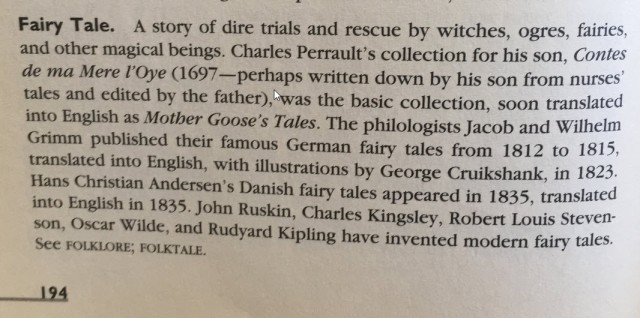
The 2nd edition of The Harper Handbook to Literature (1997) which I saved from my graduate student days has a most unhelpful definition. It does not even mention any protagonist but only the villains. Then it goes on to list collectors, editors, authors of fairy tales.

fairy-tale-handbook-definitionIn his book The Great Fairy Tale Tradition, Jack Zipes does not offer a straightforward definition either. He talks about how the literary fairy tale emerged as a separate literary art form in seventeenth-century France from the oral tradition of wonder tales. He writes, “All the early writers of fairy tales borrowed from other literary and oral tales, and thus their narratives can be regarded as retellings that adapt the motifs, themes, and characters to fit their tastes and the expectations of the audiences for which they are writing” (xii).
Max Lüthi, an early 20th century Swiss folklorist, described fairy tales in his book Once Upon a Time: On the Nature of Fairy Tales by examining a series of famous stories. The English word “fairy tales” translated the German one “Märchen.” He says that the fairy tale should not be taken literally but interpreted symbolically so that the actors (Proppian term) and the motifs should be understood as representations of larger themes and questions of the human experience, the human soul, and the human interaction/confrontation with the world.

In her book Once Upon a Time: A Short History of Fairy Tale (2014), Marina Warner spends several pages describing  the genre:

  • it is a short narrative of a page or a long novel
  • it seems familiar and connects to other similar narratives
  • it shows some allegiance to the past
  • it seems to have some connection to oral tradition or story-telling
  • it uses symbolic language or motifs to suggest larger issues of the soul or morality or human development
  • it contains acts of imagination or creation
  • it seems to have a flat surface which allows multiple interpretations

But she does not give a straightforward definition.

In her book, The Classic Fairy Tales, Maria Tatar says the fairy tale is a narrative of transformation. I don’t have the book right in front of me, but that is what I remember from my perusal of it last night.

In his 1905 edition Fairy Tales Every Child Should Know, Hamilton Wright Mabie finally gives a simple definition:  “The fairy tale is a poetic recording of the facts of life, an interpretation by the imagination of its hard conditions, an effort to reconcile the spirit which loves freedom and goodness and beauty with its harsh, bare and disappointing conditions. It is, in its earliest form, a spontaneous and instinctive endeavor to shape the facts of the world to meet the needs of the imagination, the cravings of the heart. It involves a free, poetic dealing with realities in accordance with the law of mental growth; it is the naïve activity of the young imagination of the race, untrammelled by the necessity of rigid adherence to the fact” (Introduction).

It is fascinating that the simplest definition of “fairy tale” as a genre comes from the earliest source. What does that say about how in the late 20th and early 21st century we have destabilized and undermined and caveat-ed any definition so it cannot be authoritative.

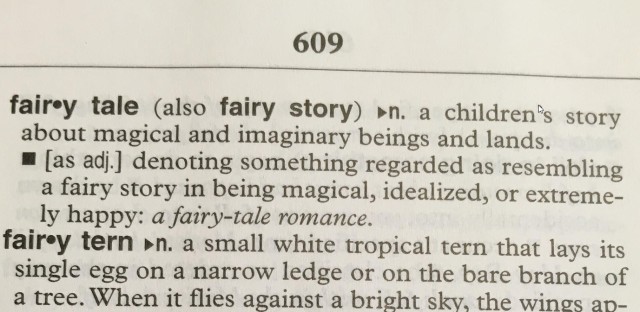
But wait! The New Oxford American Dictionary (2001) does provide a definition of “fairy tale.” How could I forget about the dictionary?

am-dict-definition

In conclusion, I don’t feel too badly that I could not come up with a comprehensive, sweeping definition of “fairy tale” for my seniors, who were asking under the pressure of having to write an original fairy tale or retell an old fairy tale.We did agree on a series of descriptors:

  • it contains a constellation of motifs common to fairy tales (think Stith Thompson’s motif index)
  • it contains at least one magical element or event
  • characters who are somewhat abstract and can represent virtually anyone
  • narrative contains a conflict or challenge
  • uses the language or phrases of fairy tales (godmother, witch, dragon, etc)
  • repetition of threes
  • set in the past or a faraway place or a non-named contemporary place

I will say that in my quest to find a definition, I was reminded of some German terms which might be useful to introduce:

Kunstmärchen or literary fairy tale

Volksmärchen or oral folk tale

Zaubermärchen or wonder tale

German is such a wonderful language to be able to create compound words to capture shades of meaning. And given that the Grimm Brothers were two of the earliest and most influential creators / editors / collectors of fairy tales, it is quite appropriate.


Posted in fairy tales | Leave a comment

Who is the astrologer in “Tebaldo”?

For the second year, I am teaching a senior elective in fairy tales. Recently, we read Giovan Francesco Straparola’s story “Tebaldo” (1550 CE). Like many fairy tales, this one begins with an intact nuclear family and everything is fine until the mother dies. Unlike in “Cinderella” and “Snow White,” the father does not remarry. Although to be quite honest, that would be preferable to what happens next.

When his daughter grows up, he realizes that she is even lovelier and more accomplished than her mother and decides he will marry her himself.

I would definitely prefer an evil step-mother.

Anyway, the daughter escapes with the help of her old nurse [think of the Nurse in Romeo and Juliet my students admonished], she gets remarried to a king of a faraway land, and has two children.

In the meanwhile, her lusty father figures out where she is and decides to break up the marriage. He disguises himself as a merchant and travels to the kingdom (England) where his daughter is now queen. He gains her confidence and manages to be allowed to sleep in the same room as her children. He kills the children with her own dagger, leaves the dagger as evidence, and climbs out the window.

Now this is where the story takes another turn. Straparola then says that “a famous astrologer” arrives in the city and the king summons him to the palace to find the murderer. The astrologer tells the king to examine the daggers of the people in the court — even his own mother’s dagger and, lastly, his wife’s dagger. It is discovered that the queen’s dagger is bloody and the king devises a horrible punishment for her.

The astrologer tells the old nurse what he has done and the old nurse travels to the queen’s new land to release her [a different student pointed out that a Marxist reading of the text would focus on the fact that the commoners have more sense and give better advice than the royalty] Once the queen’s innocence is established, the king summons his army, goes to Tebaldo’s kingdom (Salerno), captures him, and puts him to death horribly. Everyone goes back to England and lives happily ever after.

Now when I read this, I assumed the astrologer was another character and that the incestuous father Tebaldo had gone back to his own country.

One of my students asked, “Isn’t the astrologer Tebaldo?” My quick answer was, “No.” But then I paused and reread that section of the story.

Straparola never identifies Tebaldo as the astrologer. The last time Tebaldo is identified by name is when (disguised as a merchant), he kills the children and plants the dagger. After that the next morning, he has his long beard cut off, changes his clothes and walks around the city.

When the astrologer appears, Straparola says: “Soon the news of the children’s murder was spread throughout the city just when a famous astrologer had arrived” (Zipes, 51). This sentence led me to assume the astrologer was a new character. But then why would he go back to find the nurse as my perspicacious student pointed out?

Goodness but these girls ask great questions.

It seems like this is not mere coincidence that the astrologer shows up and leads the king to find the planted evidence. It is not careless narration that the astrologer makes his appearance after the disguised Tebaldo shaves off his beard. The details are too striking.

But then why would Straparola not make it clearer to the reader that the astrologer is Tebaldo? Why is it interesting that the reader (or at least this one) is confused about who the astrologer is? Is this to remind us that no one can be trusted? Is this a critique of astrology as an unreliable source of knowledge — particularly when the writer of the story is (presumably) a Catholic Italian? Is this a reminder that circumstantial evidence should not be the only basis upon which a conviction is made?

The conversation we had about this text was multi-faceted. The girls offered various interpretations of the actions based on psychoanalysis, feminism, Marxism, and reader response literary theories. They found the story deeply disturbing (incest, remember?) but bravely explored how the violence of the tale revealed often suppressed aspects of both humanity and society.

Posted in fairy tales, literature, teaching | Leave a comment

Mallarme: who is he and so what?

He is a nineteenth-century French poet who published little but thrust open the door of modernism with his poetry and his early appreciation for the Impressionist painters. He understood that they were not trying to paint an objective reality but a subjective perspective based on upon color, light, fracture of forms, and defiance of staid expectations. Apparently, he was painted by Manet, Renoir, and Gauguin. And defined Impressionism in an 1876 essay (all information gleaned from the article linked below).

As is usual it was reading a New Yorker article that reminded me of this poet whom I have essentially avoided since first year of graduate school at Harvard. The entire class was a prolonged discussion of poets and translations of poets and theorists of poets by a scholar of Chinese poetry. I can only say that I understood in a visceral way why translated poetry is a troublesome and troubling, doubtful and speculative adventure. Any translation is at best an interpretation of the original and at worst a corrupted betrayal of that original.

But enough, this particular New Yorker article appeared in the April 11, 2016 edition and was written by Alex Ross. Yes, I am slow at reading the magazines.

Ross’s article is erudite, appreciative, reflective and probing. He quotes in full a Mallarme poem about a swan frozen in the ice. He claims that if you work hard enough you can get to that interpretive end, but I must not be working hard enough because I can’t quite see the connections of the images to create the swan’s tragic fate. Except in the line “he is paralyzed in the cold dream of contempt….” But I want to know who is feeling the contempt?

Ross emphasizes that some folks (like me) give up on Mallarme because he is too dense and allusive. He says when you read his stuff, “[a]fter only one or two lines, though, you are engulfed in fine mist and a certain terror sets in” (81).

He says that Debussy’s piece “Prelude to ‘The Afternoon of a Faun'” is inspired by Mallarme’s poem. Now, I guess I will have to try and read it since that is one of my favorite pieces of music.

Ross had some wonderful lines in his article which I am going to take the liberty to quote. They  might come in useful when teaching poetry later this year. I also just love the way his passion for this poet displays itself unapologetically.

“If you can crack these poems, it seems, you can crack the riddles of existence” (82).

“It is, however, precisely this tension between traditional form [sonnets and alexandrines] and radical content that keeps reactivating the shock of his writing” (82).

“The poet himself said that he knew of no other bomb than a book” (82).

“…the poet’s function as the mouthpiece of humanity’s primal myths.” (84)

“In the sonnet ‘Sainte,’ Mallarme describes St. Cecilia, the patron saint of music as a ‘musician of the silence’ in a stained glass window.” (84)

And on Mallarme’s relationship with Hamlet: “…full of trapped, tortured figures, variations on the Hamlet persona” (82) and “…a Hero poet prepares to over come his Hamlet stasis….” (85).

Ross recommends a translation by Jeff Clark and Robert Bononno if you want to see Mallarme’s “Un Coup de Des” which is a major experiment in form and structure and thrusting words together. Sounds like something to take a look at. This edition is published by Wave Books.

Ross ends the piece talking about how he bought at auction three books by the French author Camille Mauclair. He says two of the books are in his library — “probably the most remarkable things I will ever own — shards of the Mallarmean temple, where the word was god” (85).

One reads the New Yorker for articles like this one. It is written by an author with deep knowledge and passion for a subject and reawakens the reader’s curiosity and thought.


Posted in poetry | Leave a comment