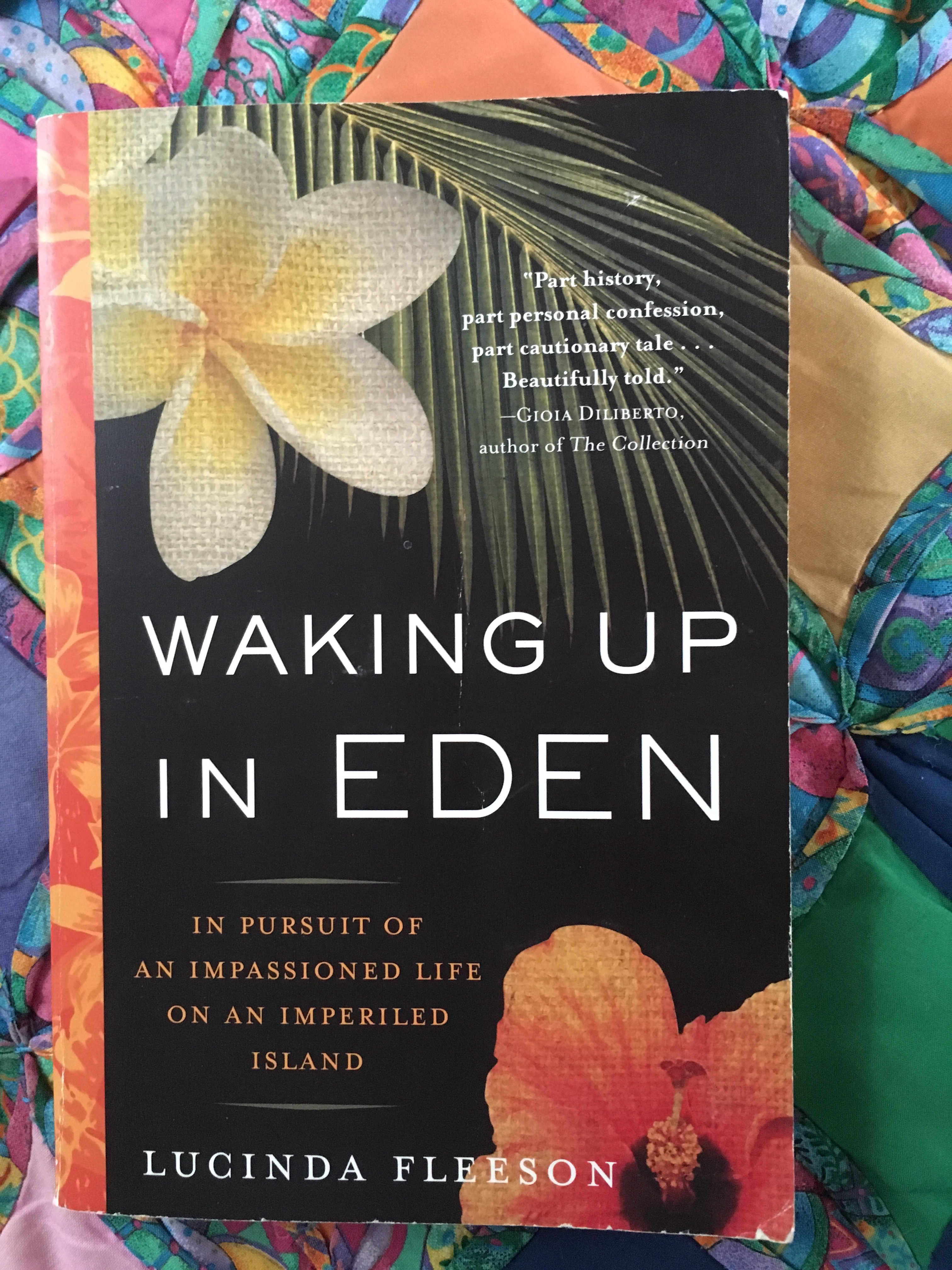
A book about a special garden on Kauai 

When our middle boy graduated from high school on 2013, we went to Kauai for two weeks. One day we toured the garden established by the Allertons when they settled in Kauai in the late 1930s to escape repressive laws against homosexuality. When they died (Robert in 1964 and John in 1985), the National Tropical Botanical Garden was established.

This book Waking Up in Eden by Lucinda Fleeson is both her personal memoir and a history of the garden. 

She left the Philadelphia Inquirer after it was bought and then the outstanding reporting staff decimated in the mid 1990s. I remember this time because the paper became so bad we scuttled our subscription. Fleeson took a job at the NTBG. In the book, she describes the island, the garden, the people with careful descriptive detail that does not overpower. She also talks about her own issues with no melancholy or overdramatization.

But I liked the book best for the history of the island and the people who recognized its beauty and tried to preserve that. 

Posted in book review, books | Leave a comment

Garden in late July

Only a few things are blooming. No day lilies. They have faded  in the unrelenting heat. But purple monarda and daisies are open and attracting bees.

Posted in garden, Uncategorized | Leave a comment

Jazz by brass on the Seine

Walking last night along the Seine, SH heard a brass ensemble playing and we walked toward it across the bridge. It was a group of friends playing together after a picnic. They were not orchestra members escaping from the baton, but clearly they had played together for years because there was no sheet music. After each number, they would take swigs from we bottles, consult, and then start again.

Take a listen to their version of an Eurhymics song.

Posted in Uncategorized | Leave a comment

Dancing on the Seine


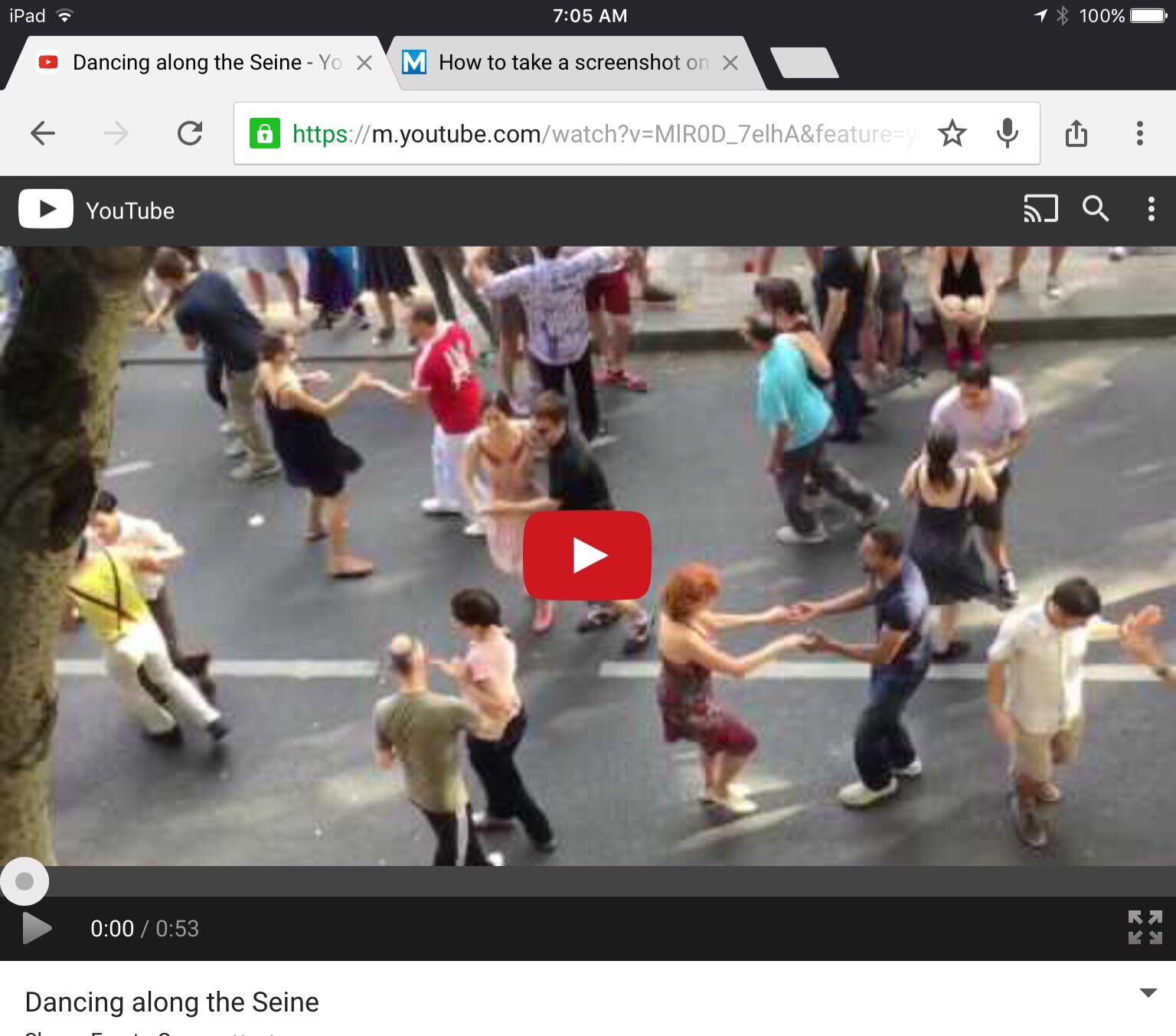
On our first evening in Paris, we walked along the Seine and passed an outdoor restaurant on the bank of the river. There was a jazz band playing and people were dancing in the street. They jitterbugged, twirled, two-stepped, and laughed. Some of the couples were quite good. One couple jittered in place until they caught the beat. Another couple was very intense and the man especially focused in his footwork.
Such a difference to the USA. I don’t ever remember seeing such an impromptu dance party where the music was free and the enjoyment so pure, especially with old fashioned dancing. I usually see hip hop moves or break dancing or the off beat random moves of teenage dancing to their loud, bass-driven music. 
I also thought this might be why Parisians are in general so fit and thin. They walk everywhere and dance when they can.​

Here is link to the video.

Posted in Uncategorized | Leave a comment

My latest project for sanity

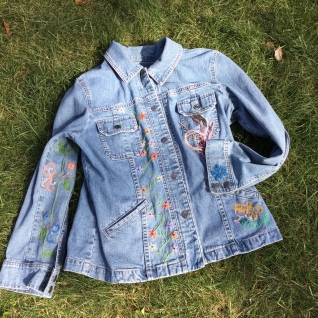
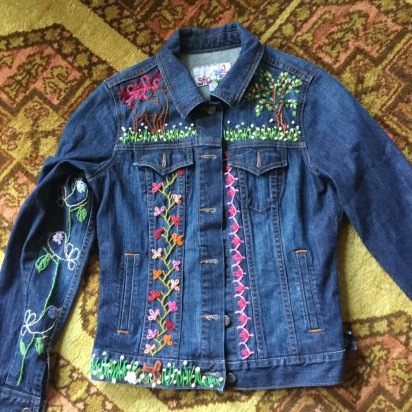
Knitting has always been a way for me to calm down, enter a zen-like state, and create something beautiful (if lucky). Another form of needle art that I occasionally practice is embroidery. The latest project involves embellishing a denim jacket which I bought at a second hand store in Sun Prairie, WI last year while visiting my sister. This is not the first jacket that I have embroidered. The first one was for my daughter. Sadly, it was a junior size and I did not realize that was why she had put it in the give-away bag.

The theme for this jacket was woodland with a stag, rabbits, and flowers, and a tree. The yarn is double-stranded crewel wool. Some of the stitches include fern stitch, french knot, split stitch, straight stitch, daisy stitch, bullion knots, and satin stitch.

My jacket has right now a sea theme. The mermaid and mer-king are designs in Aimee Ray’s Doodle Stitching. She has her own wonderful website and you can be inspired by some of her original doodle designs.  I was very clever in how I transferred the design. I took a picture of each on with my ipad. Expanded the picture until it was the size I wanted. Flipped each design around and the traced the design on tracing paper. Then I used transfer paper and a transfer wheel to get the design on the denim. In some cases, I had to trace the design several times since as I stitched some of the lines disappeared.

One sleeve has a branch of two sitting birds which was a motif I used on the jacket last year and really liked. The other sleeve has a quotation from Shakespeare’s Tempest. It is a line from Ariel’s song in Act 1, scene 2. Eventually, I will embroider a tree on the back but that will have to wait until after this trip to Paris. We leave today!


Posted in crafts | 1 Comment

The Charlotte Bronte I did not appreciate

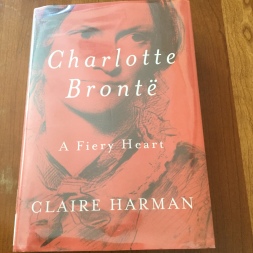
fiery heartSummer is such a wonderful time for teachers to read books we otherwise don’t have time for  during the school year. This is a new biography of Charlotte Bronte which Haverford Township Free Library had on its new book shelves. Written by Claire Harmon (2016), Charlotte Bronte: A Fiery Heart narrates the life of this remarkable author who was inspired and challenged to write by her siblings (Branwell, Emily and Anne) and her own ambition to be an author.

I had always known intellectually about the tragedy and grief of Bronte’s life: the early death of her mother in 1821, her oldest two sisters Maria and Elizabeth dying in 1825 of tuberculosis, her alcoholic brother Branwell dying and then both sisters Emily and Anne dying of tuberculosis. But I had not appreciated that Branwell, Emily and Anne had all died within the span of few months. Branwell died in September 24, 1848, Emily died on December 19, 1848 and then Anne died on May 28, 1849. Charlotte was with Anne in Scarborough when she died. They had gone there in the hopes that the sea air might ease her tuberculosis. These three siblings were Charlotte’s direct competitors, instigators, critics, and audience for her novels.

After their deaths, she returned to writing but only after a time. She eventually did get married to Arthur Nicholls in 1854 but then she dies on March 31, 1851. Harmon convincingly argues that she died as a consequence of hyperemesis gravidarum (HG). This condition of violent and unceasing nausea and vomiting is caused by the hormones of pregnancy. Harmon makes the contemporary connection to Kate Middleton who was hospitalized for the condition.

I am a little annoyed with myself that thus far this blog is only about the family and romantic facts of Bronte’s life. But on the other hand I already knew about her books since I have read, reread, studied, and taught them for many years. What this biography highlighted for me was the reality of her life, the events and relationships which shaped her.

I also have not mentioned the married teacher Belgian Constantin Heger with whom Charlotte fell obsessively in love while a student at Roe House from 1842 until December 1843. I have known about this relationship as well, but had not fully appreciated how much Edward Rochester was modeled upon Heger or how much Jane’s address and tone to Rochester might have been modeled on her interactions with Heger. Also apparently, the character Monsieur Paul from Villette was modeled on Heger and many of the readers of this novel were obsessed by him: “One correspondent who had previously determined to marry only the counterpart of Mr. Knightley (from Jane Austen’s Emma) “now…vowed that she would either find the duplicate of Professor Emanuel or remain forever single!!!'” (Harmon, 349).

Harmon does quote one of Heger’s comments on an essay that Charlotte wrote and the advice is still good for writers today:

What importance should be given to details, in developing a subject?–

Remorselessly sacrifice everything that does not contribute to clarity, verisimilitude, and effect.

Accentuate everything that sets the main idea in relief, so that the impression be colourful, picturesque. It’s sufficient that the rest be in its proper place, but in half-tone. That is what gives to style, as to painting, unity, perspective and effect. (Harmon, 161)

I also had not appreciated the unyielding nature of Emily Bronte who would not bend for anyone and apparently was a spiritual tyrant as Branwell was an alcoholic tyrant. A fellow teacher had told the story about how Emily beat up her own dog Keeper until he was half blind for climbing on her bed. But in Harmon’s book I read that when she was bitten by a possibly rabid dog, she went into her house, grabbed a hot poker and burned the bite, cautherizing the wound and killing any rabies. One of their friends remarked about Emily: “Imagine Emily turning over prints or ‘taking wine’ with any stupid fob & preserving her temper & politeness” (Harmon, 160). She also refused to die — like her own characters. She would not admit any weakness and “went as far as take up her sewing, though the servants saw that her eyes had already begun to glaze over” (Harmon, 287).

The other thing I had not appreciated is how much Charlotte Bronte’s stories of Angria prepared the way for her novels and in particular her creation of and obsession with a male character named Arthur Augustus Adrian Wellesley, Marques of Douro, King of Angria and Duke of Zamorna. In Harmon’s biography, this character is always referred to as Zamorna and gets his own entry in the biography’s index. Zamorna was Bronte’s idealized sexual fantasy: a dark, enigmatic, intelligent, decisive, mysterious, powerful, handsome man who has multiple affairs. Bronte describes one of her female characters reflections about him:

“The young lady’s feelings were not exactly painful, they were strange, new & startling — she was getting to the bottom of an unsounded sea & lighting on rocks she had not guessed at” (Harmon, 130).

I supposed if I were teaching I would have to make the girls explore those metaphors of sea and rocks and submersion.


Posted in book review, literature | Tagged | 1 Comment

Some Observations about Guns

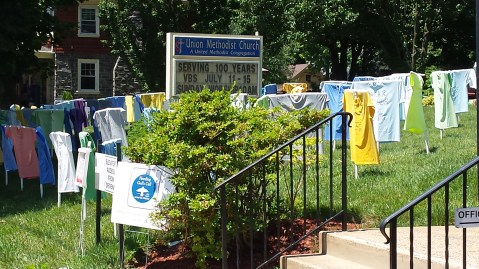
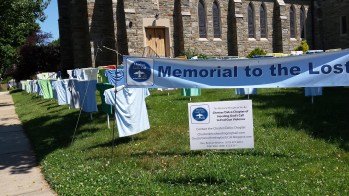
20160618_120735.jpg20160618_105927.jpgIn four days I observed public displays on the subject of gun control: in Philadelphia and then in the rural areas of Indiana and Illinois. The differences could not be more telling.

On June 18, walking to a piano lesson, I crossed Brookline Boulevard and saw t-shirts in front of the Union Methodist Church. Another memorial, I thought, but to what?

It was just days after the shooting at the Pulse nightclub in Orlando (June 12) and that hit close to home since our middle boy enjoys going to nightclubs.

The sign explained that each shirt represented someone in Delaware County who had died from gun violence: 154 lives gone between the years 2011 to 2015. On each t-shirt was written the person’s name, birth date and death date. Some were just little children.

Then on that Monday, I started a drive from Philadelphia to Madison with a layover in Cincinnati. The drive between Cincinnati and Madison passed through Indiana and Illinois, and there I witnessed a very different attitude toward guns.

Between Cincinnati and Indianapolis and then between Indianapolis and Champaign-Urbana, a pro-guns group had posted cute little rhymes about how guns save lives:

Roses are red
Guns are blue
I am safe
How about you?

Young thugs
Might stop to think
If teachers 
Shot back.

 
Better watch out
You bad guy
We have conceal and carry
 In Illinois.

These two are just a sampling of the lies that the pro-gun folks promote. If you have a gun in the house, someone is 43 times more likely to use that gun to kill a family member or a friend than a robber. 43 times more likely!

While I was in Madison, the Democrats in Congress supported by some of their Senate colleagues stated a sit-in to protest that the Republicans refused to pass a law banning someone on the terrorist watch list from buying a gun. Congressman John Lewis led the sit-in which lasted for 25 hours (see the article on Wired). I could not have been prouder of them for highlighting the hypocrisy and cowardice of the Republicans who bow to the will of the NRA. I only wish they had continued the sit-in until gun control legislation was brought to a vote. Keeping sitting. Keep protesting. Keep pressuring.

Near my sister’s house, there lives a strong Democrat who has  made a huge sign at least 10 foot by 12 foot on which s/he paints commentary and thoughts. While I was there, the sign read, “Enough is enough. Stop the GOP and the NRA.” I asked my sister to get a picture of the sign for me for this blog but had already been changed!

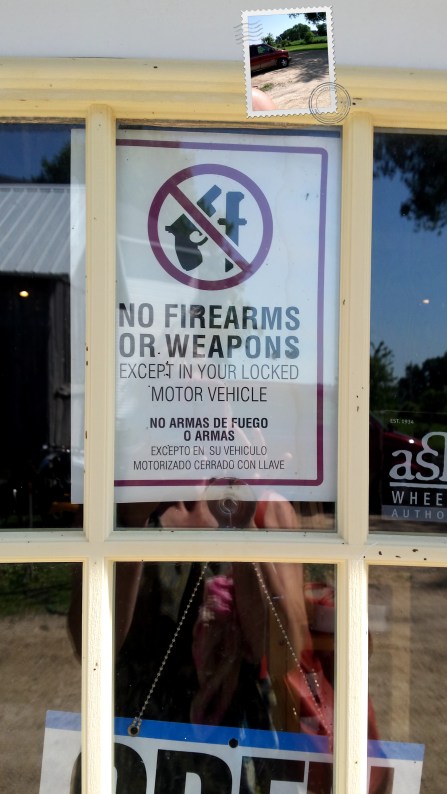
Wisconsin is a conceal-and-carry state. You can take your fire-arm into any public place — unless the store posts a sign that forbids the practice. We went to a yarn shop and I wondered how many of customers Susan lost with this sign.

20160625_102805.jpg

I did not grow up with guns. But my father did go deer hunting — with a bow.

Guns kill people. No one needs a gun unless that person goes hunting. And a person does’t need a military-style gun or a hand-gun to kill a deer. If a person is a good shot, one or two shells should do the job. If a person can’t shoot with that degree of accuracy, s/he should not be shooting at all.

Any gun — other than a hunting rifle — is designed to kill other human beings. No one needs that kind of gun except for the professional men and women who are hired and trained to protect the community and its citizens.

We need to stand up to the NRA and outlaw guns. Let’s have a buy-back program the way Australia did in 1996 (See NYT article).

No mother should have to get texts from her son as he waits for a killer to find him as he hides with other frighted people in a nightclub where they all went just to dance and celebrate life.


Posted in life in general, Uncategorized | Leave a comment

Master Gardener in Cincinnati (for Richard & Judy)

This garden is the result of 30 years of loving care and time. Amongst all the plants are many sculptures and wind spinners. The plants are juxtaposed to create contrasts of color, texture, form, and height. The Gardner planted planted at least 80 red geranium along the drive way and uses allium or chives to border walkways. He loves day lilies and many were in bloom underneath white hydrangea balls.

He also tends a huge public triangle garden in the city of Cincinnati and has won awards for his gardening service and dedication.


Posted in garden | Leave a comment

The Garden in June

The pictures say it all.

Posted in garden | Leave a comment

Summer reading at last!

Folks sometimes ask during the school year, “What are you reading?”

They expect me to reel off a long list of titles with short critical assessments.

That is not the answer they get.

“Right now, nothing.”

This is always true except for long holidays breaks like winter or spring breaks. Otherwise I am reading and rereading material for class. Don’t get me wrong. The stuff is great such as Jane Eyre and O Pioneers! But I have time for nothing else between class prep and grading.

But I just finished a book I have been wanting to read for over a year called The Invaders: How Humans and Their Dogs Drove Neanderthals to Extinction by Pat Shipman. It was published in 2015, and I read a review of it in the Minneapolis/St. Paul newspaper. It sounded fascinating.

Last week I used the Haverford Township Free Library website to request the book (I have decided to try not to buy any books after performing Kon-Mari cleansing on my shelves). They had it ready in just a couple days for pick up. Public libraries are so wonderful.
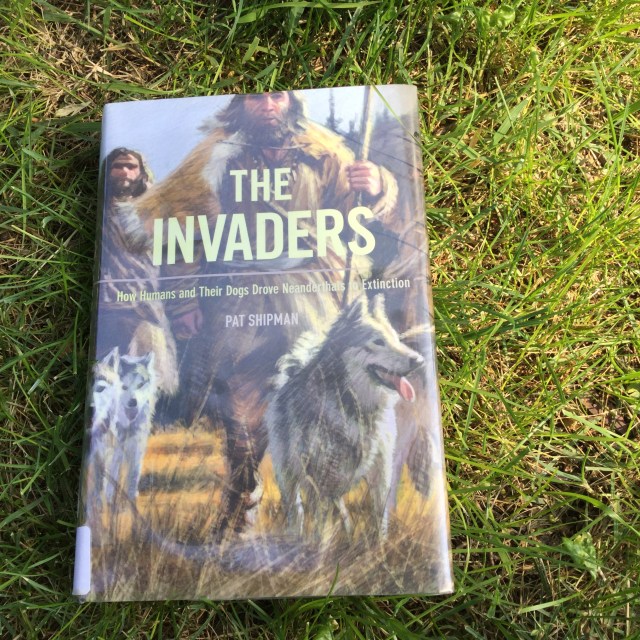
I finished the book last night and it was a great introduction to current ideas, research, excavations, and theories about the evolution of Homo sapiens and Neanderthals. It seems that they coexisted in Europe for between 2,600 – 5,400 years about 40,000 years ago. Modern humans arrived in Europe from Africa about 44,000 years ago.

Shipman does not say the humans went to war and killed the Neanderthals. She rather argues that the humans were more successful at acquiring food, had a more varied diet, and used living tools — wolf-dogs.

She calls us “the most invasive species that has ever lived,” because when we come into an area flora and fauna are destroyed as we take over. Based on archaeological records, we drove to extinction the following types of apex carnivores: two types of bears, large cats, cave hyenas, dholes, and Neanderthals. We also killed off lots of different herbivores: red elk, giant deer, wooly rhinos, and mammoths. We are particularly to blame for the mammoths based on the multitude of mammoth megasites from the Gravettian period (32,000 to 15,000 years ago). Here there were so many a mammoth bones that humans used the bones to build huts. No wonder the mammoths went extinct. Apparently at the Neanderthal sites there were not nearly as many mammoth bones. So how did the humans do it?

Shipman posits that some humans managed to sufficiently domesticate wolves through genetic breeding and training at 2-4 weeks of age, that they used the wolf-dogs’ superior noses, ears, speed, and numbers to locate, track down, keep in place, and help kill the larger prey animals like mammoths. Her evidence is fascinating and draws from a wide array of sources.

First, the skulls of these early dogs are different from wolves and more like modern dogs with a wider brain pan and shorter muzzle.

Second, dogs are found buried in graves starting about 30,000 years ago. There was even one dog buried with a mammoth bone in his mouth.

Third, dog canine teeth were often found with holes drilled in them for use as pendants. Maybe the teeth were used to designate the wearer as one of the People of the Wolf.

Fourth, neither humans nor wolf-dogs are found depicted in cave art from 32,000 years ago.

Fifth, unlike Neanderthals, humans killed lots of wolves as evidenced by skulls. Sometimes they were filleted for food as attested by nicks in the bones and sometimes just skinned for the hide. Shipman suggests the humans killed the wolves to protect their wolf-dogs from attack. Very interesting idea.

Sixth, humans have white sclera around irises which other primates don’t have. Was this to improve visual communication with each other as well as dogs, who focus more on our eyes and where we look than any other creature? Dogs are programmed to watch us watch things like the mammoths we are hunting.

I am sure I am missing other points from her argument. But these are the ones I remember best.

Yes, her arguments become speculative at the end; however, her impeccable research and lucid prose, makes her hypothesis quite convincing.

I highly recommend this book.


Posted in book review, books, dog, Uncategorized | 1 Comment