The last thing I “lost”

IMG_20150410_180606

When I got the prompt “Lost Serially” yesterday from Writing101, I was less than enthused, but willing to give it a go. For a day I started cataloguing things that I had lost recently. It was not a very long list and that was a bit of a surprise. I don’t tend to lose stuff. I used to. Frequently. When we first moved to Boston from Cincinnati, we had to paint and scrub our apartment in Brighton before it was fit for habitation. I took off my rings: a sapphire ring which my father had given me as a high school class ring; and my sapphire engagement ring. I managed to lose both of them but that story is for a later post.

What does it mean to lose something? Does something qualify as “lost” only if you lose it permanently? Or does something qualify as “lost,” if you can’t find it for a certain period of time? I think if you lose something and it causes heart ache and a frantic search, then it falls in the category of lost items — even if the said items are eventually recovered.

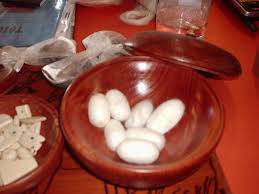
cocoons

Silk worm cocoons in a bowl; these are not dyed.

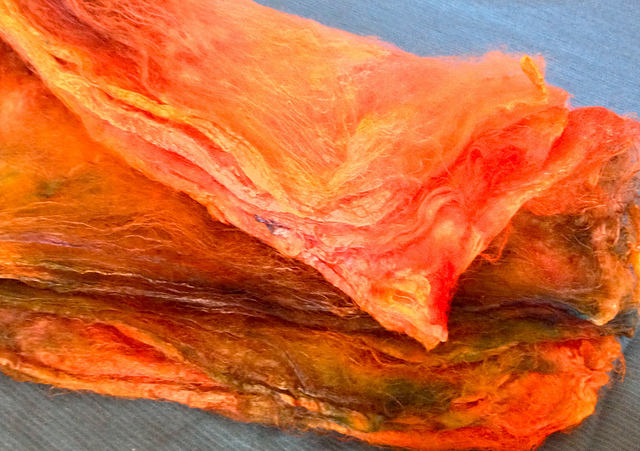
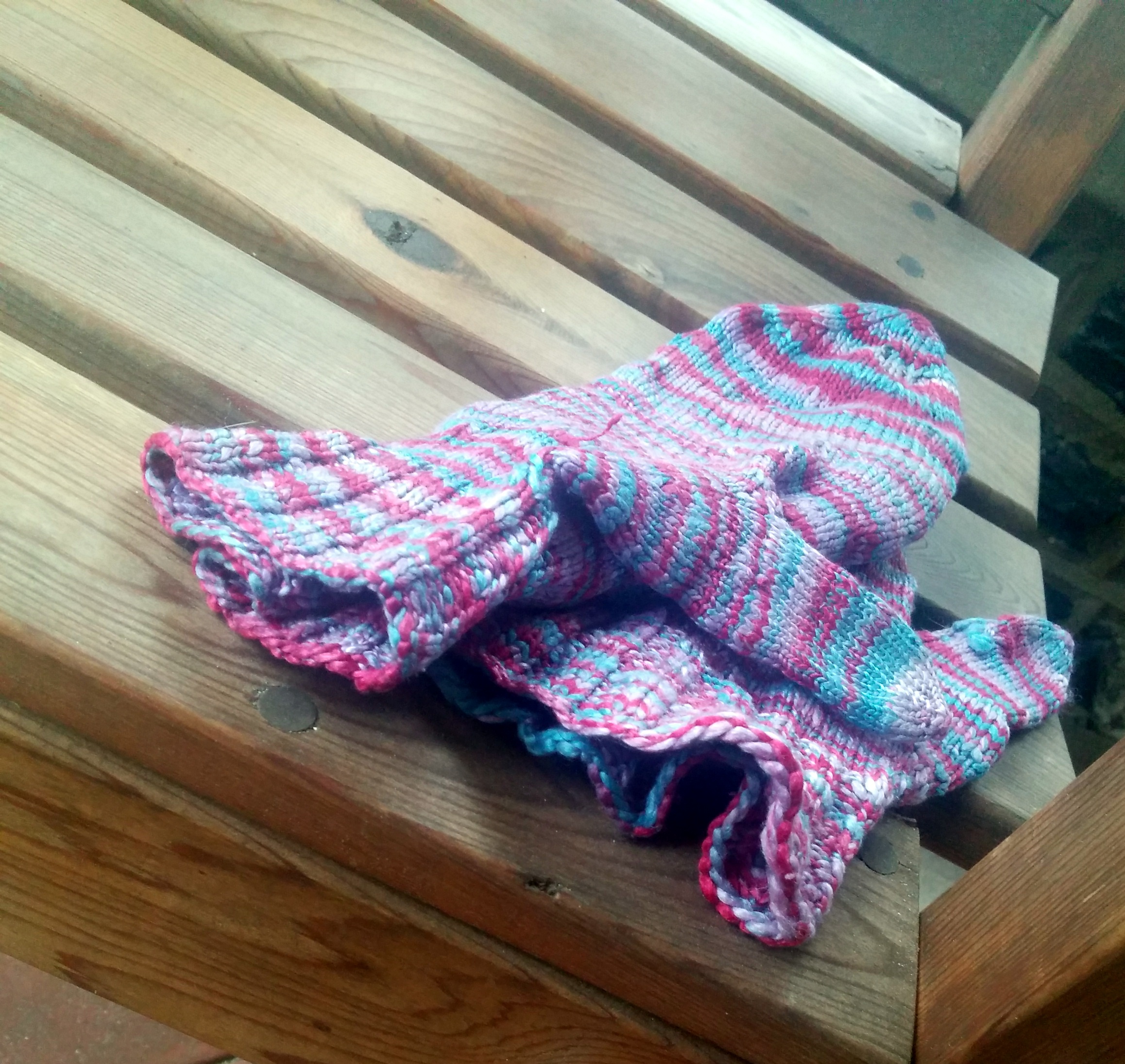
These mittens don’t look like much. And they are not really. Except they are hand made from beginning to end. A friend gave me a set of silk hankies which (for those who don’t know) are a stack of fine, fine layers of silk taken from silk worm cocoons. To make the yarn for knitting, you separate each layer from the hanky and stretch it into a loop from the center

A silk hanky

A silk hanky

and keep pulling and pulling until you have the diameter yarn you want. You “break” the loop and then you wind it onto a tube. You keep repeating the process until you have used all the layers. You connect the yarn by overlapping the ends and rubbing them together until they cling. I made at least 400 yards of single-ply silk yarn in this way. It took a long time and I had to be careful to keep my nails and cuticles smooth so the yarn would not catch.

When the yarn was made, I knitted the mittens. That took more time and I realized that next time I should not pull the silk into such a fine thread.

Those mittens were so warm! Silk insulates marvellously. I wore them all the time but not when shovelling or dog walking.

Last year I took them with me to run an errand on a rainy winter day and managed to lose them. I did not realize that I had lost them at that moment. I was too distracted talking to my children. It was not until a day or two later when I could not find them anywhere in the house that I started to get really worried.

I searched everywhere. Nothing.

Then as a last resort because I remembered I last had them on this errand, I drove to the little town and parked near where I had parked before.

There they were! Someone had laid them on the park bench. They looked beddraggled and dirty but there they were!


Posted in knitting, life in general | Tagged | Leave a comment

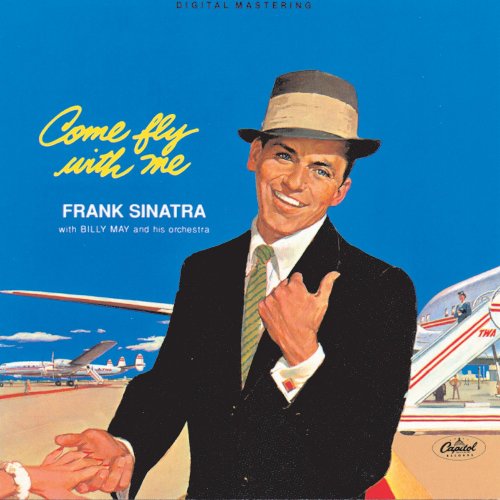
Music: a life-sound track — Frank Sinatra, Beethoven and Faure

51Fdzov3KPLI grew up listening to Frank Sinatra. My parents were huge fans but especially my father who was also a radio broadcaster. He broadcast in the days when folks had to create their own mixes using cuts from real records. I remember going with him into KHMO in Hannibal, Missouri. His sound booth had one or two turntables, lots of buttons, and toggle switches, and slider switches, and a microphone that was suspended on a metal arm. When my sister and I were in the sound booth,  and the red light was on, we had to be absolutely SILENT.

He created his own lists of music and had everything timed to last 15 minutes or 30 minutes because at those intervals, he had to read an advertisement or the weather or the latest headlines off the AP teletype machine. He loved Frank Sinatra and made sure to include Ol’ Blue Eyes every time.

He collected all of the albums and when he died and my mom moved after her retirement, I got his record collections with all those old original albums.

SONY DSC

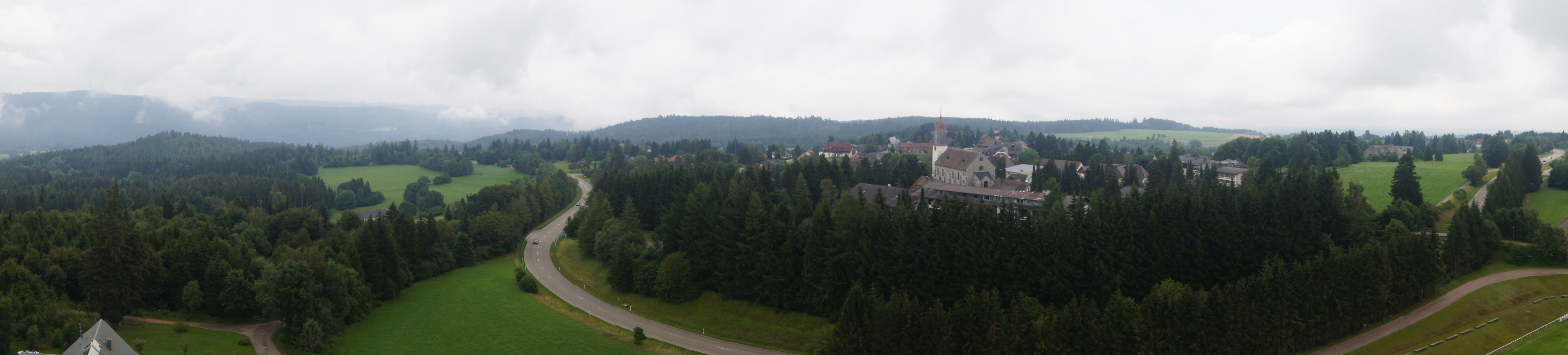
I have Frank on the one side and on the other Beethoven’s Ninth Symphony. The first time my husband took me to visit his family in Germany, we rented a little car with a cassette player. We had not brought any cassettes so we stopped at a music store and he bought several cassettes. Now up to that point, I had not really listened to classical music but I did on that trip. I remember listening to the Ninth (while at the same time being car sick from the twisty German roads) while he drove me and his sister and her boyfriend from Hoechenschwand to Freiburg. As the Grand Chorus began, we were driving through the narrows of the valley, past pine trees. That is now Beethoven scenery for me.

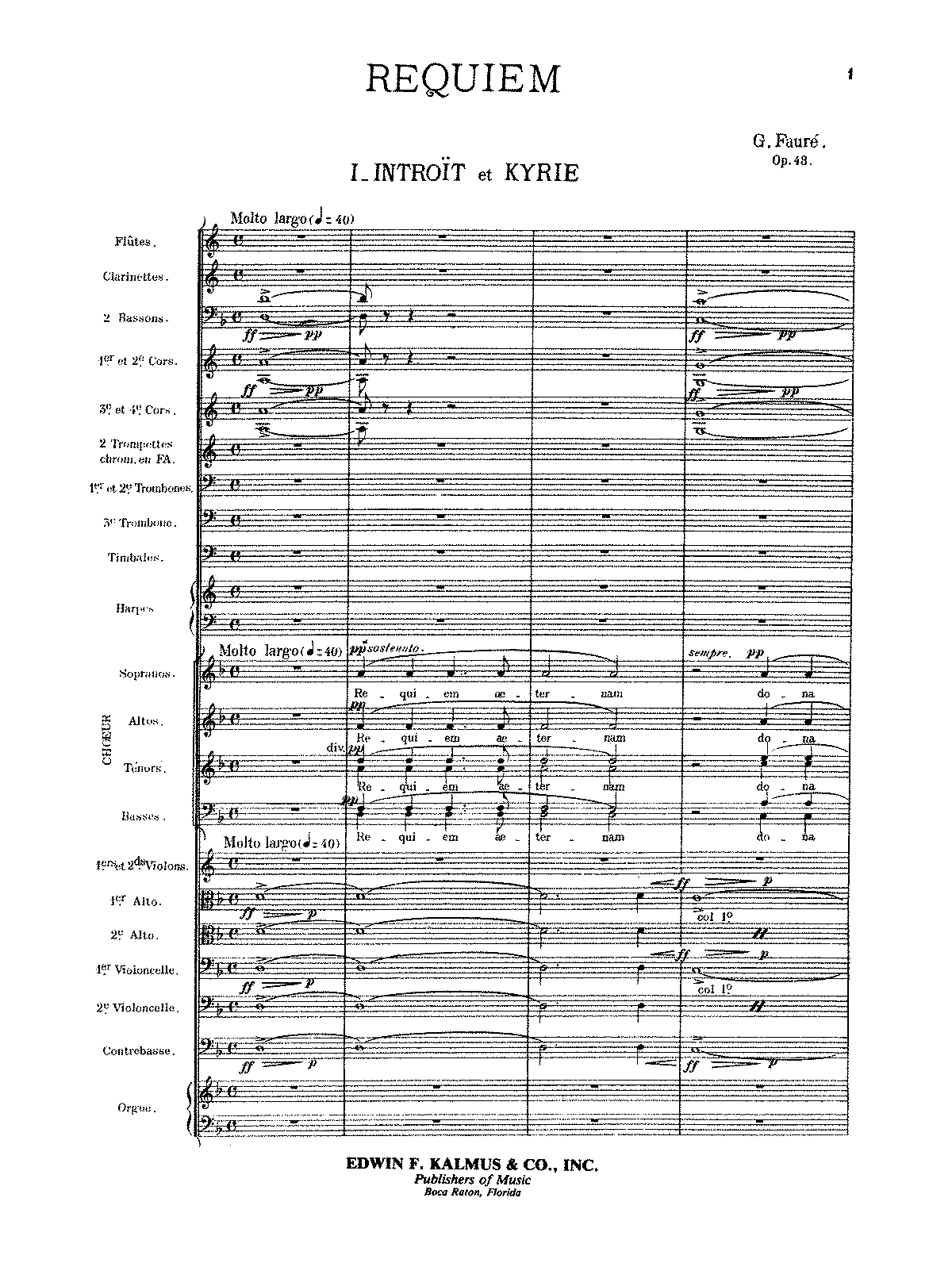
requiem faureThe third piece of music that just fills my heart is Faure’s Requiem. The first time I heard it was in Boston. My good friend (the one mentioned earlier who is living with cancer) took me. Her parents could not come down from Maine for the concert — snow or some conflict — and gave my friend their tickets. We went together and sat in Symphony Hall while Seiji Ozawa conducted the Boston Orchestra. The piece also calls for a chorus and soloists. I had not heard it before and when they sang the last part and the organ came in, my eyes just flooded with tears.

Dover Books publishes complete scores of music pieces such as Handel’s Messiah. I bought the score of the Requiem, and I took the score with me last year to two different performances of the Requiem. The first was on All Soul’s Day at Bryn Mawr Church of the Redeemer and then the second was in March by the Philadelphia Orchestra. Now I am thinking about forcing my husband to travel with me to see other performances of the Requiem. 

Posted in music | Tagged | Leave a comment

The Cave Church of St. Peter in Antioch (Antakya)

Looking back on a school trip to eastern Turkey, I wonder whether there was a subtext, a hidden message conveyed by the places where we were taken on one particular day in June.

We visited the cave church of St. Peter which is in the mountains behind Antioch. We parked the bus at the bottom of the hill and started to climb the rather steep pathway. The land was dry. The trees stunted and twisted. The teenagers laughed and talked loudly. Even the Americans were not really impressed by our destination. The Turkish teacher said her students had been there before so this was a little dull for them.

As we neared the entrance, we passed a man selling medals for pilgrims. I bought a St. Peter’s medal and then bought three sandstone figurines for colleagues as gifts.

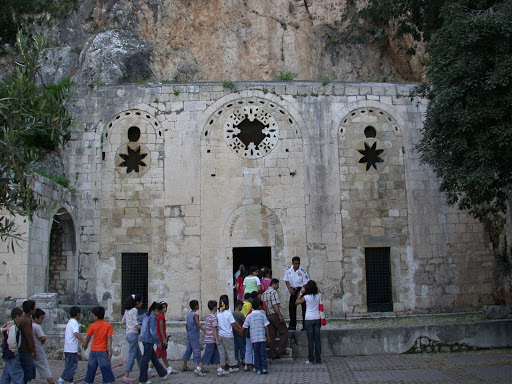
St. Peter's Church in AntiochWhen we came closer, we entered through a stone gate into a flat, smooth-cobbled square. The entrance into the cave church itself was decorated with a series of columns and cut-out, interlaced stars. I took a picture. The stones were cream and grey and white. The elaborate facade was only added much later by the crusaders. At the time when St. Peter was conducting services, there was only a hole in the mountainside. Nothing could distinguish the entrance from the many other cave holes in the cliff. This meant the church was secret and the worshippers would be safe from detection and arrest.

But even so, inside the church the early Christian left a bolt-hole, a long tunnel where they could crawl to escape. Crawl up without light. Stay there hidden until the Romans left with their torches. How long would they have to stay in the narrow tunnel, cold, trembling, hungry, blind?

The inside of the church was dark because clouds scudded across the sky. It was also cold and the stones were damp. But I felt disoriented and awed. I am not a devout person — the furthest thing from devout, but I wondered at these early Christians who endangered themselves and their families, who walked up into the hills to create a community of believers.

Posted in life in general, Turkey | Tagged | Leave a comment

Writing101: What weighs on my mind

Just a few minutes ago, I called a good friend who  lives far away and is battling cancer. Her voice was hoarse, and she sounded exhausted. Her doctors have switched her chemo attempting to arrest the growth of several tumors. Needless to say her prognosis is grim.

Cancer is a part of my life. My husband fought lymphoma a few years ago and is in remission. He is a pediatric oncologist and a researcher so he deals with this disease every day: in the lab, in the clinic, in the hospital. He has  a scan coming up soon. We both put our awareness of this test in a little box in our brains and shut the door. For a while, the clinic would call the house and remind him of the test. It was a robo call and since I am the one who answers the phone and listens to messages, that was how I learned of the scan. He would not tell me otherwise. When he realized that the robo reminders were coming to the home phone, he deleted the home number and put in his cell. Then I never knew when the scans were happening. But tonight he told me about the upcoming scan.

But that is not really what this freewrite is about. Generally, I do not write about these sorts of things — too melodramatic, too emotional, too revealing. But this disease frightens me. People can be sick with cancer and not know it for years. Not know it until they feel tired, or have a cough that won’t go away, or feel a lump, or can’t catch their breath, or have an unexplained pain. Or maybe they don’t even know they have stage 4 CA until they go to some regular doctor visit and Wow! look at what the blood test shows; Wow! see what the physical exam reveals. Cancer can kill you without any sign. Why is that so much scarier than heart disease? or old age?

I am also afraid of Alzheimer’s. What a terrible idea to lose your mind and know that you are losing it and what the progress of the disease will do to your family. I will not go see that movie “Still Alice.” No way. Too near to home. A linguistics professor who loses it. I have trouble remembering names. Is that an early symptom?

Actually what this freewrite is about is the factual reality that my life is half over. At 50 years of age, I am unlikely to make it to 100. Not sure I want to be 100 anyway seeing the bad shape my grandma is in with her brittle bones. So the midway of my life is here (probably happened a few years ago but went by unremarked). What should I do with the time left? Am I doing what I love every day? Or doing at least one thing that I love every day? What will I leave behind when I die? Children, yes. But anything else of value? No, not really.

We all die. We “rage, rage against the dying of the light” as Dylan Thomas says in “Fern Hill.” We fear this end point; however, there is no guarantee for anything after this life. No guarantee at all — unless you have a faith but even strong faith has moments of doubt.

My friend who is so sick meets her mortality each day. She sees it in the mirror when she looks at her wispy tufts of hair before she hides her baldness under a hat. She sees it in her thin arms and legs, without muscle and so she sways as she shuffles down the hall. Not all of us see this. We are not a culture any more of memento mori. Not like Dante who wrote about how he became lost in the woods “midway upon the journey of our life.” Dante knew about death. He knew about the fear of it. But we bury it and deny it. I buried it and denied it. But no longer. Not now more than midway upon the journey of my life.

Posted in friends, life in general | Tagged , , | Leave a comment

NYTimes: The Cuddly, Fluffy, Surreal World of Angora Show Bunnies

stella-english-angora

NYTimes: The Cuddly, Fluffy, Surreal World of Angora Show Bunnies
http://nyti.ms/1xCQJSz

You have to click on the link above to see the bunnies photographed by Andres Serranos, who usually is making rather more controversial art.

Of course the comments are more interesting than the article. They run the gamut.

  • Don’t buy one of these high maintenance pets for Easter
  • Angora rabbits are tortured for our sweaters — but only in China
  • Do rabbits have armpits
  • We are a decadent society on the road to Hell for enjoying these pictures
  • Rabbit stew is revolting and so are the folks who call it “loser stew.”
  • This is the next installment of the Monty Python’s Holy Grail.

For myself, I will just settle for enjoying the pictures for what they are and remember my trip to an angora farm. It was years and years ago in Massachusetts to buy some angora for spinning. The bunnies were this woman’s livelihood and she took incredibly good care of them. She hand combed them to gather the fur and sold it by the ounce to spinners (people spin yarn on a spinning wheel or drop spindle).Now I realize I fall in the decadent category too.


Posted in crafts, life in general | Tagged , , | Leave a comment

How goes the Poetry Time Line Project?

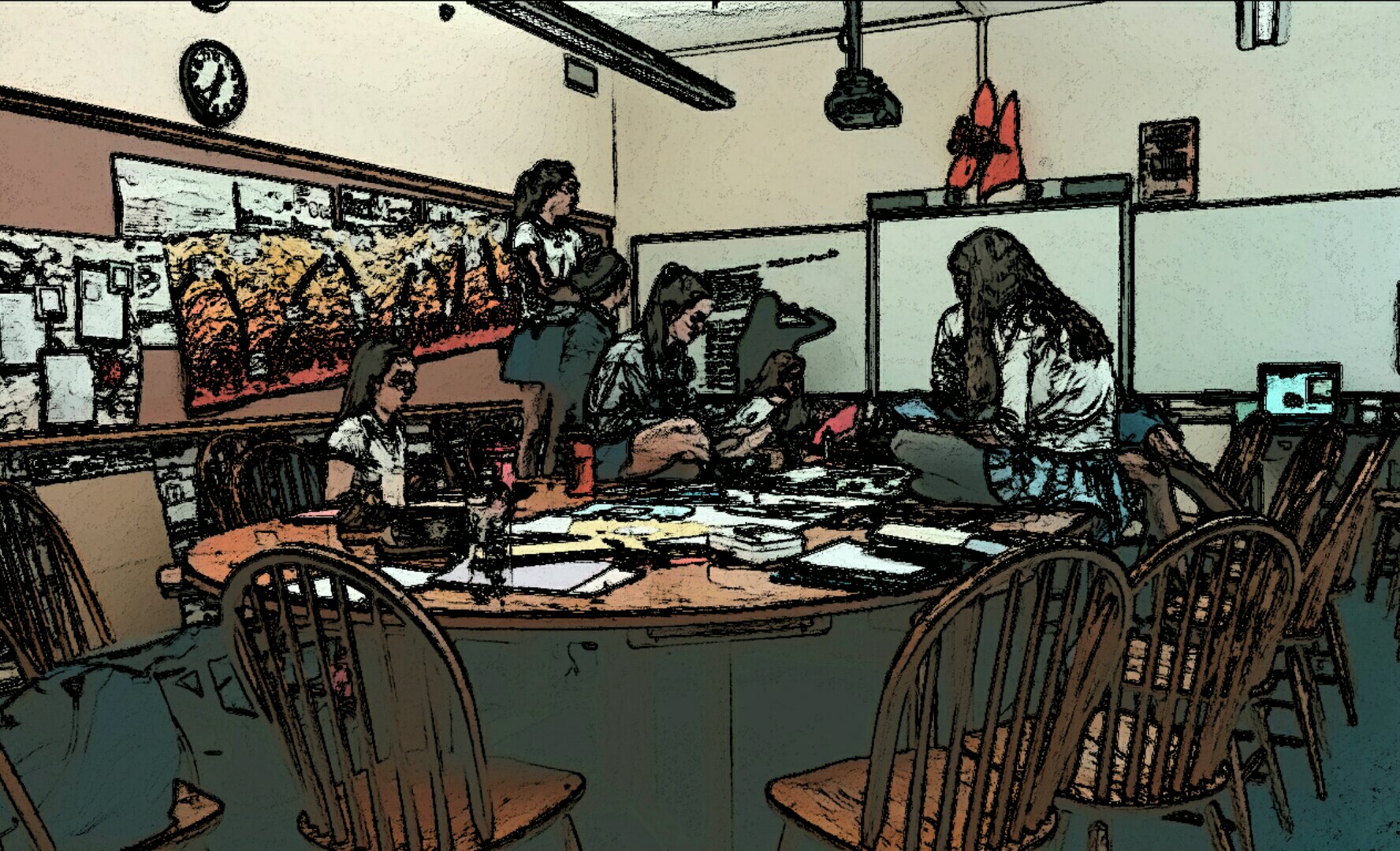
imageThe students have been working for the last 2 days on their timelines in addition to the 2 days before they had spring break. Each class has two teams to create their timeline. They have needed lots of supplies: construction paper, markers, glue, double-sided tape, scissors, markers. One group ran to the art room and borrowed watercolors and brushes. Every group has been using their computers to look up information about the authors, poems, time periods, literary periods. They have also looked up images so they could draw free hand: leaves, cats, tigers, pears, trees.

I am struck by the degree of collaboration and the division of labor. Each group had a different process. One group spent the first class discussing each poem exhaustively and writing notes. One group started designing and executing the timeline complete with flames. Another group divided up so some worked on the poster, some wrote the poetry analysis, some worked on researching the literary periods. The fourth group was more fluid and students went back and forth between tasks and roles. (But even so, in each group there was one or two students who seem a bit more disengaged. That is always a challenge: how to make sure everyone or encourage everyone to participate equally).

What are they learning? As I floated between groups, I did witness epiphanies as they recognized how the poems fit together and as they figured out how the poetry developed over time. The students had to negotiate and compromise as they executed their timelines. In one group, a student said at first they were clashing because everyone had different ideas, but that they came together at the end. Usually one or two students assumed leadership roles. They talked a great deal about design and how to combine information with visual appeal with signficance.

I am currently witnessing a group realize they are missing an analysis for John Donne’s “Death Be Not Proud,” and a student is volunteering to write that analysis quickly. They are learning how to work in times of stress.

I just visited my other group and one student said at first they were clashing because everyone had different ideas, but that they came together at the end.

Posted in teaching | Leave a comment

What is implied about race by advertising? (In the New York Times Sunday edition)

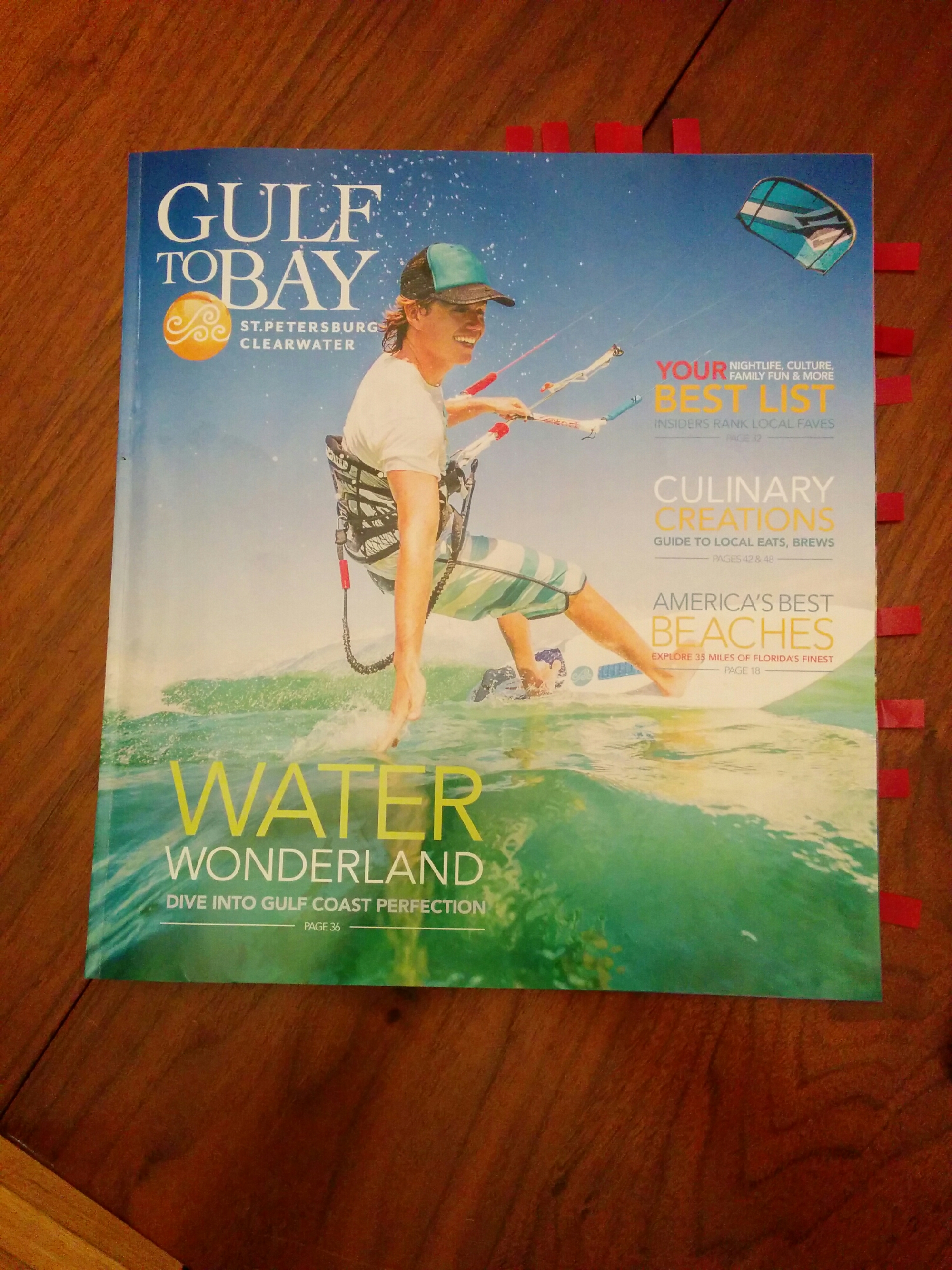
wpid-img_20150330_203357.jpgThis past Sunday morning (March 29) I was looking through the New York Times. I picked up this hefty advertisement for fun in the Florida sun and started flipping through it. The producers has pitched this to a different economic bracket and I was noticed the affluent looking people on the glossy pages. The front cover has a 20 something woman clearly having fun on this weird parasail with a seat. How did they get such a perfect angle of her hand in the water? Inside I noticed an attractive woman leaning into a more wrinkled, more mature man carrying a 4-5 year old boy (blue shorts and shirt are a giveaway).  But as I flipped though looking for more evidence of the target audience, I noticed that all the people were white.

Wait a minute! This is the New York Times. Then I started looking in earnest. Could that wpid-img_20150330_205116.jpgman dancing with the woman on page 14 be black? Hard to tell given the shadow and the romantic coloration. But possible. I kept turning pages.

I next found a picture of two women walking into the surf, water thigh high on p. 36. The white woman’s face is turned toward the camera. The other woman’s face is turned away from the camera. Her skin is dark. What ethnicity is she? This picture prefaces a list of the best “white, sugar-sand beaches” (p. 36).wpid-img_20150330_205512.jpg

I kept turning pages, the next black person appears in a panorama of an Italian market on p. 44. There are two black folks in this picture. The woman on the far left has her head turned away from the camera and the man walking to the right is blurred — but then everyone is blurred to show movement in the center of the shot.

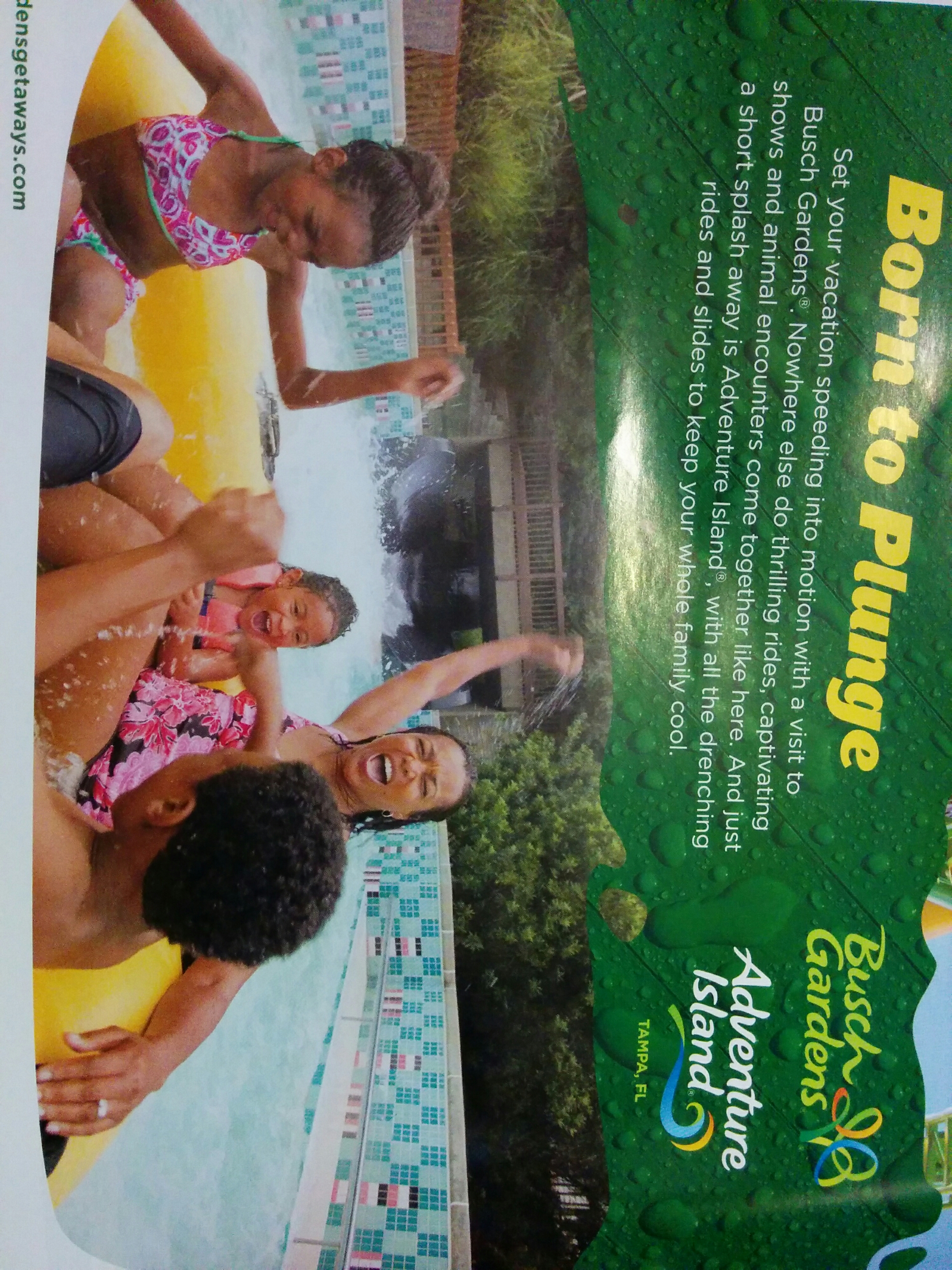
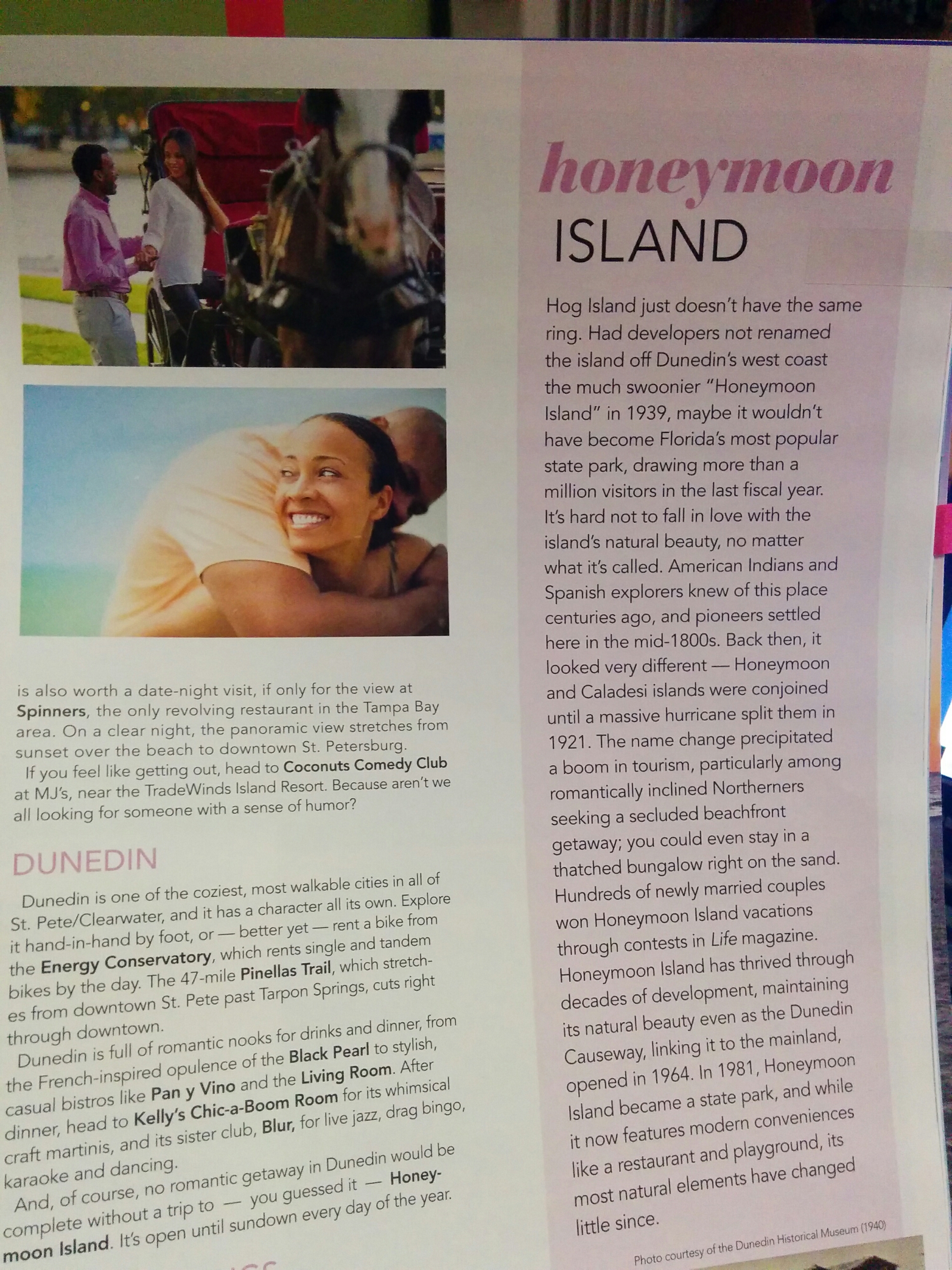
The first time there is a black family is on page 62 in an advertisement for Busch Gardens in Tampa, Florida. And on the 76-77 page spread for “Love: Romantic Excursions in our Little Pocket of Paradise,” there are two black couples on honeymoon.

wpid-img_20150330_210610.jpgwpid-img_20150330_210741.jpg


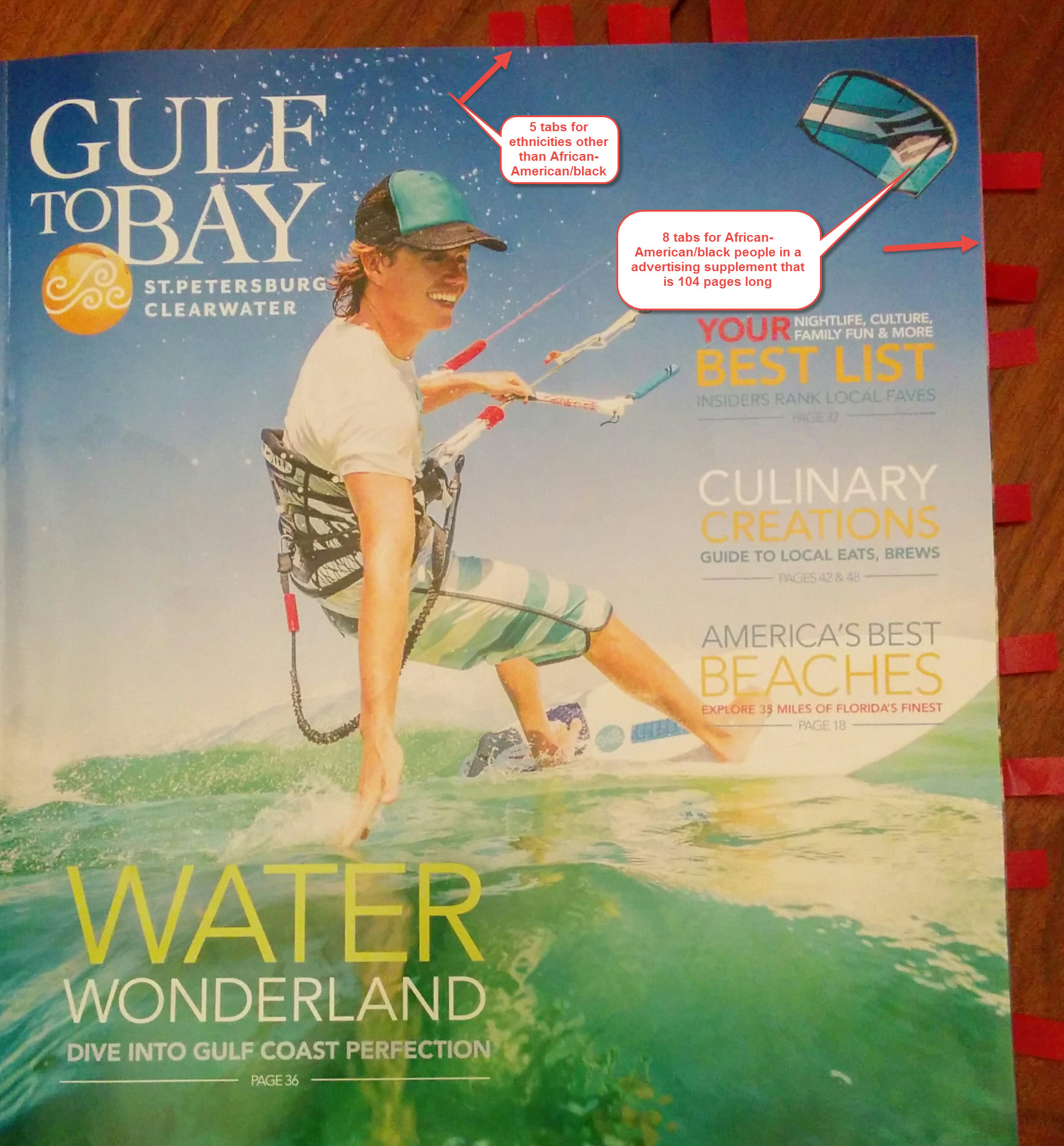
After swiftly paging through the magazine, I decided to be a little more systematic. I took out the post-it flags and used it to mark pictures with people other than Caucasians. The 5 tabs on the top mark pages where non-white, non-black folks appear. The 8 tabs on the side mark pages where black folks appear. Now this glossy, expensive advertisement is 104 pages long with multiple pictures on each page.

What messages was this magazine/advertisement communicating — about who can go on vacation? who has money? who deserves to have a good time in this exclusive playground in Florida?

wpid-img_20150330_203357b


Posted in life in general | Tagged , , | Leave a comment

Reflection on Donne’s “Death Be Not Proud”

wpid-img_20150328_104819.jpgSince posting yesterday, I have been thinking about what to write about this Donne sonnet. The meaning is relatively straightforward: don’t fear death, since it is only the passageway to eternal life.

The poem is more about the narrator, who directly addresses Death. I could not even call this a dialogue. More like a dramatic monologue. I guess in another post, I could imagine Death’s replies and comments to the narrator, but not today.

The narrator speaks to Death as though Death were standing right in front of him. The first line contains an imperative: “be not proud.” We would not say this in Modern English. If we were phrasing a command to someone, we would say, “Don’t do that!” or “Don’t be proud!” Donne has left out the “do” in an ellipsis. Instead of the emphasis on Death not behaving pridefully or feeling pride, the emphasis seems more like one of state of being. It is as though Donne were saying “Cease to exist being proud.” For me, as a person steeped in Hamlet, this half-line reminds me of Hamlet’s “To be or not to be” soliloquy in Act 3. To over simplify this soliloquy grossly, Hamlet questions where he should continue with life or commit suicide. But Hamlet also thinks about how he fears not death but what comes after death: “that undiscovered country from whose bourne no traveller returns” (if I got this wrong, I am working from memory). Now that is quite different from Donne’s narrator who fears not the afterlife, but dying.

Or does the narrator really fear the afterlife? Or does he fear the process of dying? At one point in the sonnet, he says that death gives men “Rest of their bones, and soul’s delivery” (l. 8). This seems positive: rest from toil and saving from temptation. The narrator expresses no doubt that he won’t wake up in the afterlife: “we wake eternally.” Wisely he refrains from saying he will be in heaven (or hell); he can’t know which since only God makes that final determination on the Day of Judgement. That way Donne’s narrator cannot be accused of arrogance, because he believes he is one of the saved. In all, the sonnet seems relatively neutral or indistinct about the afterlife.

The narrator is  not neutral about death whom he calls a “slave” which “does with poison, war, and sickness dwell” (line 9). In Elizabethan England, about 90% of the population died before age 60 and about 30% of all children died before age 6. Most of the people died of disease, which is the last of three causes of death Donne’s lists. Why does he list poison and war before sickness? It would not ruin the rhyme scheme to rearrange the words. What war did Donne live through? He lived through the Anglo-Spanish War (1585-1604) and the Nine Years’ War (Irish: 1594-1603), but these don’t seem to have involved massive casualties. Poison? If you define “with poison” as deliberately poisoned by another person with intent to kill, that would not be a very large number. But if you define “with poison” as dying from a noxious substance, then lots of people could die of poison: bad water, botulism, chemicals, etc.

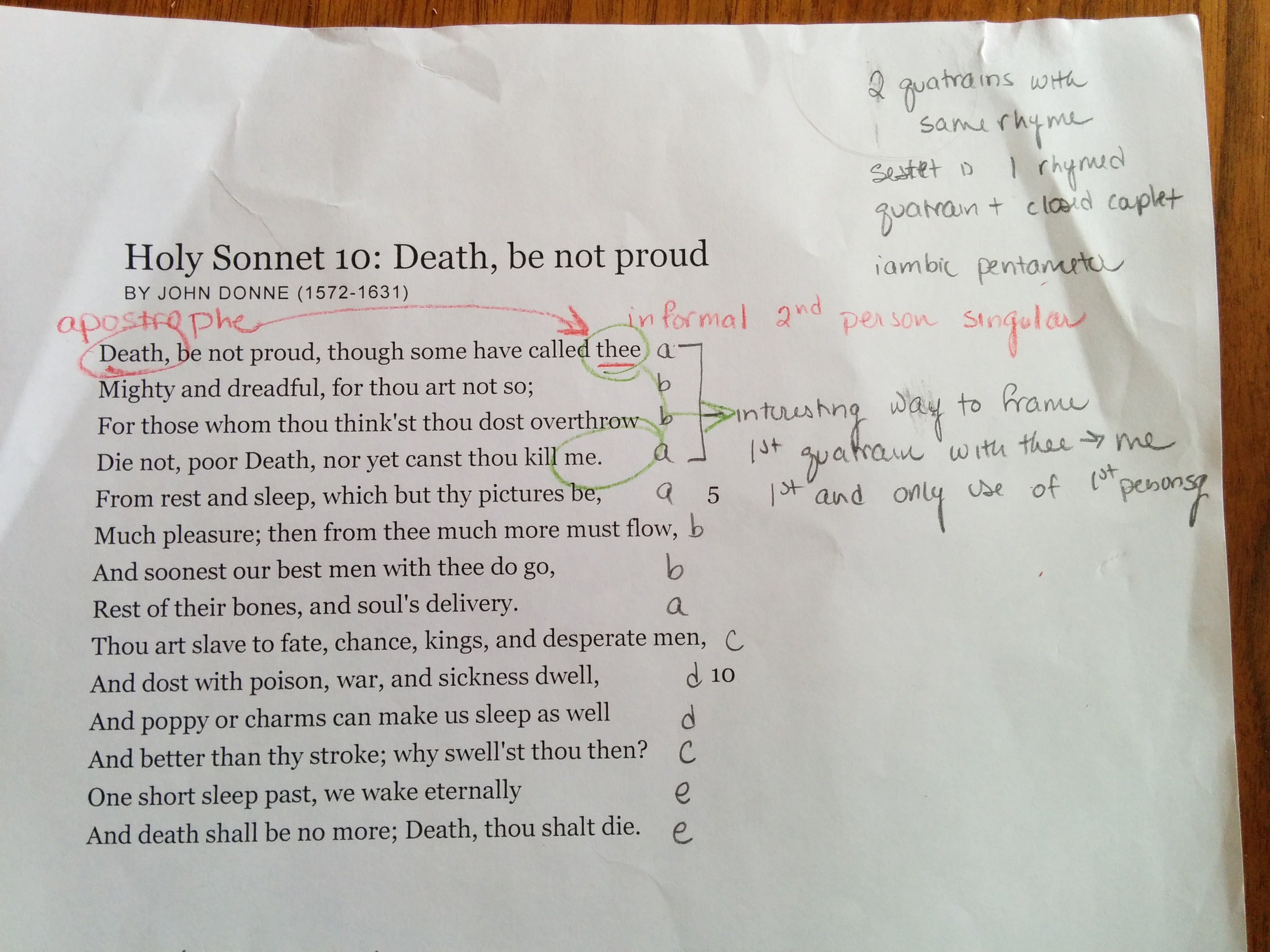
At the beginning of the poem, the narrator seems to defy Death: “nor yet canst thou kill me.” He addresses Death as at best an equal and at worst an inferior. Early Modern English still had two forms of the second person pronoun. The form “you” could be used to address more than one person or to address a single person formally. The form “thou” could only be used to address a single person and was often used informally or intimately. For me the distinction between “you” and “thou” is paralleled by modern German “Sie” and “du.” In modern English paraphrase, Donne declares, “yet you cannot kill me.” Only in this line does Donne use the first person singular. No where else. It makes the line personal: death cannot harm the narrator. The narrator is insulated from Death’s power and terror. Why? Because the narrator does not see Death as an end but as a passage way to eternity. The poem also ends the first quatrain with the object pronoun “me,” which rhymes with the first line “thee,” referring to Death. The quatrain is framed by two foes: Death at the beginning and the narrator at the end. By the rhyme scheme of abba, the narrator also vanquishes Death.

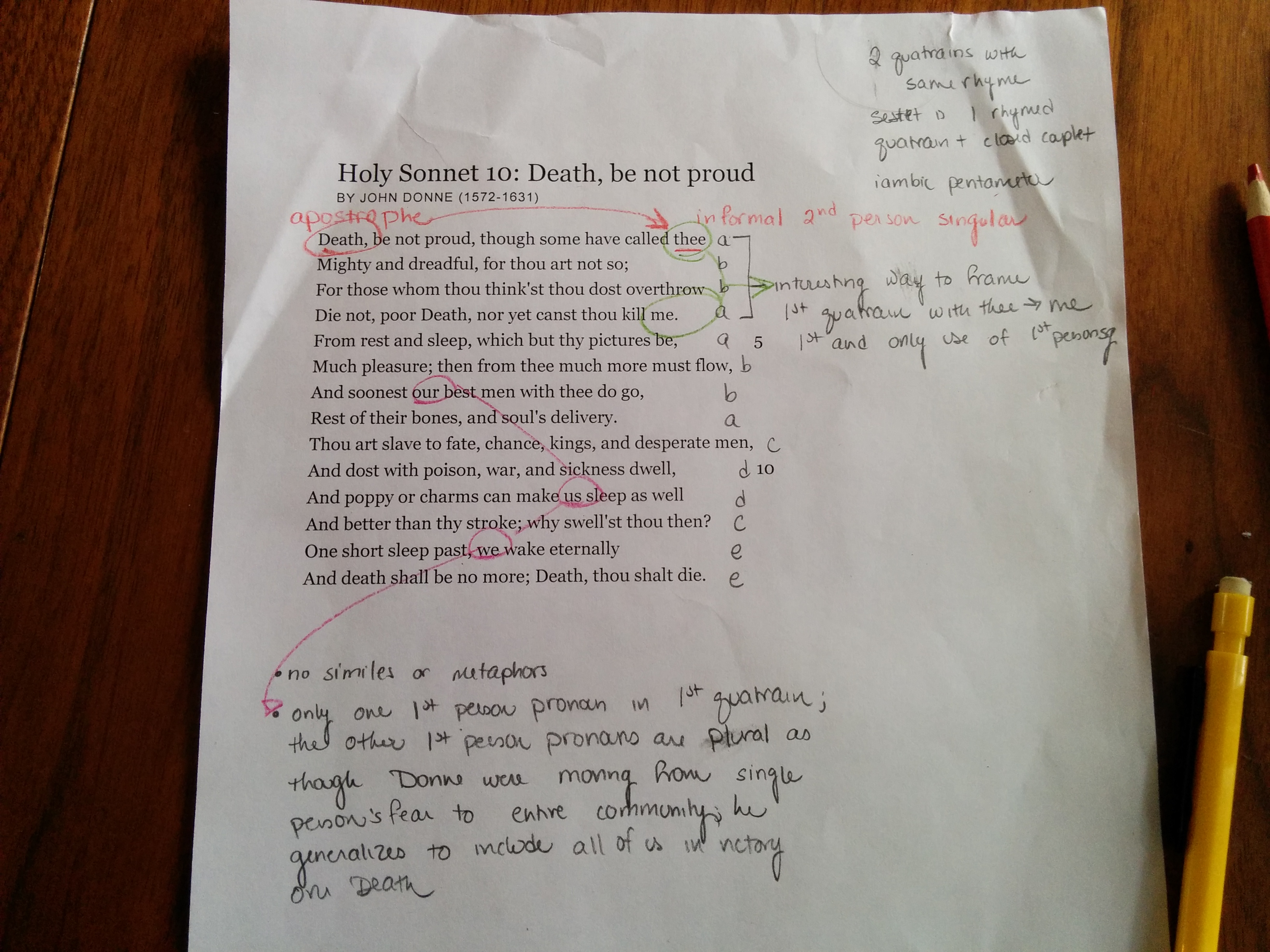
After this line, all other first person pronouns are plural: “our” in line 7; “us” in line 11; “we” in line 13. Donne leaves behind the concern of the individual for his own survival and puts the narrator in the larger group of all humanity. We all must face death and this poem is our comfort that we will live spiritually after our bodies’ die. Donne’s move from the particular to the general reminds me of his sermon “No man is an island,” where he admonishes his audience that every time the bell tolls for an dead person, it is ringing for us: any man’s death diminishes me, because I am involved in Mankind” (Meditation 17). So of course, Donne would say that we all surmount Death and wake together in the afterlife.

In the last heroic couplet, the narrator predicts instead Death’s death:

One short sleep past, we wake eternally
And death shall be no more; Death, thou shalt die.

He argues that since all living things will wake eternally after “one short sleep,” that death will no longer exist.  The last line has “death” uncapitalized and “Death” capitalized. The first “death” is just the action of dying. The second “Death” is the being whom the narrator has been defying. He says, “Death, thou shalt die” (line 14). This is a paradox. How can death die or cease to be or cease to ever happen again? It is also a rhetorical example of traductio (declining the same word into its various forms such as noun to verb, etc). The narrator kills Death with a rhetorical device. Now that is an interesting move.

 

Posted in poetry | Tagged , , | Leave a comment

What does it mean to analyze a poem — Donne’s “Death Be Not Proud” is on the dissecting table!

When I work with a poem, I will sometimes read it for pleasure but then will sometimes “pull” at it.

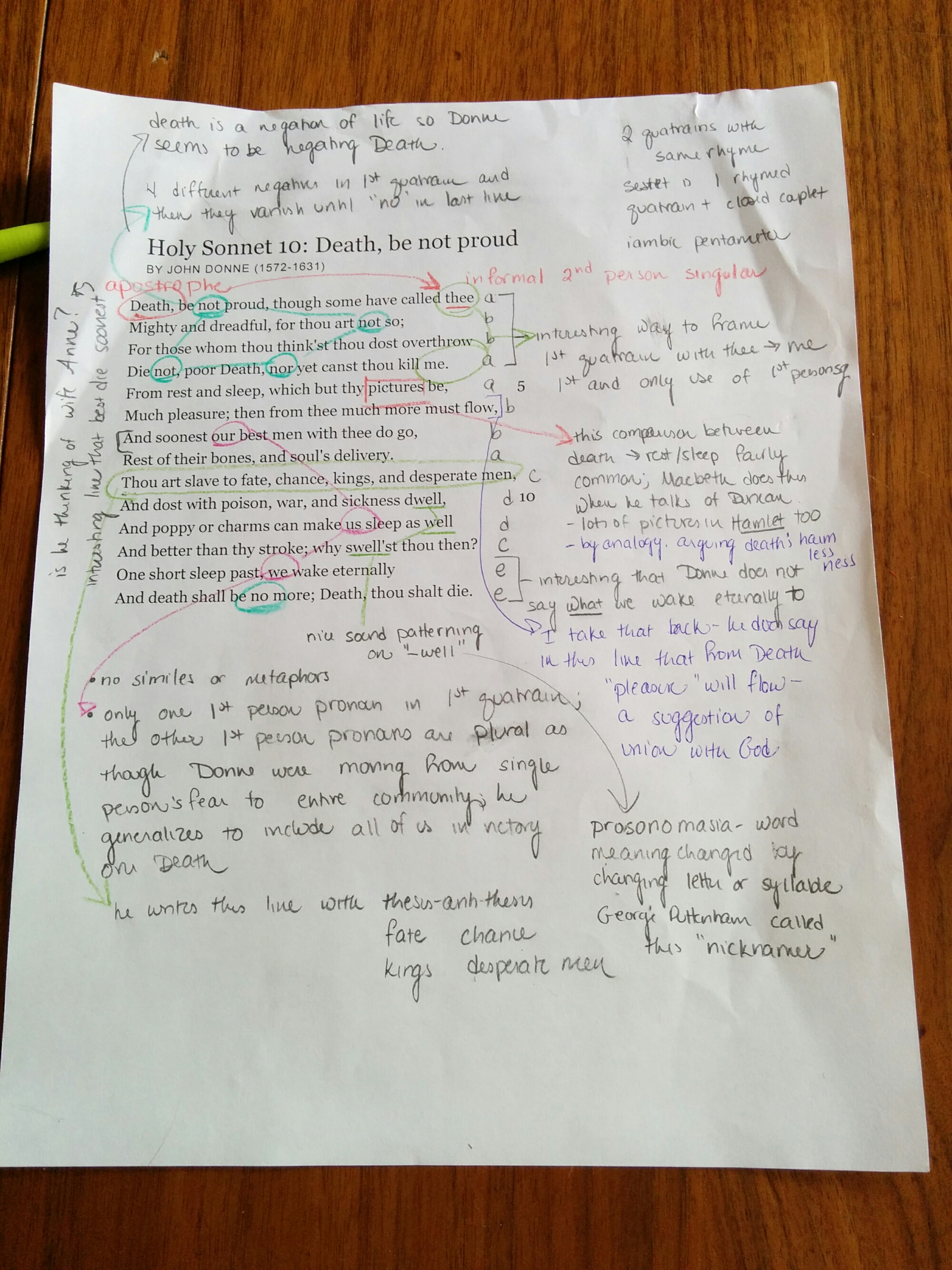
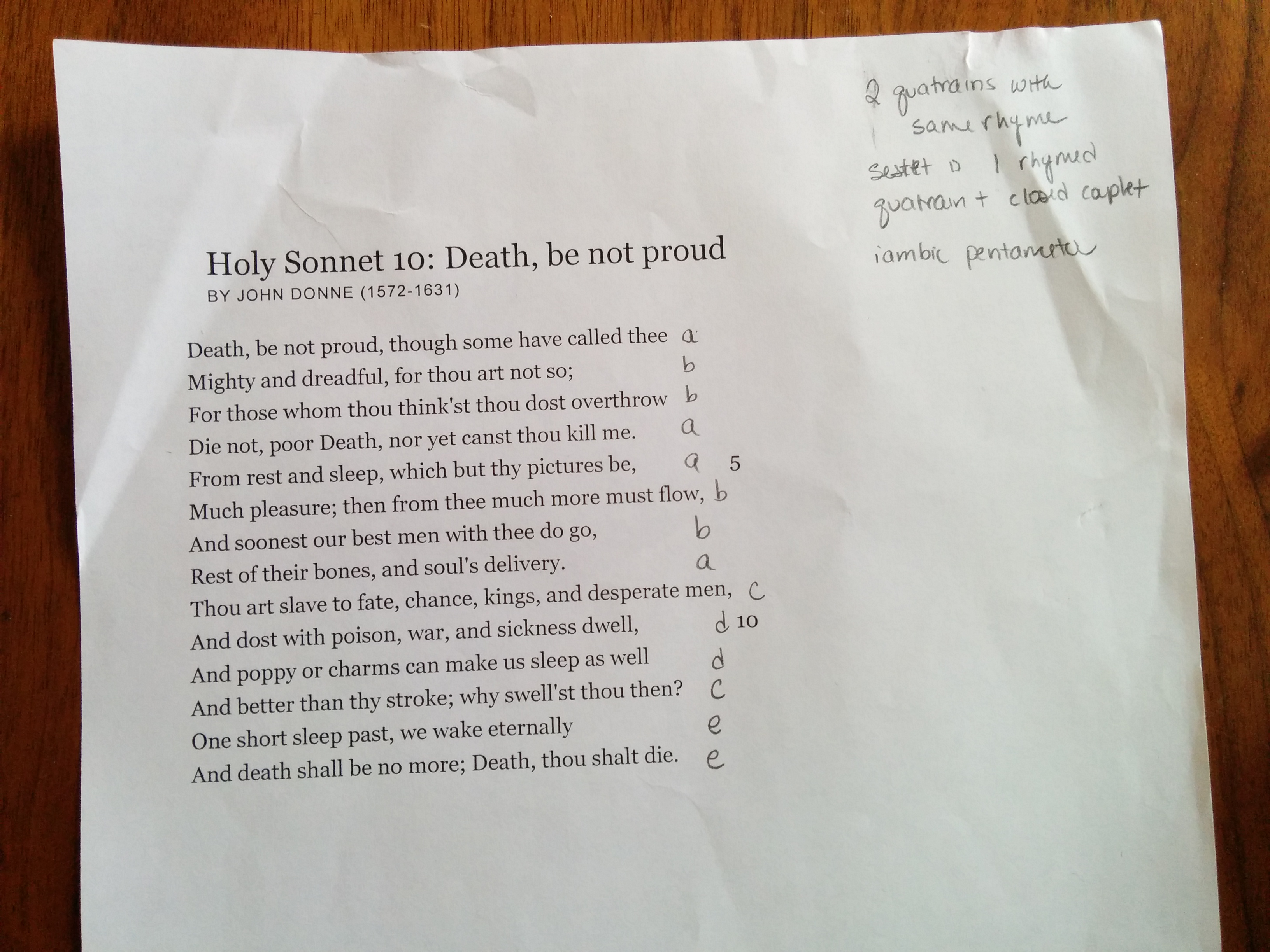
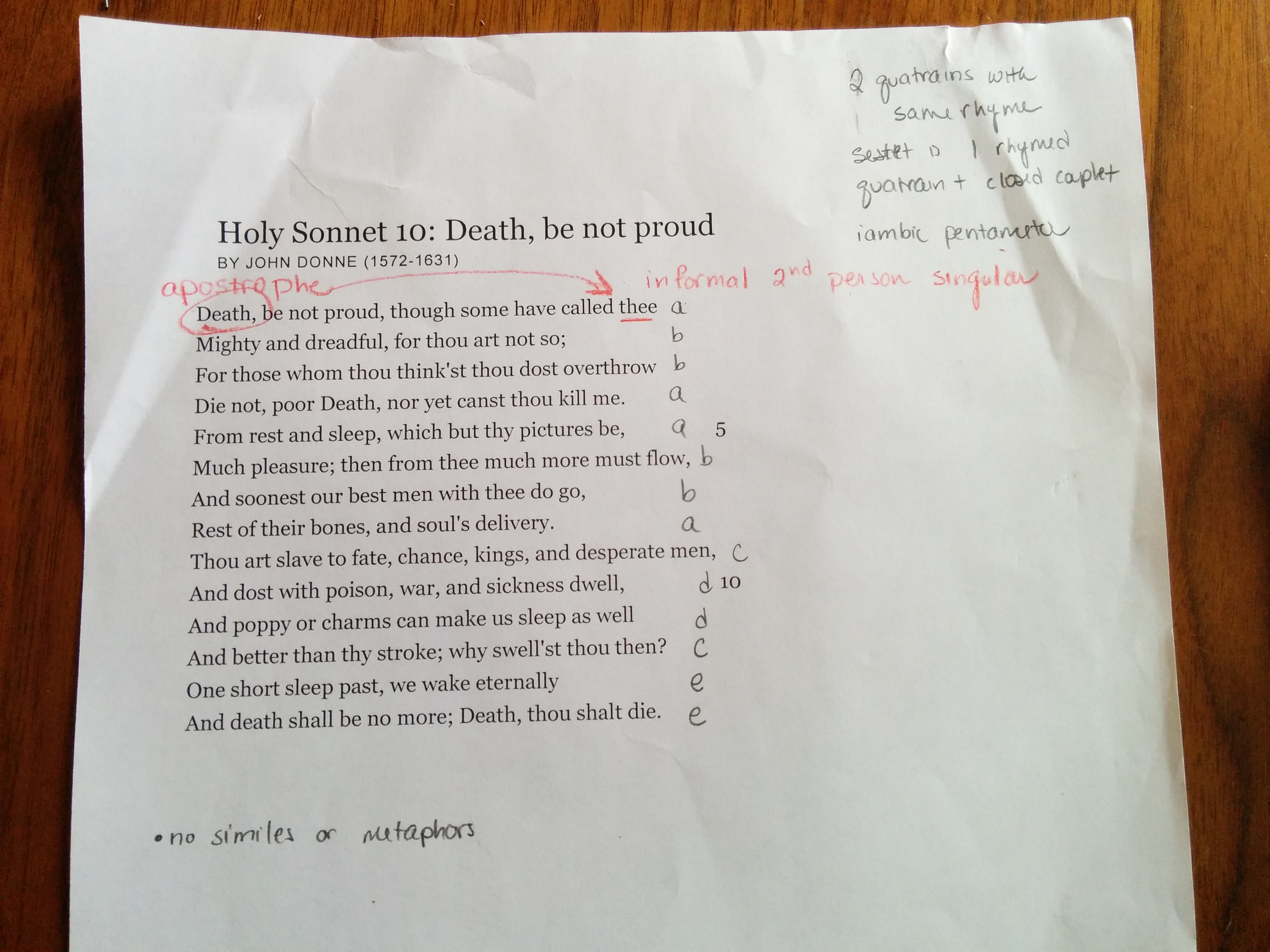
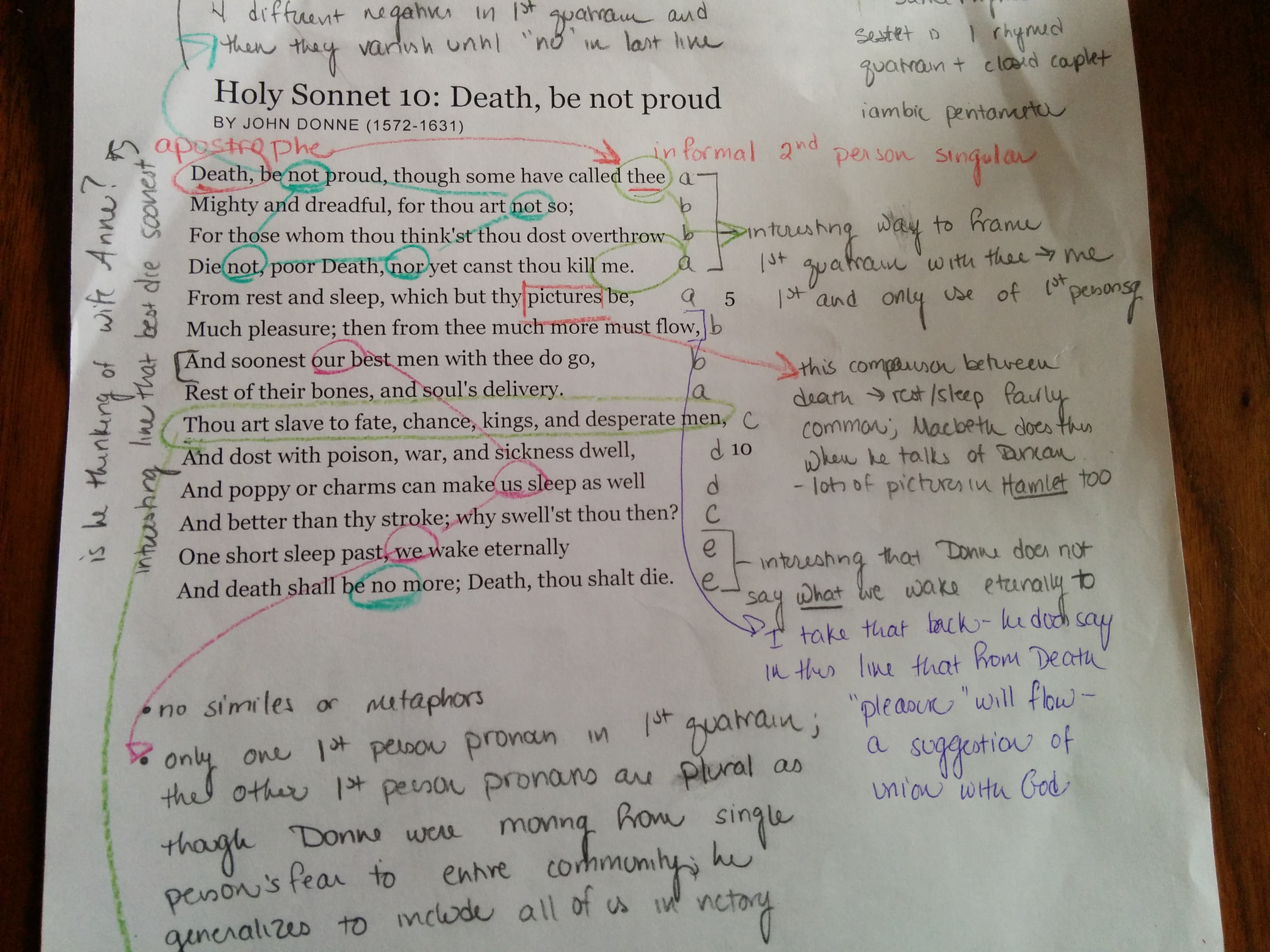
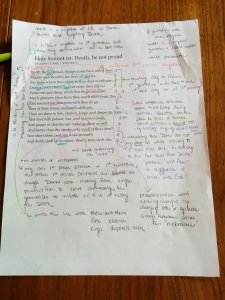
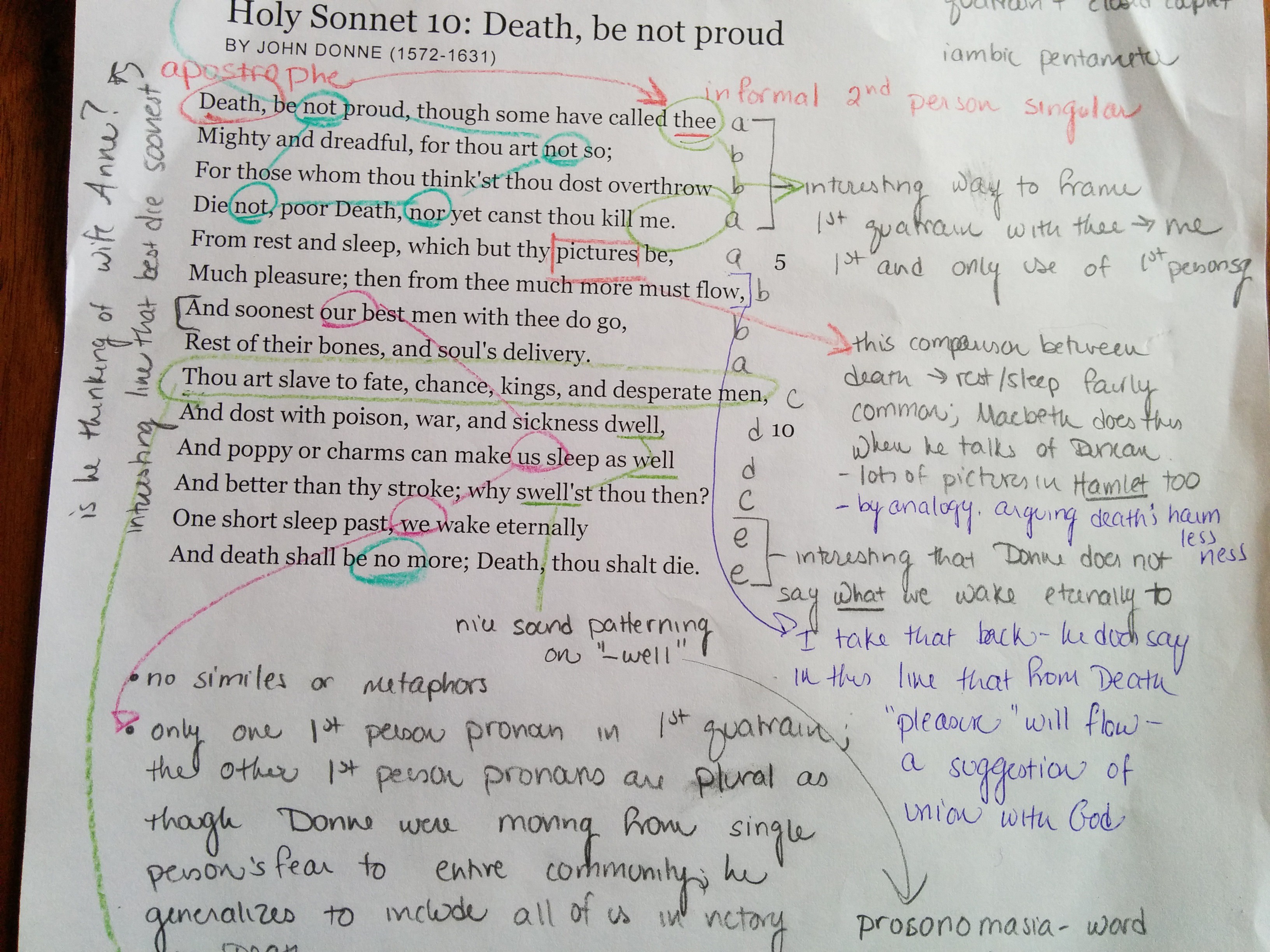
Here is a series of pictures for how Donne’s sonnet was atomized. In the post for tomorrow, I will see about writing a unified interpretation/appreciation of the poem.

IMG_20150328_091220

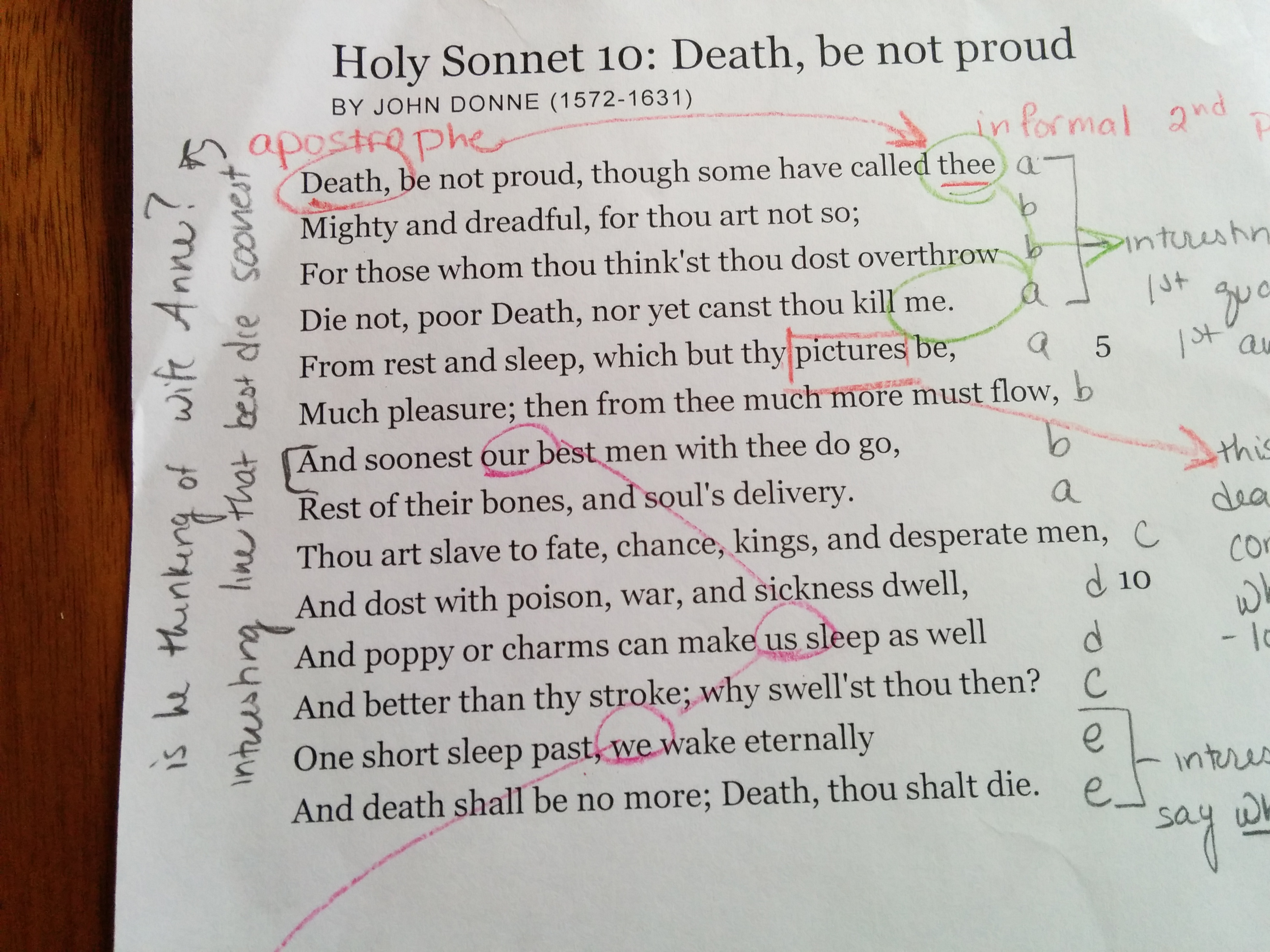
The bare text of the poem, whose first few words has seeped into common parlance, often without folks recognizing the source in this poem.

IMG_20150328_091458

Generally, I identify the poetic form, rhyme scheme, stanza structure. I also check for end punctuation. This one has full stops for each quatrain.
IMG_20150328_091938

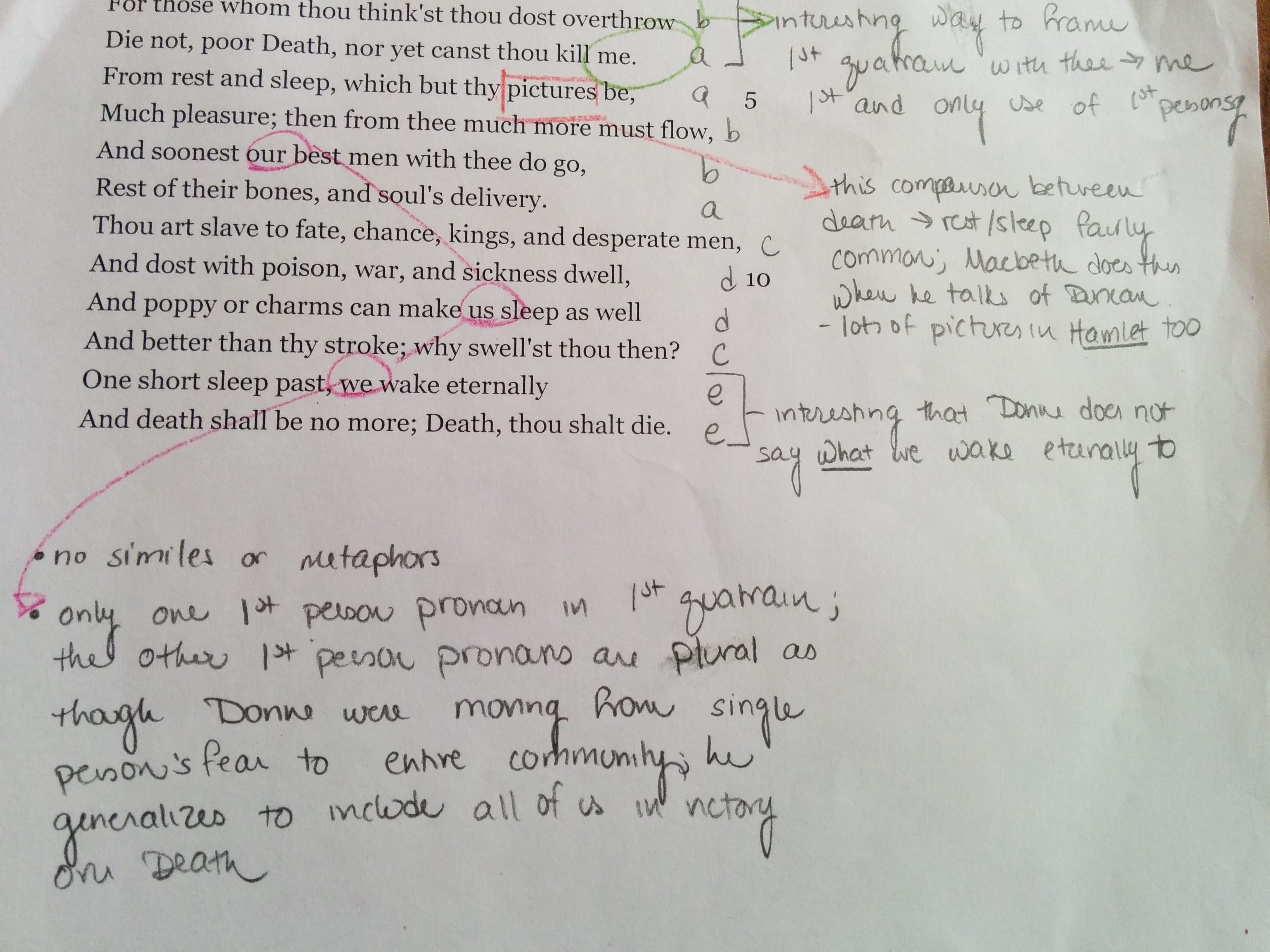
Next I look for any obvious literary or rhetorical devices. Donne personifies death and addresses it directly in apostrophes throughout the poem. What is interesting is that there are no discrete similes or metaphors.

IMG_20150328_092137

When Donne addressees Death, he uses the second person singular informal. This choice mirrors how God is addressed in the King James bible as “thou.” In both cases, the choice of pronoun shows intimacy. In the case of God, the informal pronoun suggests that the narrator has a close, loving, respectful relationship. In the case of Death, the informal pronoun suggests disrespect and derision. In Shakespeare’s plays, characters will use this pronoun for those who are beneath them socially or those who are being disparaged.

IMG_20150328_092426

I also check every poem for repetition. This one repeats negative words. Not much else to say since it is in the note.

IMG_20150328_092650

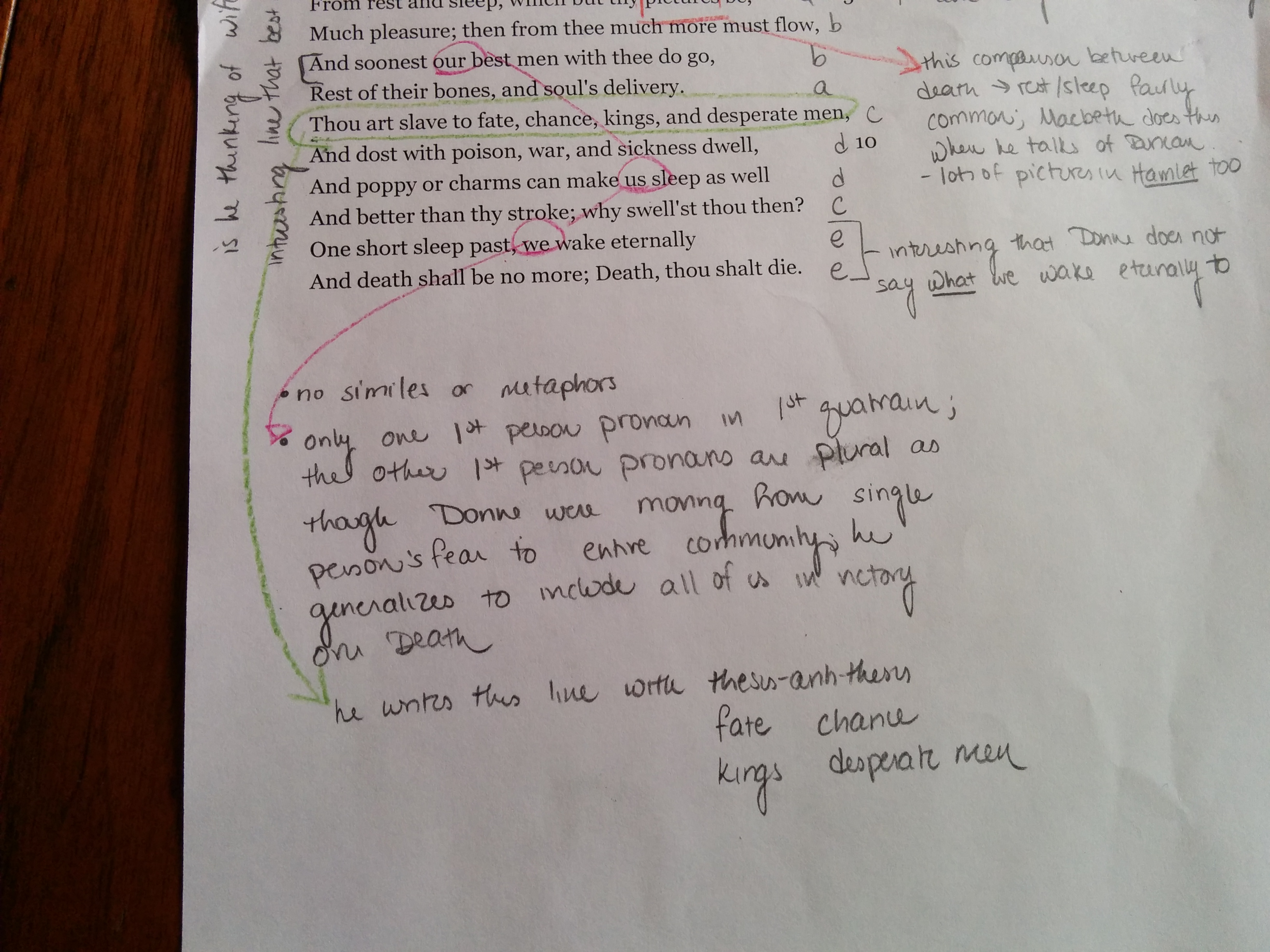
Next, I noticed the reference to pictures. To paraphrase, Donne tells Death that it is just another version of sleep. Sleep and Death are pictures of each other. I want to do some more work and rereading of Macbeth and Hamlet to see how Shakespeare uses pictures in those plays. I suspect that saying death is like sleep is just a worn trope.

IMG_20150328_092809

The poem ends with a closed heroic couplet. At the time I was marking up the poem, I was focused on how Donne does not actually say where we go after we die. Now I am struck by how he contrasts “eternally” and “die.”

IMG_20150328_092937

This next note is just thinking about why Donne says that the best men meet death soonest. This just seems to be another trope about how the most beautiful and the honorable always die first.

IMG_20150328_093108

The first line of the sestet has a 4 item list of what enslaves Death.

IMG_20150328_093432

For this comment, I came back to the negatives in the sonnet.

IMG_20150328_093629

In the purple script, I revise my earlier comment that Donne does not say anything about what the after life is like. He does but it is in line 6.

IMG_20150328_095141

Sound echoes and patterning is critical for binding the lines of a poem together. Here Donne plays with the /well/ sound, using the rhetorical technique of prosonomasia. Another great example is when Macbeth says in Act III, “I am cabined, cribbed, and confined.”

IMG_20150328_095906

I came back to the picture comparison in the second quatrain. Not much else to say.


Posted in literature, poetry, words | Tagged , , | Leave a comment

Reading about Mary Sutter

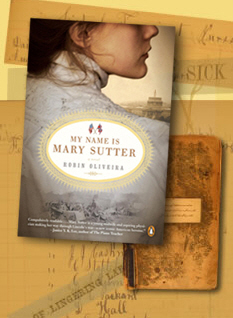
marysutterWhen I was visiting friends in Decorah, I spied Robin Oliveira’s novel My Name is Mary Sutter on a coffee table. I had finished already the YA novel Flora and Ulysses by Kate Di Camillo, which is a delightful magical realism story about how a squirrel acquires unusual powers after being sucked into a vacuum and has adventures with his human rescuer Flora. It was a book my mom recommended and it is an interesting cross between a straightforward novel and a graphic novel since some chapters are cartoons.

But enough of that! I picked up the Oliveira book listlessly and, after reading the back cover, opened to the first page. The book plunges immediately into a crisis because primip can’t deliver her baby and the surgeon has no idea what to do. Mary Sutter to the rescue with calm efficiency and expertise. I only read a few pages and then had to set it aside when my friend came down. The protagonist haunted me for the rest of the day: would she find a doctor willing to train her in surgery? I had to know and so downloaded the book on my kindle for the plane ride home.

Right now where I am in the book, the Civil War has begun and the first wounded are arriving at the Union Hotel after the battle of Manassas on July 21, 1861. Oliveira really makes the reader see how inadequately prepared everyone was for the wounded: not enough food, beds, nurses, doctors, supplies, medicines. Nothing clean. No sanitation. No ventilation. And no one had any idea how to do surgery; they just read from a manual.

I picked up the book, compelled by the heroine and her desire to learn in a man’s field. I also wondered if it might be a summer reading book for students in high school. I must continue reading and finish the novel before deciding. It might be good for rising eleventh graders since eleventh grade is the year of US history.

Robin Oliveira has a website where she describes how she researched primary materials to learn about medicine, surgery, midwifery, the Civil War.

Posted in books | Leave a comment