Bread Recipe

This is a bit random but I need a place to post a bread recipe after posting this picture to King Arthur Flour:

20140213_120218

Put in the bucket of a bread machine these ingredients:

1 cup KAF sour dough (recently fed)
2 teas salt
1 table sugar
2 eggs (at room temp)
1.5 cup sour milk (warmed)
4 C KAF European style flour
2 teas yeast

Let the machine make the dough. When it is finished, deflate the loaf, form into a ball, and let rise in well-floured brot form.

Bake on a heated stone (covered with bread crumbs) in a 350 degree oven for about 20 minutes!

Posted in Baking | Leave a comment

How to imagine an affair between Edgar Allen Poe and Francis Osgood?

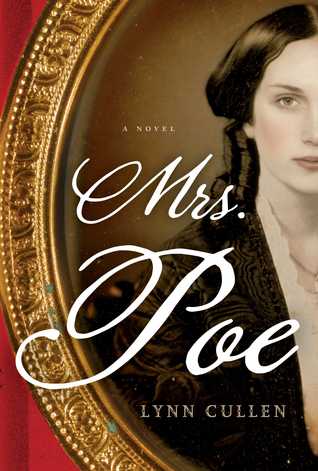
That is what Lynn Cullen’s book Mrs. Poe creates. It is told from the point of view of Francis Osgood, who was herself a poet. It begins in the winter of 1845 and end in the winter of 1847. I read the book over this past weekend, eagerly devouring the pages and delighting in how she wove the poetry with the history with her imagined events. The depictions of Poe and his wife seemed true and I liked to have various authors from that time period walk on stage at the conversaziones at Miss Lynch’s house — Melville, Whitman, Emerson, Alcott, Fuller.

Cullen was excellent at contrasting the freedom of a male writer to write all kinds of macabre tales and poems and the constriction of a female writer to produce only children’s literature, flower poetry, and other such things. The big question becomes where did Poe get all the inspiration for his tales of horror? Cullen ponders the dichotomy between the man (cultured, intelligent, controlled) and the stories (obsessed, violent, lurid).

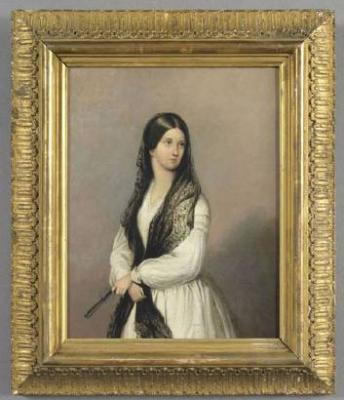
Painting by  Samuel Osgood

When Osgood is sketching Mrs. Poe in preparation for painting her, Cullen gives Osgood a great comment about art: “What you call color and form are simply patterns of light…Oddly enough, while looking for light on the outside, I often find alight from within. I cannot explain how that works. Instinct, I suppose” (226).

The climax of the book is rather disappointing — in seems too much of a Hollywood, movie episode. Too predictable by far which was too bad given the engaging characters.tumblr_mu2bsx8QjC1qaosbbo1_400

Cover of Cullen's novel

Posted in book review, books | Leave a comment

Human – Digital Centaurs!

Image

Clive Thompson has a book called Smarter Than You Think which adds to the debate about whether computers are making  us stupid. I first encountered this book in a review in the NYT (the place where I learn about new books).  The review was by Walter Isaacson and like the very best book reviews, he taught me a great deal. I found myself wanting to run and grab a pen to write down terms such as: “intelligence amplification,” “creative texture,” “collaborative creativity,” “ambient awareness,” and “transactive memory.” Instead I made a mental note to find the review on the NYT site and reread the review when writing this blog to get down the exact phrases.

Now that I am reading Thompson’s book, I see that he describes a similar process when he was writing the first chapter “The Rise of the Centaurs” in his book about chess players interfacing with computers to defeat other teams.

Right now we are in a transition phrase as people adapt to the technology that surrounds us on all sides. We are questioning it. Is it good for us? Should I be able to forgo learning phone numbers because my phone does it for me? But then what happens when I lose my phone or it is out of power? And what about paper books? Are they really going to vanish? Even though I am a huge technology advocate, I still prefer to deal with a hard copy of a text I am teaching. Or if I am writing an article on something, I want my primary source in front of me so I can flip through it and compare passages and find connections. But maybe that is because I am still trying to stand astride two different worlds — one of molecules and one of electrons.

Here is the link to Isaacson’s review: http://www.nytimes.com/2013/11/03/books/review/smarter-than-you-think-by-clive-thompson.html?smid=pl-share

Posted in book review | Tagged , | Leave a comment

A modern “Artist of the Beautiful:” Davis Esterly

When the Harvard Magazine arrives, I usually sigh a bit (mentally) and shrug. The articles are interesting but they seem like such a rah-rah effort to advertise Harvard’s greatness. I will usually try to read at least one — because they are generally well-written and I do learn from them.

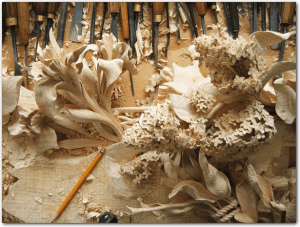
But this summer when the magazine arrived this article about Davis Esterly immediately caught my attention because what he creates is so defiantly reactionary and post-post-modern. He carves lime or linden wood to create the 3-dimensional objects that outdo nature. His work reminds me of the watch maker in Nathaniel Hawthorne’s story “The Artist of the Beautiful.” This artist creates a beautiful, mechanical butterfly after years of devoted study, craftsmanship, and dedication. Hawthorne says that even a breath from an inimical person made the glowing, floating butterfly fade and droop. I feel like Esterly’s carvings are like that butterfly — imbued with an artificial life.

To read the article, click the link below:

http://harvardmagazine.com/2013/07/the-art-of-subtraction

To visit David Esterly’s website, click here:

http://davidesterly.com/index.html

Posted in books, life in general, nature | Leave a comment

What are two types of prayers and why is that interesting for a medievalist?

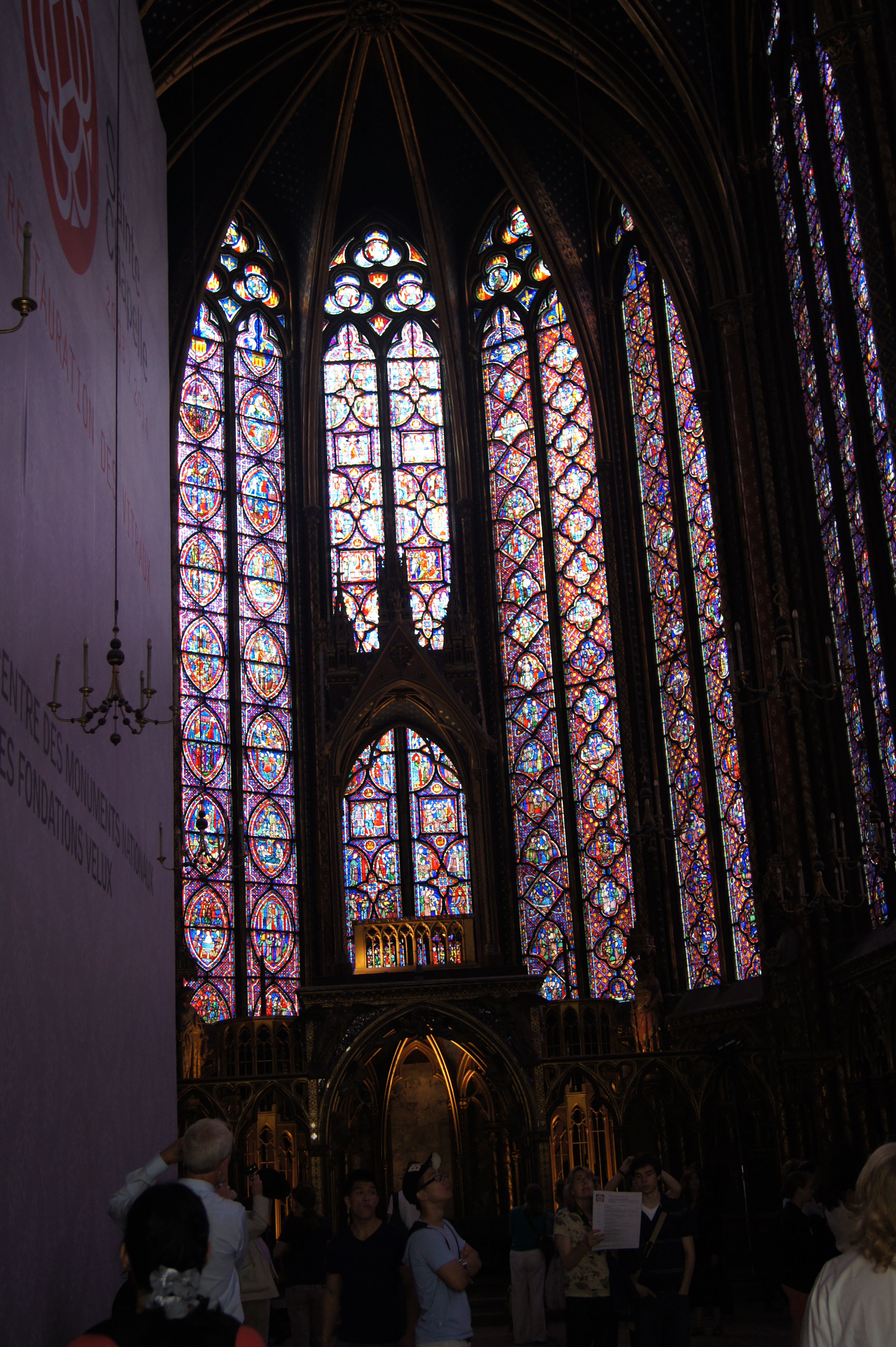
Sainte Chapelle, Paris

T.M. Luhrmann had an interesting piece about different types of prayer. Here is the permalink for her “Why We Talk in Tongues.”

She says there are two main categories of Christian prayer: apophatic and katophatic. Apophatic prayer means emptying the mind of thought. Katophatic is repeating a series of words or lines or following a particular path of thought in a kind of directed daydream.

What Luhrmann does not supply are the etymologies of both words. So I hopped on Wikipedia to learn more. Apophatic is from the Greek word apophemi (long e) which means “to deny.” Interestingly there is a form of theology called apophatic theology which seeks to understand God by defining on what he is not.  Katophatic is from two Greek words: cata meaning “to descend” and femi meaning” to speak of.” The entire word means to “bring God down to speak of Him.”

As a medievalist, I find these useful categories for rethinking various saint’s lives (the life of St. Teresa), medieval treatises on prayer (such as Juliana of Norwich’s Revelations), and even some of the dream visions (the Anglo-Saxon Dream of the Rood). The Gawain poet’s poem called “The Pearl” might be an example of a kataphatic experience since he enters into a prayer like state and is guided by signposts provided by the New Testament.

Juliana of Norwich had her revelations which she was deathly ill. She recovered and wrote down descriptions of what she saw and heard. It seems that these visions came to her when she was in a apophatic state — mentally exhausted and weakened by prolonged sickness. In this receptive state God came to her to show her the unity of creation and the everlasting, all encompassing mercy and love of God.

It seems to me that many of the dream visions fall into the category of kataphatic prayer. In “Pearl,” the narrator is grieving over the death of his daughter and has a vision in which he enters into the kingdom and heaven and finds his daughter with the saints. His path is determined by the medieval geography of heaven. By following this path, he has a revelation of heavenly peace and salvation which allows him to return to his earthly live and accept the death of his child.

I am writing this by drawing on old memories from years ago and feel inspired to seek out these books on the shelf and reread them.


Posted in literature, medieval, words | Tagged | Leave a comment

How does beauty connect with self and writing?

Waimea CanyonSome times you are in a place so lovely that it defies description. That was the Waimea Canyon in Kaua’i in July.

But isn’t this judgment subjective? Someone else might not find this view sublime because it contains no human figure to provide perspective. Or that because there is nothing in the foreground to catch the eye, the seer just wanders into the landscape and is lost?

Or is that the point of a view like this — to become lost from others and self?

Lately I have been thinking a great deal about my place in this world and this life since I am leaving one position and moving to another one and since two of the three children are leaving home for college. How shall I feel and fill the hours?

Once I wrote a dissertation. It took all my powers of concentration and thought to compose sentence after sentence and have it all make sense. I have not done any real writing since then — and means not counting letters, comments, short reflections. My mind feels atrophied and yet the barrier to begin writing is so high since writing is painful and painstaking.

I have one friend who manages to write poetry while being a husband, dad, and full-time teacher. He churns out poem after poem of austere allusive erudition and wit. How does he manage?

Because he makes it a priority. It is just that simple.

Posted in nature, writing | Tagged , | Leave a comment

A List of Summer Doings

Now that summer is drawing to a close, I want to make a list of what I managed to accomplish or do so I remember that not every day was full of nothing. Sometimes the days that are full of nothing are actually full of the most life.

1. graduation celebration for middle child who will attend McGill University this fall
2 week vacation in Kaua’i with the family
3. floors refinished on the first and second floor — this was a huge deal because everything (pictures, furniture, curtains) had to be removed from each room and put somewhere else
4. repainted the children’s study room “Moroccan Spice” (that took 2 days) and learned to patch plaster walls using adhesive patch tape (miracle invention)
5. had a watercolor lesson with Helena and we painted purple clematis at her house
6. learned to make an accordian book at a local art store and then made several — including a birthday one for my husband
7. planned and executed a memorable weekend for my mother-in-law including dinner at Moshulu and a trip to Longwood Gardens
8. made her a picture book of the weekend and sent it to her house
9. drove children all over Philadelphia
10. reconnected with a long lost friend over McDonald’s ice coffee
11. solidified friendship with a colleague at former place of work
12. had happy hours with my “big sister”
13. started spinning wool again
14. went on overnight camping trip with book group
15. dealt with a dog who got a bad case of fleas and could not stop scratching
16. started working out again (sporadically)
17. sorted out and filed away lots and lots of papers related to teaching and home stuff
18.  spent way too much money

Posted in life in general | Tagged , | Leave a comment

“Crisis of Masculinity” and Dracula

I was reading a New York Times book review (May 12, 2013) called “On the Brink” by Harold Evans as he talks about two books which survey the causes of World War I. Evans notes that in his The Sleepwalkers: How Europe Went to War in 1914 Christopher Clark says that scholars writing about gender have described a “crisis of masculinity” during this time and Clark argues that this underpinned the actions and decisions of  the male leaders of Great Britain, Russian Germany, etc. Evans quotes from Clark: “competition from subordinate and marginalized masculinities — proletarian and nonwhite for example.” This made me think immediately of how non Englishmen are portrayed in Stoker’s novel Dracula as a threat to English power, patriarchy, and sexuality. Characters that spring to mind are Dracula, Quincey Morris, the Russian captain of the Demeter. The Englishmen, Holmwood, Harker, Seward, are lauded for their strength, self-control, rationalism, firmness of purpose.

Posted in literature | Leave a comment

I learn from obituaries — or at least some of them!

Reading in the New York Times site a couple of days ago, I clicked on a link for an obituary. Normally, I do not read these — why be reminded of mortality? But this one intrigued because of the by-line that the dead woman had single-handedly given Japanese women certain important rights when the Japanese Constitution was written after World War II.

This woman Beate Gordon was fluent in several languages — including Japanese, which she had learned as a girl living in Japan with her parents who were musicians. Because of her linguistic fluency, she went with General MacArthur to Japan as an interpreter in 1945. Her real reason for going was to find her parents who had been missing for several years. She did find them in an internment camp for foreigners. But then in February 1946, she was the only woman on a committee of men who were drafting the Constitution. She inserted a few words — not many — and those words enshrined rights for women such as free choice of spouse, ownership of property, inheritance. She also put in language that forbade discrimination on the basis of race, religion, sex, social status. No language protecting sexuality though.

What a fascinating woman. A biography was written of her — in Japanese. And she was apparently very proud that Japanese women wanted their pictures taken with her.

Here is the link for the full obituary: http://www.nytimes.com/2013/01/02/world/asia/beate-gordon-feminist-heroine-in-japan-dies-at-89.html?smid=pl-share

Posted in learning | Leave a comment

Random — the word

Last week driving home on a Friday, it was dark. The car headlights pierced by tired eyes but then I perked up . NPR was finishing out the time before 6 pm with a bit of a linguistic ranting about the word “random.”

Here is the link: http://www.npr.org/2012/11/30/166240531/thats-so-random-the-evolution-of-an-odd-word

It used the OED to trace the etymology, history and usage of the word. What is interesting is that the meaning of the word contracted in the early 20th century, when scientists used it to describe the behavior of atoms. Now the meaning has expanded colloquially to include “weird” or “unexpected.” The ironic thing is that pedants are complaining about this :”new” usage but in fact it recaptures the original meaning of the word.

Language constantly changes. Prescriptive grammarians and English teachers try to put their fingers in the dike of “proper usage” but the language water keeps creating new spouts of energy and imagination.

What is grammar for? To create common rules so we can understand each other in writing when we don’t have the coloring of tone provided by vocal inflection and facial expression. But once you know the rules of grammar, defy, bend, and even break them!

Posted in words | Tagged , , | Leave a comment