Poetry as a Transformation of Mind

I just read a New York Times article “Philosophy and the Poetic Imagination: by Ernie Lapore and Matthew Stone about how how poetry demands a certain type of reading which must be cultivated and nourished and sustained.

Here is the Permalink: http://opinionator.blogs.nytimes.com/2012/12/02/philosophy-and-the-poetic-imagination/?smid=pl-share

What I jump to is the idea that poetry can be created out of ordinary prose with the imposition of selective line breaks. Yes, that is another example of found poetry but then they go on to analyze how the line breaks create signficance in the pauses between the lines and the juxtapositions and tensions created by links, parallelism, and balanced oppositions.

I want to do the same with a sentence from the novel that I am currently teaching my V form American Literature class. I am sure that one could find a line from Cather’s O Pioneers! whose inherent poetry could be forefronted by line breaks.

Posted in literature, poetry, words, writing | Tagged , | Leave a comment

Verbalizing Nouns

I love this linguistic stuff. The facility and fluidity of English grammar allows the adoption and shifting of all kinds of words.

Some purists hate the idea of a verb being used as a noun or a noun being used as a verb. But I am all for the ongoing creative synergy of the language.

Here is Helen Sword’s article from the New York Times: http://opinionator.blogs.nytimes.com/2012/10/27/mutant-verbs/?smid=pl-share

Posted in grammar, writing | Tagged , , | Leave a comment

Haskell and the mandalas of nature

I discovered David Haskell in this New York Times Article:

http://www.nytimes.com/2012/10/23/science/david-haskell-finds-biology-zen-in-a-patch-of-nature.html?smid=pl-share

Here he describes visiting the same place “mandala” for observation and renewal.

He has a word press blog “Ramble” which I follow.

Posted in grammar, literature, nature, politics, writing | Tagged , | Leave a comment

Grammar and the dash

I liked this article about the history of the dash as a grammatical sign. Ben Yagoda discusses the versatility of the dash and shows how various writers (Dickinson, Twain, and Fitzgerald) have used it to great affect.

http://opinionator.blogs.nytimes.com/2012/10/22/mad-dash/?smid=pl-share

Posted in grammar, writing | Leave a comment

Just a trial

After starting to use WordPress for my classes this fall, I wondered if I wanted to pick up blogging again. I had established a blog 5 years ago on bloggr but now prefer the versatility of the WordPress interface. On the other hand, I did not want to lose all the posts on my original blog. Then I figured out how to combine my old bloggr page with this WordPress page — thank you to WordPress for extensive help files and directions. Voila! the old posts are now merged with the new ones. Who says that old wine cannot be poured into a new bottle!

Posted in School | Leave a comment

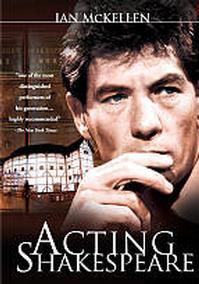
Thoughts on Ian McKellen’s "Acting Shakespeare"

In 1982, Ian McKellen entertained a live audience for 1 hour and 26 minutes performing select speeches from various Shakespeare plays: Hamlet, Romeo & Juliet, Henry IV Parts 1 & 2, Henry V, MacBeth, Tempest, King Lear.

I was particularly struck by ihs rendition of Act 2, scene 2 where Hamlet asks the Player to perform the death of Priam and then the succeeding soliloquy. The scene is all about Hamlet thinking about how the Player so gets into his role that he actually cries. Hamlet wonders how the Player can cry over Priam when he is not Hecuba and that he Hamlet is so distanced and unemotional when his own father has been murdered.

At the beginning of the soliloquy as I watch Ian McKellen perform, I realize that Shakespeare is telling the people how they should behave as an audience, how they should enter into the world of the characters and respond to their dilemmas.

Why had I not noticed this before? I think it was because as I watched this old dvd of McKellen’s one man snow, I was struck by the artificiality of what McKellen was doing as he introduced each character and scene, acted the speech, and then wove in facts about Shakespeare’s life and Elizabethan England and London.

His performance of Polonius listing the actor’s repertoire was hilarious — and that is something I barely read finding it too tedious.

I am watching this section of the dvd again. McKellen sits in a plush brown velvet chair as Hamlet, and then stands up when he becomes the Player reciting the murder of Priam by Pyrrhus and the grief of Hecuba, the mobiled queen. When he sits down again in the chair, his entire demeanor changes and he becomes the suddenly ashamed and hyper-critical Hamlet.

McKellen wears grey pants and a blue shirt with the buttons half undone down his chest. His hair is air blown without any grey and his face is craggy with pronounced cheekbones and thin sensitive lips. His face is free of wrinkles except around the eyes and sketched on the forehead. His blue eyes recede and blaze with emotion occasionally. When he says “vengenance,” he raises his voice to a shout and his clenched hands to the heavens. He rubs his temples when he says “brain” and then has the suddenly inspiration of how to trap the conscience of a king.

Bob has a small poster of McKellen from this production. He always spoke of watching this of PBS and wishing to have a copy to share with this students. While it is quite good, I think the students would prefer to see excerpts since they might find the style a little old-fashioned.

Footnote: He has a great Scottish accent version of Macbeth’s speech “Life is but a walking shadow.” He then summarizes the progress of Macbeth as a character from the play’s beginning to the end.

Posted in shakespeare | Leave a comment

More on the Academic Schedule

Each day during the Cambridge Teacher Seminar, we had a full day of sessions, activities, and discussions planned.

Here is a brief overview:

Sunday, July 4
Walking tour of Cambridge by Suzanne Lynch; this was our quick orientation to the village of Cambridge, the nearby colleges, and how to get back to Westcott House

Monday, July 5
9-12:30 Visual Experience discussed “What is art?”
2-4:30 “Writing England: Viriginia Woolf and Questions of National Identity” by Dr. Suzanne Lynch
4:30-5:30 “Cambridge University in 1,000 Steps” which was a guided tour by Dr. Nicholas James and an explanation of the Cambridge undergraduate educational system

Tuesday, July 6
9-12:30 Visual Experience learned about architecture from the medieval period to the modern and then took a walking tour of various colleges to see examples
2-4:30 A Poetry reading by Andrew Motion, former poet laureate of Great Britain
4:30-6:00 “Literature Makes History: How Poets Helped End Slavery” by Professor James Basker, the founder of the Oxbridge Summer Programs
8:00-9:00 “Emotions and the Good Life” by Dr. Nick Treanor

Wednesday, July 7
9-12:30 Visual Experience discussed various aspects of art: line, color, form, compostion, etc and then took a tour of the FitzWilliam Museum
2-4:30 A tour of the FitzWilliam by Hannah Malone
5-6:00 Choral Evensong at King’s College Chapel
8-9:00 Cambridge Voices a cappella concert in the Wesley Church

Thursday, July 8
9-12:30 Visual Experience learned about Funerary architecture
4:30-6:00 “Oliver Cromwell: A Great, Bad Man” by John Morrill
6:30-9:00 Reception with the Gates Scholars and staff from the Cambridge Tradition and the Cambridge Prep Experience

Friday, July 9
9-12:30 Visual Experience discussed Impressionist Painters, their techniques and their popularity
2-4:00 “Trip to the Whipple Museum and Cambridge Science” led by Dr. Simon Mitton
4:30-5:30 “Animals and Ethics” by Professor Michael Banner

Saturday, July 10
9-12:30 Visual Experience learned about the history of burials and cemeteries and visited a graveyard
6:30-9:30 Farewell banquet hosted by Professor James Basker in The Prioress’s Room, Jesus College

Posted in cambridge oxbridge | Leave a comment

Clare College Fellows Garden

On my early early Saturday morning walk, I found the gate to the Fellows Garden of Clare College. It was a wrought iron gate with a piece of convex glass embedded in the center. Of course it was locked, but I promised myself that I would come back later in the day. I could glimpse through the gate how lovely the gardens were.
I was not disappointed. Come in and see the flowers.

A slide show of the flowers.

Posted in cambridge oxbridge | 4 Comments

A Contrast

On Saturday I went to the Cam on two separate occasions. The first was quite early in the morning. The only sounds were the birds and my own footsteps. Not even the river made any noise at it slipped past. Here is a video:

Posted in cambridge oxbridge | Leave a comment

I spy….


There is a guitar player somewhere in this picture. Can you find him?

Posted in cambridge oxbridge | 1 Comment