NYT Book Review

Notes to self — what to read next

The Nine: Inside the Secret World of the Supreme Court. By Jeffrey Toobin.
Reviewed by NYT Sept. 23, 2007.
Looks like an interesting read discussing and analyzing the dynamics and procedures of the Supreme Court. NYT calls Toobin an intelligent and engaged outsider who is not awed by the Court, but he might have asked more probing questions of various sources.

Loving Frank. By Nancy Horan. Reviewed by NYT Sept. 23, 2007. About the love affair of Frank Lloyd Wright and Mamah Borthwick Cheney who ran away from a husband and children in order to live with Wright. NYT review made this sound intriguing because of the independence of the woman.

Shadow of the Silk Road. By Colin Thubron. Reviewed by NYT July 15, 2007.
I want to read this book after visiting Antioch which was the terminal destination of the Silk Road. This book sounds like a synthesis of both history and contemporary observation which is exactly what I want.


Soul Eater.
By Michelle Paver. Reviewed by NYT July 15, 2007.
The reviewer said that this would be a good book for anyone who loves HP. It is recommended as a real page turner with elegant prose.

Posted in To Read | Leave a comment

Senior Hike


The new academic year has begun but the seniors did have a pause of two days as they hiked 17 miles of the Appalachian Trail near the Lehigh Valley. The 60 students were chaperoned by 12 teachers. We hiked over rocks, climbed over rocks, went down rocks, and slept on rocks. Nonetheless, the hike was beautiful and I loved being outside under the trees during the day and under the stars at night.
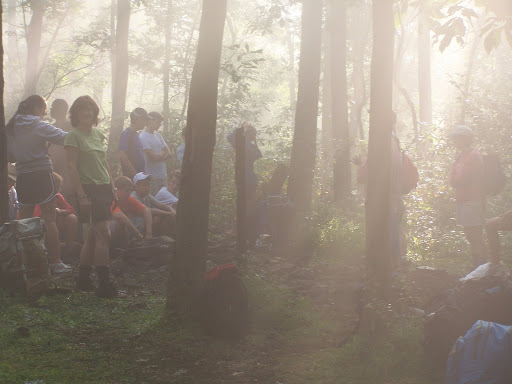
This picture was taken as we all gathered early Monday morning to begin the hike to buses. The mist was thick but shot through with sunlight.

Posted in School | Leave a comment

Princeton and Florence: Treasure Hunter Novel

n short succession I read two books focusing on the same fascinating time period — the late fifteenth century Renaissance.

The first was a novel by the collaborating authors Ian Caldwell and Dustin Thomason was a mystery set in contemporary Princeton but having roots in the Renaissance. The mystery centers on how to interpret and understand a massive and puzzling Renaissance text called “Hypnerotomachia Poliphili.” The first-person narrator is a senior undergraduate English major at Princeton, who struggles with questions of loyalty, identity, and love. The action of the novel moved swiftly and once in a while I stumbled upon a magnificent analogy which encapsulated the narrator’s emotions and reactions.

From this novel, I went to a biography of Machiavelli — famous for writing “The Prince” — and who was a contemporary of the purported author of the “Hypnerotomachia Poliphili.” King writes a lively and humorous prose; he rather enjoys focusing on the more scurrilous aspects of Machiavelli’s career which seems to be his method for offsetting Machiavelli’s rather black reputation for deception, treachery, and aggression.

After reading both books I was struck anew how my selections of books are almost predetermined. I picked up the Machiavelli book because of “The Rule of Four.” I picked up “The Rule of Four” because I had read a review of it last summer in the “New York Times” and remembered seeing it on my son’s bookshelf.

Sometimes what I read is just by happenstance, but that is what I love about summer reading — I can go anywhere inclination and Fortuna leads.

Posted in book review | Leave a comment

Rome and France

After reading “Liszt’s Kiss,” I went to the public library and found Dunlap’s previous and first novel. This one was also set in France during the reign of Louis XIV whose queen was the Austrian Maria Theresa. Again the novel focused on music and singing — not a surprise given than Dunlap has a Ph.D. in music history from Yale. The female protagonist of this first novel, Emilie, resembles the girl in the second novel — musically talented, innocent, manipulated and influenced. Dunlap has some exquisite descriptions of Emilie’s voice — she describes it as “opening like a flower” in the middle range and being clear in the top range. That simile “opening like a flower” is particularly resonate and evocative. The two composers that figure in this novel are Jean-Baptiste Lully and Marc-Antoine Charpentier. After reading this novel, I want to listen to works by both men: Lully’s “Alceste” and “Psyche” and Charpentier’s sacred music.

But before I read Dunlap’s novel, I read a novel called “Medicus” by Ruth Downie. This novel set in Britannia during the reign of Hadrian was really entertaining. The main character is a doctor named Ruso who has a penchant for damsels in distress — dead and alive. Both he and the narrator have a rather droll sense of humor, often rendered by wry understatement and ironic juxtaposition. It is a pity that this is Downie’s first novel, because I would otherwise have to run to the library to check out her other novels. The novel was published in 2006, so I can expect to wait at least another year for the second novel to appear to learn what happens to Ruso and Tilla next.

Posted in book review | Leave a comment

John Donne and Doubt

Browsing the books shelves of our local library, I found a new biography about John Donne, who wrote intellectually muscular poetry. I took down the hefty book and remembered that Donne struggled with his conversion to the Church of England, and tried to defend that conversion as not made for expediency but for true righteousness. I also recalled that when King James I appointed him Dean of St. Paul’s Cathedral in 1621, some controversy existed because of Donne’s background (his family was Roman Catholic), his early poetry (rebellious, erotic, and unconventional), and his marriage (he married his patron Lord Egerton’s niece in secrecy). But I remembered Donne as a great doubter and questioner — who defended suicide in one tract, who questioned the existence and presence of God. And also he lived at a time when England was dominated by religious antagonism and hatred, because the official religion of the state was Protestantism and Roman Catholics were persecuted and shut out of public offices. Everyone had to attend Protestant services and if someone did not, that person was suspected of being a Catholic and subject to questioning.

As I remembered these broad characteristics of Jacobean England, I was reminded of a NPR program, Krista Tippet’s “Speaking of Faith” in which she interviewed Deborah Michael Hecht who wrote a history of doubt. Hecht argues that doubt has a great and long history beginning in Ancient Greece and that doubt about God and questions about God coincide with periods of cosmopolitanism and social upheaval. That description certainly seemed to fit England during Donne’s lifetime and so I decided to read this biography by John Stubbs.

Stubb’s biography of Donne is not written for the casual reader, but the reader who likes a challenge. In fact, his biography seems modeled on one of Donne’s poems — it demands patience as the narrative unfolds but the reader is rewarded by wonderful pictures of everyday life in London — in the city, in the country, at the court, and among the poor and persecuted. Stubbs has written one of the most readable accounts of the tense relationship between Protestants and Roman Catholics in Jacobean England. He also shows how fine the line of distinction could be between the two religions.

Stubbs had to weave in Donne’s own words — from poetry, letters, sermons, etc. Given that all of Donne’s poetry is undated, he takes a conservative and balanced approach to matching certain poems with certain events in Donne’s life. For example, he matches “The Flea” to the time he was seeing Anne More clandestinely before their marriage. He assigns most of the Jack Donne poetry to Donne’s twenties before he met More while serving as secretary to Lord Thomas Egerton. I guess the greatest tribute I can give Stubb’s analysis and contextualization of Donne’s poetry is that I have gone back and reread some of the poems he analyzes and I want to read Donne’s essay “Biathanatos.”

So if I had not heard Hecht’s theory about doubt thriving in a cosmopolitan, questioning setting I might not have decided to read Stubbs’ biography — and I would not have met again one of my favorite poets.

Posted in book review | Leave a comment

Tolkien and Liszt

Within the last week, I have read two diametrically opposed books.

Marjorie Burns published a book in 2005 titled Perilous Realms: Celtic and Norse in Tolkien’s Middle-earth. This scholarly book published by University of Toronto Press is based on the reasoned premise that Tolkien used both Norse and Celtic mythology, folklore, and epics to give his own texts a resonating depth and energy which makes his ostensibly simplistic characters and plot ambiguous and allusive. Burns argues about how Tolkien combines both Norse and Celtic elements to create a balance between the the pragmatic and realistic Norse and the mystic and spiritual Celtic. In her list of works cited, most of the texts Burns gives are translations from the Old Norse or the Celtic or scholarly commentary.

For Celticists intrigued by echoes of Welsh and Irish folklore in Tolkien, Burns deals head-on with a troublesome issue. Tolkien always denied any affection for Irish literature — considering the land alien and the folklore off putting. But on the other hand, he always expressed a fascination with the music and orthography of Welsh. Burns neatly sidesteps Tolkien’s own denials of the Celtic — as any decent scholar should do — and goes right ahead arguing that Tolkien employed the model of the Celtic sovereignty goddess when imagining Galadriel, or the Irish sidh mounds when describing the Elvish hidden kingdoms. As I read Burns’ study, I wanted to go back and reread certain section of Lord of the Rings as well as my copies of various Old Irish sagas.

The other book I finished was a ballast to the scholarship. This was a novel set in early nineteenth-century Paris by Susanne Dunlap. The title is scurrilous — Liszt’s Kiss. It is a combination of a historical romance, mystery, and musicology. The setting is a rather interesting time when Paris was the center of culture and famous artists and composers lived in close proximity and knew each other — Chopin, Paganini, Liszt, Delacroix. Dunlap’s description of this intense concentration of talent reminded me of early twentieth-century Paris . And Dunlap includes the historically accurate drama and pathos of a cholera outbreak. One of her characters is a medical student who serves at the city hospital. In the course of the novel, he performs emergency surgery. I asked my husband to read that scene to assess the historical accuracy of the description. He agreed it was horrifically accurate and we then had a conversation about the miracle of anyone surviving a surgery before antibiotics or sterile procedure.

I ate up Dunlap’s novel in just a day. It was not a demanding read but Dunlap has a marvelously restrained prose when narrating an assignation or a kiss which is refreshing after the otherwise torrid descriptions in contemporary fiction.

Posted in book review | Leave a comment

Images and Energy


For a teacher, the summers are a special time of recharging, reflecting, and resting after a hectic year. But last week many of us at my school gave up a week of our summer to learn more about technology and how to use technology more effectively in our classes to energize our students. Under the experienced guidance of Thomas Daccord from Alan November learning, I downloaded, registered, and explored a variety of programs, and websites. I learned about blogging, flickr, wikis, google earth tours, voicethreads, and lots of other programs.

And I also rediscovered the power of image. A single image. So much of what I do in the English classroom is word based — connotations of a single word, symbolism of a word phrase, structure of repeated metaphors. But all word based. I can get incredibly excited by a single phrase and the way that phrase creates meaning through association and conflict. Yet this last week I watched my colleagues get excited by pictures they sent back and forth to each other. They not only sent images to each other, but they also recorded little messages and stories to accompany those images. The atmosphere of the room shifted from silent passivity to vociferous engagement — laughter, smiles, quips. And yet we were all still learning and focused.

I decided I wanted to create my own images using a digital camera and then manipulating the images in Adobe photoshop or ArtRage.

The image above is a result of experimenting with a picture taken of a hydrangea blooming in my garden. I uploaded the image as a tracing image in ArtRage and then played with various tools. Not that anyone needs to know that, but in case I forget how I made the image later. It took me at least 4 different tries before I got something that looked okay. At first I just had a blank background but the the blossom looked lost. But the image started to look better when I used layers to establish background, outline of petals, color of petals, and dots for the centers, and then metallic glitter for some variation.

So this image is both a concession and an acknowledgment.

Posted in images, learning | Leave a comment

Caesar: Within His Time — Still Extraordinary

When I was traveling back from Turkey, we stopped in Heathrow, London for a 5 hour layover. There I found Adrian Goldworthy’s biograpy of Julius Caesar, titled simply Caesar.
He writes in a lively, engaged tone instead of the dry, objective tone of a historian. He weighs the contemporary evidence — letters, commentaries, histories — and always keeps emphasizing that Caesar was not inevitably successful in politics or war.
If you have watched HBO’s series Rome, you might find this biography worthwhile.

Posted in book review | Leave a comment

LOTR Video

from YouTube: “How the Lord of the Rings Should Have Ended”

Posted in LOTR | Leave a comment

St. Peter’s Church in Antioch


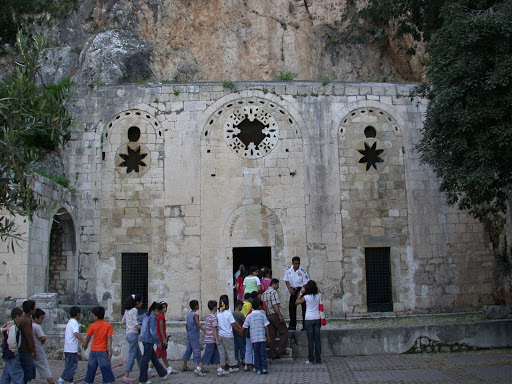
On the trip to Antioch, we saw St. Peter’s Church, which is high in the mountains above Antioch. In this cave church (which once had a mosaic tile floor and murals on the wall), St. Peter and others met and worshiped as Christians. Anyone coming to this church is granted a plenary indulgence for all sins. In other words, if you make pilgrimage to this church, you are forgiven all your sins.
In the middle ages, people would make a pilgrimage to this church, buy a St. Peter’s medal, and pray for forgiveness. In the middle ages, a pilgrimage to St. Peter’s would be incredibly dangerous — over the stormy seas, through treacherous mountains, through strange cities, and past bandits and robbers. Anyone surviving the pilgrimage and returning home would be famous!

Posted in Turkey | Leave a comment
Josefin Waltin spinner

For the love of spinning

CAROLYN'S SHADE GARDENS

THE JOY OF GARDENING IN THE SHADOWS

NothingButKnit

yeah right.

Knitting Nuances

A 2015 - 2018 Top 100 Knitting Blog!

Yarn, Books & Roses

life with a chronic disease and a really big yarn stash

the twisted yarn

Knitting, crochet, running, and silliness.

Love Those "Hands at Home"

Celebrating the Human Touch

Story Mask

Story Mask is a blog where my writing goes public. Enjoy stories, flash fiction, horror fiction, fantasy fiction, poems, and writing tips. My blog is geared to be family friendly.

Your Home for Homemade Japanese Food

How to cook "with visual instructions" "using familiar ingredients from your local grocery stores" healthy, traditional and delicious Japanese dishes!!

Cooking Without Limits

Food Photography & Recipes

The Play's The Thing

Reading Shakespeare's Plays with Dennis Abrams

Who needs to think?

A modern commonplace book

lovewhilehalfasleep

Do justly now, love mercy now.

Unleashing Me

An Experience In Progress