Women are allowed to want.

screenshot 2019-01-18 09.24.15Recently I just finished the third book in Katherine Arden’s Winternight trilogy about a woman in medieval Russia who takes on the responsibility of trying to save her people of Rus from human depredations and supernatural threats and negotiate a compromise between Christianity and animism.

The third book was vastly more satisfying than the second.

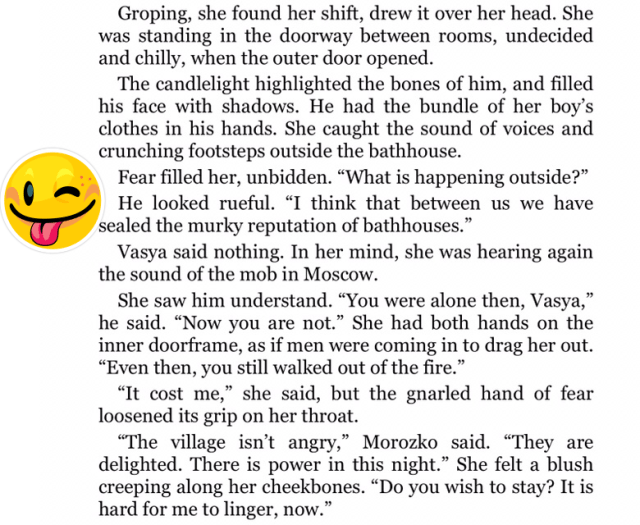
Without giving away too much the plot, Vasya reunites with the winter-king after freeing him from a spell — any astute reader of this genre of books knows that they will inevitably reunite. But the way Arden describes the morning after has a wryly humorous moment when the winter-king Morozko says that bathhouses will now be forever seen as places for unseemly encounters.

img_1173

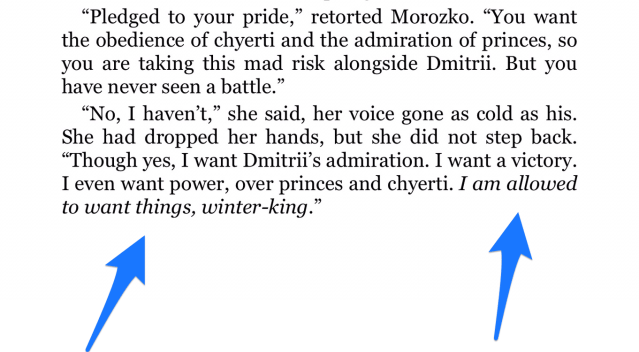
Much later at the book’s climax, Vasya and Morozko have an argument about what Vasya should do.

Here is the conversation:

img_1174

What I love is Vasya’s declaration that she as a woman is allowed to want the things that a man wants: power, honor, respect, freedom.

Arden writes the scene and prepares for the scene in such a way that the characters are believable in that moment and Vasya’s declaration is not out of place in medieval Russia. So yes, she does give Vasya the desires and ambitions of a modern woman, but she also gives Vasya a family lineage which aligns to Russian folklore traditions of strong women who are labeled witches (such as Baba Yaga) and makes her declaration believable.

Posted in book review, books, Uncategorized | Leave a comment

Annotations Galore!

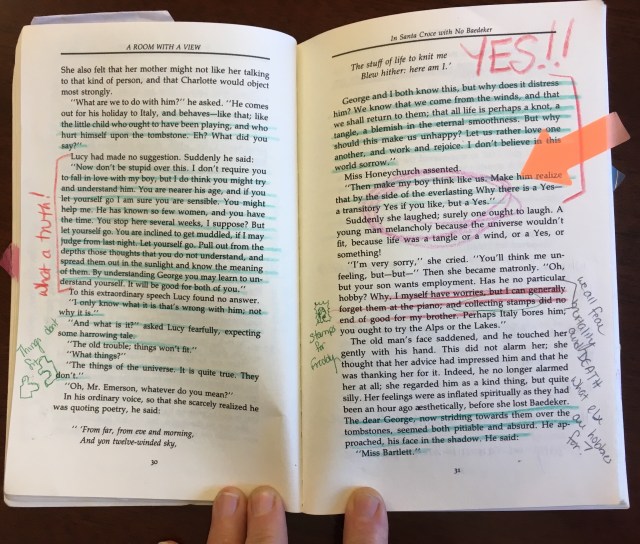
img_1155

My annotations on an opening of Forster’s novel A Room with A View

Once upon a time, I took so many notes and underlined so much in my textbooks that when I got done, the books looked like a very neat second-grader had been let loose with colored pencils. My old college edition of Shakespeare’s collected works and my old graduate edition of Benson’s Chaucer looks like that. I can barely stand to look at those pages because the amount of marking is too distracting.

But lately my annotation of books has entered a new phase which involves fewer colored lines and more marginalia consisting of commentary, questions, definitions.

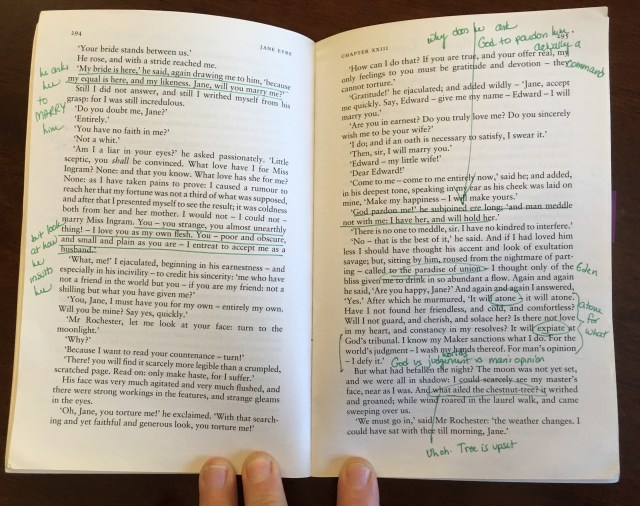
And just this year, we have made a real push to have the students buy the books in hard copy and annotate them. The eleventh graders were especially keen about annotating their copies of Jane Eyre: definitions of words and allusions, personal reactions, caustic commentary, plot summaries, questions. The tenth graders were less enthused about annotating A Room with a View. 

When it came time for the juniors to write their papers, we decided to let them devise their own topics based on their annotations. The papers we got were some of the best I have ever read about Bronte’s novel. They talked about architecture as a symbol, supernatural voices which guide Jane, fairy tales which parallel Jane’s character development, Rochester’s immaturity as it develops into wisdom and acceptance, the entire novel as an example of female power triumphing over male patriarchy, the actual human body as a metaphor for spiritual connection. I was astonished not just at the variety of perspective but the depth and sensitivity of their analysis.

One day, one of the girls lost her book. She was actually broken-hearted because she had lost not just the book but all of her annotations. The book was later recovered. One of her classmates had picked it up and shoved it into her backpack in the rush to go to lunch.

Now the girls see their books as very personal possessions which represent themselves and their ideas.

Now books are either throw-away things or coffee-table icons which have been signed by the author, printed on exceptional paper, are gigantic in size, etc.

But those throw-away books could become artifacts of the spirit with annotations and worthy of preserving — made valuable by the human handwriting in the margins.

img_1157

My annotations on an opening of the chapter in Jane Eyre where Rochester asks Jane to marry him.


Posted in books, teaching, Uncategorized | Leave a comment

Weaving a plaid — it takes yardage

img_1150Weaving anything I am learning takes a great deal of yarn. For example, this third project used (conservatively) 940 yards of worsted weight alpaca and 200 yards of mohair. The warp was 112 inches long and there were 162 warp threads. This means the warp required approximately 500 yards. The weft required 16 inches for each pick and there were roughly 8-9 picks per inch. This means the weft required approximately 440 yards.

For the warp, I decided to make a wide red stripe on one side of the scarf and then smaller grey stripes. There just was not enough red to make a second wide warp stripe and I also wanted the stripes to be a bit irregular because I was going to be spontaneous about where to add grey or red stripes in the weft. To figure out exactly how many strands of each color to use for the warp threads, I took a ruler and wound it with the various colors until I got a pleasing ratio. When it finally came time to warp the loom, I ended up doubling the number of red and grey warp threads.img_1129

The red and grey stripes in both the weft and the warp were doubled yarn: a sports weight yarn and a strand of mohair. This made these yarns roughly the same weight as the aqua alpaca.

To weave the weft, three shuttles were necessary so I had to improvise a third using a strip cut from one of my old campaign signs.

img_1132I used the full width of the loom — every slot and eye — and this actually is not a great idea because it makes winding the warp on the back beam tough because sometimes the side warp yarns fell off the paper which was supposed to separate each layer of the weft to keep the tension even.

I have learned that even tensioning across all the warp threads is critically important so when you move the heddle the threads move up or down to create a clean shed (a shed is a triangular space between the up and down weft threads through which you pass the shuttle carrying the weft yarn). If you don’t have a clean shed, you can get floats which are very annoying to correct if you catch them. So far, I have discovered 3 different floats which happened in the first 12 inches of weaving.

Lesson: don’t use the full width of the loom.

When weaving the stripes, I tried carrying the grey yarn along one side against the dark aqua, as was recommended by a couple of different experts. But for me, carrying the unused lighter color on the side created an unsightly edge. So after trying this for three stripes, I cut the carried grey yarn in the middle at the selvage and sewed the ends into the weaving so nothing would unravel. But carrying the aqua weft threads up and over the grey and red stripes looked fine because the aqua weft blended into the aqua warp selvage threads.

Making this decision meant that for the grey and the red weft stripes, I had to hide the ends in the weaving so that meant I started weaving odd number weft picks so the tails were tucked under alternate sides and not the same side. I feared if all the tails were on one side, the entire weaving would become lopsided.

The weaving took time but was calming. Once I established a rhythm, it almost became as soothing as knitting.

When the weaving was done, I cut the loops off the back beam and untied the knots on the front beam. Then came the finishing, which must be done carefully and precisely so the ends look good. This time I knew I wanted to have a twisted fringe. I grouped the weft threads in groups of 4 and tied knots very close to the weaving. The grey and red weft threads became their own knotted group. Then I tried twisting but the twists would not stay until I ran my fingers up and down the twist several times which made the fibers mat and keep the twist.

Two hours later, the shawl was ready for a bath in very hot water with a tiny bit of soap in the bathtub. This bath in HOT water relaxes the yarn and allows it to fluff up, meshing the yarns into something more like cloth.

Once the water had cooled, I squeezed out as much of the water by hand and then laid it out on towels spread on the guest bed to dry.

img_1143The next day, I tied the knots at the ends of each fringe twist and used a tape measure to ensure the knots were roughly at the same spot. The last step was cutting off the excess yarn and again a tape measure was involved.

My SH really loves the stripes of this and wants one of his own but in different colors and narrower. He wants to wear it with his father’s boiled wool German overcoat which makes him look like a dignified Herr Doktor Professor of the old world.


Posted in crafts, weaving | 4 Comments

“Mom, you are just like Penelope”

Said our daughter as she saw me weaving on my rigid heddle loom. Except, thought my pedantic self, Penelope would be weaving on an upright loom. My SH liked this comparison because by extension that made him the wily and intelligent Odysseus.

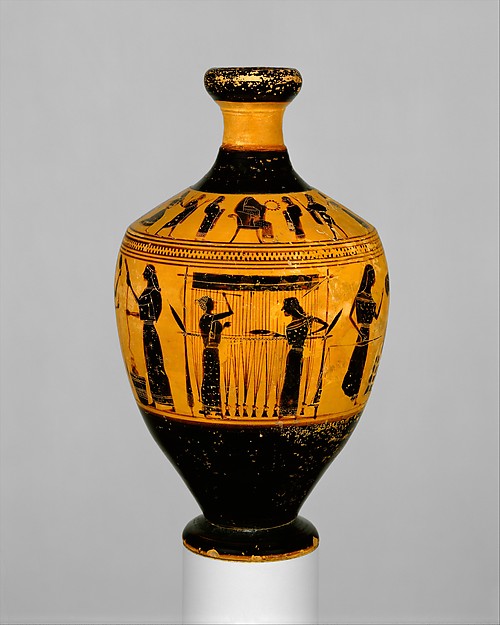
loomThat comment got me thinking. What kind of loom would Penelope have used? I always imagined her sitting down to weave.

But a google image search of Homeric weaving yielded this vase. Look at this depiction of two women weaving.  They are standing upright and beating the weft upward into the warp threads. The weights at the back of the loom tensioned the warp threads. Or so I learned by reading Susan T. Edmunds’ article on weaving in the Homeric age. Click here for Susan T. Edmunds article

But now after making numerous weaving mistakes, I have a new appreciation for Penelope’s skill at unweaving. Remember that one of her delay tactics for the amorous (greedy) suitors was that she would choose one of them to be her husband when she had finished the shroud which she was weaving for Odysseus’s father Laertes. She wove the shroud during the day and unwove it at night. For a scholarly discussion of Penelope’s deception and its symbolism, see Steven Lowenstam’s article “The Shroud of Laertes and Penelope’s Guile” from May, 2000 Classical Journal.  

Sidenote: Lowenstam has an interesting interpretation of the shroud based upon its description as shining like the sun and moon. I highly recommend reading the third part of the article if you don’t have time to read the whole thing.

So far I have finished two projects, but I have had to unweave several casts of the weft (weavers call these picks) to correct mistakes. These mistakes are created when you don’t press all the weft threads up or down completely. If  you cross your weft over the wrong warp thread, you create a “float.” For a plain weave article, a float is a bad thing. In some types of weaving, floats can create designs. Click here for some examples.

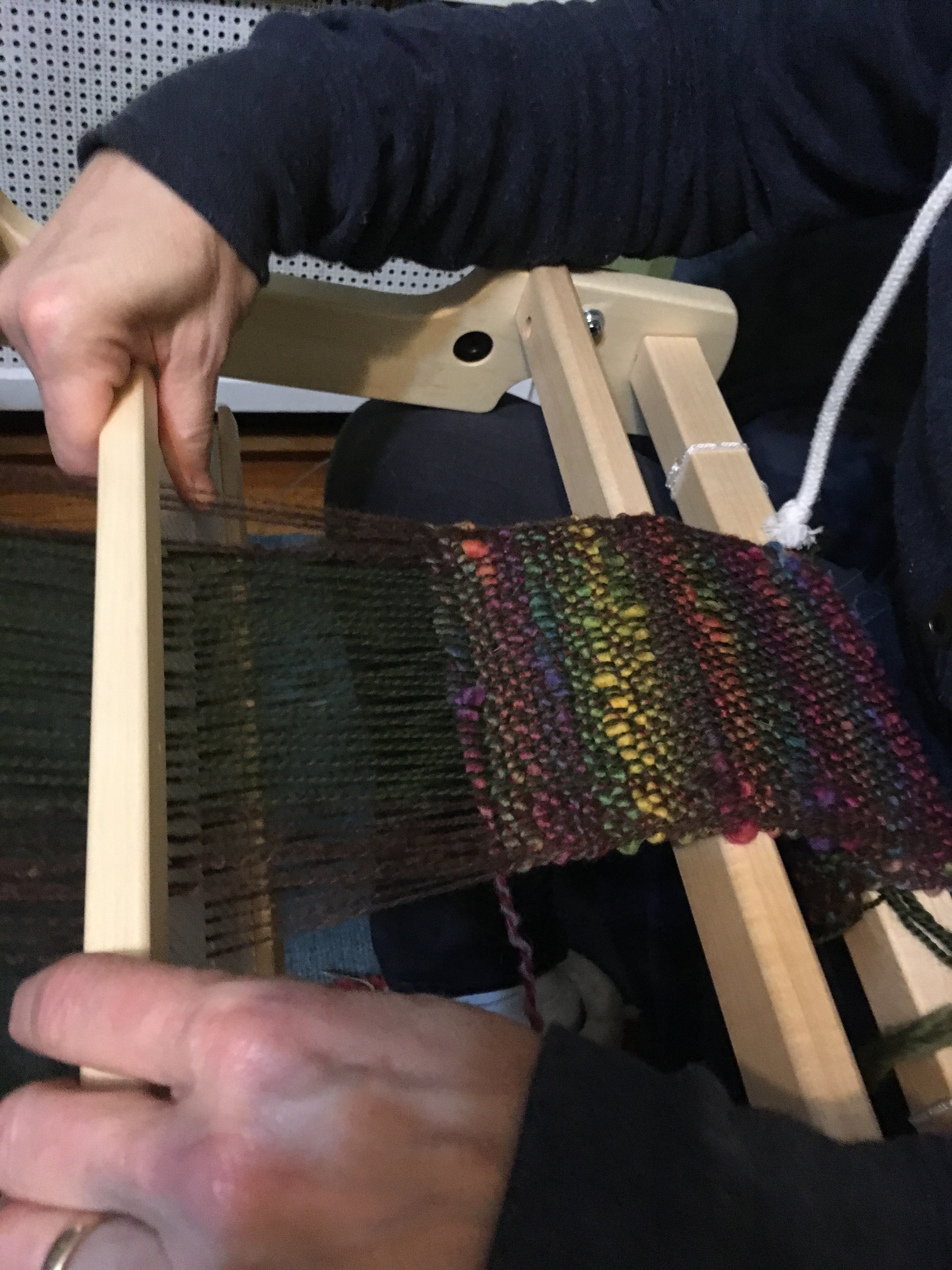
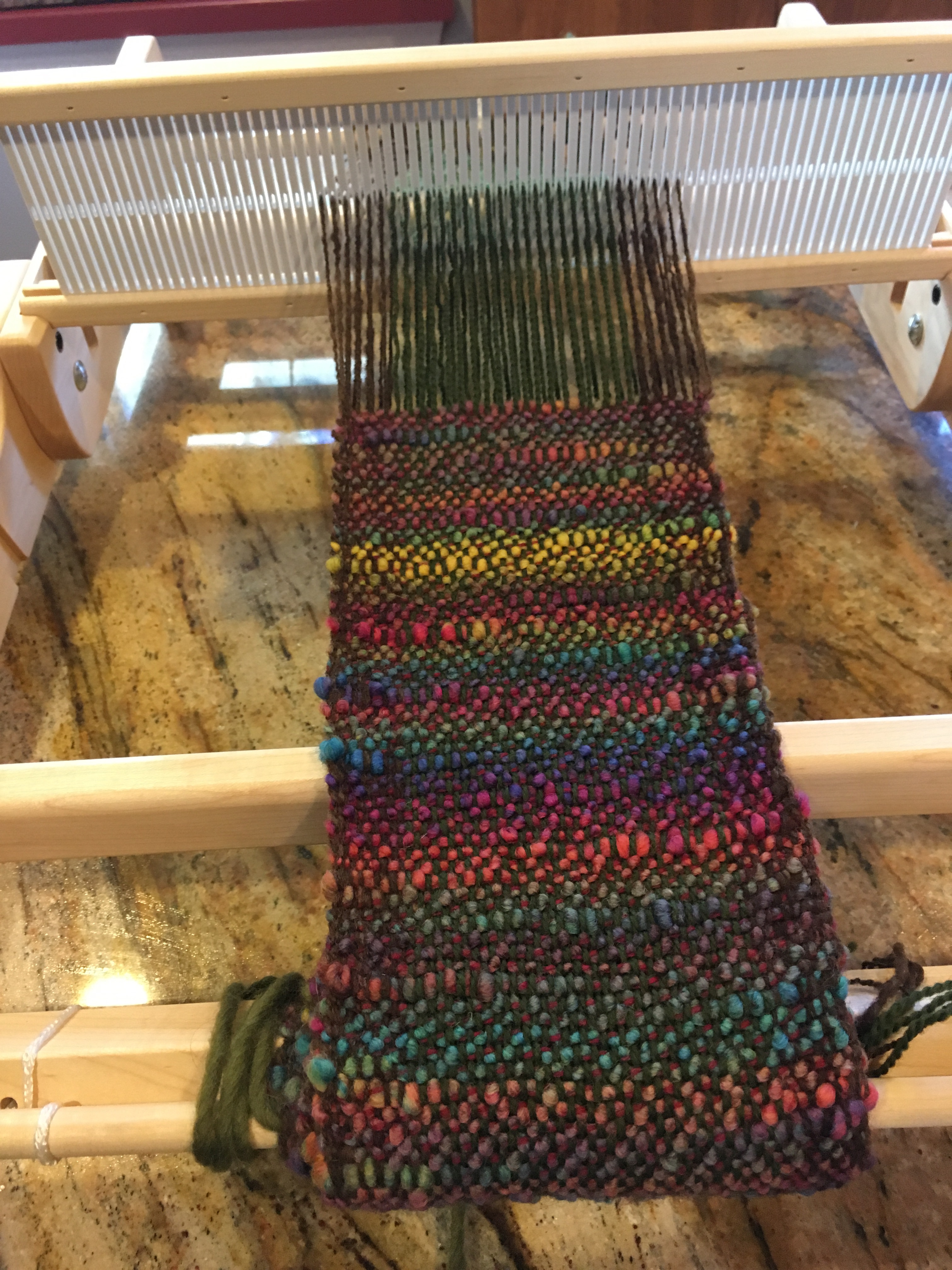
See if you can find the mistakes in these two pictures of a plain weave plaid item:

The mistakes are hard to spot until you know what you are looking for. But you have to look for them. Sometimes I did not find the float until I had finished 8 picks! 

Undoing the weft takes time, patience, and bright light. If you don’t press down all the threads, when you run the shuttle back, you can create another tangle. Then you have to undo that in order to correct the mistake you spotted originally.

So how on earth did Penelope manage to unweave all those picks at night? She had no candles. She only had torches.  Or moonlight. Or maybe Athena gave her special light. She was always helping her favorite Odysseus out so why wouldn’t Athena help out Penelope?

I know from even the little bit of weaving which I have done that unweaving takes more time than weaving. Unweaving is more tedious. 

What did Homer know of weaving? When did he see women weaving? Was it something they did in the public rooms? Writing this little blog post makes me ask questions I never would have asked before about life in Ancient Greece.

Here are the mistakes in case you did not spot them!


Posted in crafts, weaving | 1 Comment

Not enough sticks!

The new loom came with two stick shuttles. All well and good until you want to use three different colors for your weft design and you don’t want to wait for the order to come from Webs and you don’t want to drive an hour to a shop in Skippack, PA.

So I am walking the dogs this morning and coming back home, and I see a stack of my yard signs from my failed 2016 commissioner campaign. Maybe one of those might just work….

So I brought one in and laid it on the kitchen island. I took a real wooden shuttle, laid it down, drew around it, and cut a plastic shuttle with the kitchen utility scissors.

I notched the center (next time make the notches deeper) and rounded the sharp ends. I wound the red yarn around and tried it out. This home-made shuttle worked just fine. Maybe I don’t need to order those wood shuttles after all.

Posted in crafts, weaving | 1 Comment

What was THE Christmas gift?

Something that has proven a most absorbing and entertaining activity during the two-week winter break which my school gives everyone.

My SH of 30 years gave me (per a request submitted by a secret unknown informant) a 15-inch rigid heddle Schacht loom. Like I did not have enough hobbies to occupy myself when not teaching English. He is quite indulgent.

Here it is in the middle of the mess in the kitchen — sometimes neatening is not a top priority.

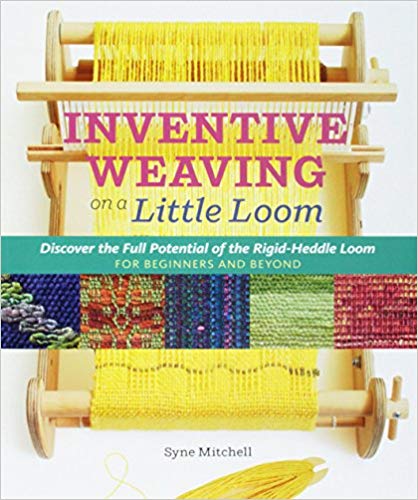
First it was unpacked from the box and I had to set it up. This required reading the enclosed directions, consulting my new bible, Syne Mitchell’s Inventive Weaving on a Little Loom, and viewing the Schacht video about threading apron strings.

Side note: Looking for a link to post for Mitchell’s book, I discovered she has a blog and that she has written science fiction as well as lots of articles, etc about weaving. Check out her blog: Syne Mitchell: Writer, weaver and all-round curious person.

Then it was time to dive into the stash and find some yarn to use for the first experiment.

Nothing was labeled, but it was all wool.

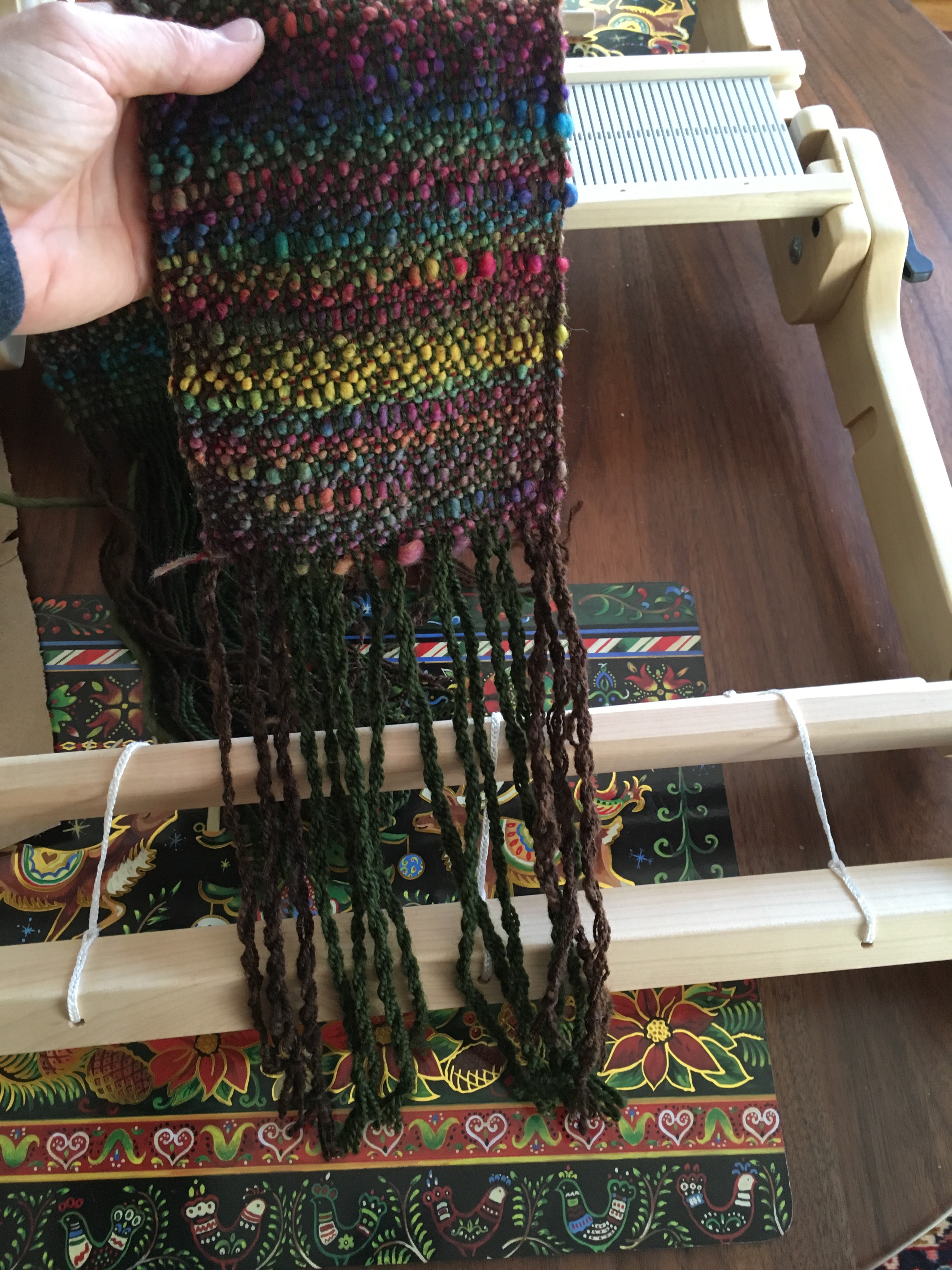
I found a ball of forest green fingering weight wool, some left-over handspun brown wool, and then a skein of a knobbly thick and thin multicolored wool.

Let’s go!

After a good bit of patience, the 10 sett heddle was threaded and after consulting Mitchell’s book again, it was time to start weaving. To finish the ends, I twisted 4 ends together and tied a knot at the bottom and then at the top very close to the last weft thread.

Posted in crafts, weaving | Leave a comment

An Old Family Sugar Cookie Recipe

Here is a very pretty cookie for Christmas when it is dressed up with red and green sprinkles. But it is also a delicious cookie for every day indulging. This makes a crisp cookie with a wonderful texture and delicious flavor.

This is a cookie that my mom used to bake for us on Sunday and then my sister and I had them for our lunches and for our “treat” in the evening before bedtime. I remember dunking them in milk but they would also be good with tea or coffee.

I will have to ask my mom, but I think this was one her grandma used to make for her. My great-grandma (my mom’s mom’s mom) had a farm in Iowa and she worked before daylight until well past nighttime. 

Here is the everyday recipe and then I will tell you a variant I invented this Christmas to make the cookies more seasonal. 

By the way, it is an easy cookie to make and does not require refrigeration before baking. This recipe makes about 50 cookies and really only requires about an hour’s worth of time.

Ingredients (and preheat oven to 350 degrees)
1 1/2 cup sugar
1/2 cup unsalted butter
1/2 cup Crisco 
Cream these three ingredients until light and fluffy. It is important to have half butter and half Crisco to get the crisp crunch of this cookie. When we were growing up, we could not afford butter and so my mom made these with 100% Crisco and this was in the days when Crisco contained tranfats. 

Then add 2 egg yolks and beat again.

Add 1 teas baking soda and beat.

Add to this mixture:
1 teas cream of tatar
1/2 teas salt
1 teas vanilla and beat. I usually add an extra teaspoon of vanilla.

Now add 2 cups of flour and beat. The dough will get heavy but trust this.

Now add 1/2 cups of chopped nuts and beat. I prefer pecans and usually add 3/4 cup. 

Drop cookies onto a cookie sheet. Nowadays, I always bake with parchment paper because it makes clean up so much easier.

My mom’s recipe called for rolling the dough into balls by hand and this was probably one of the reasons I did not make these cookies since I hate rolling cookies. I hate how sticky and greasy my hands get, and I hate the time involved. So boring. Instead, I use a smallish cookie scoop — it is probably a 1 teaspoon size. 

Make sure you leave space between the cookies. I usually have 16 cookies on each sheet.

Bake them for 12-15 minutes. Take the pan out of the oven just as the cookies barely get brown at the edges and let them cool on the pan for at least 5-10 minutes. Otherwise if you try to take them off when they are hot, they will crumble apart. These are delicate cookies.

Let them cool completely before you pack them away. I suggest waxed paper between layers but my mom never did that!

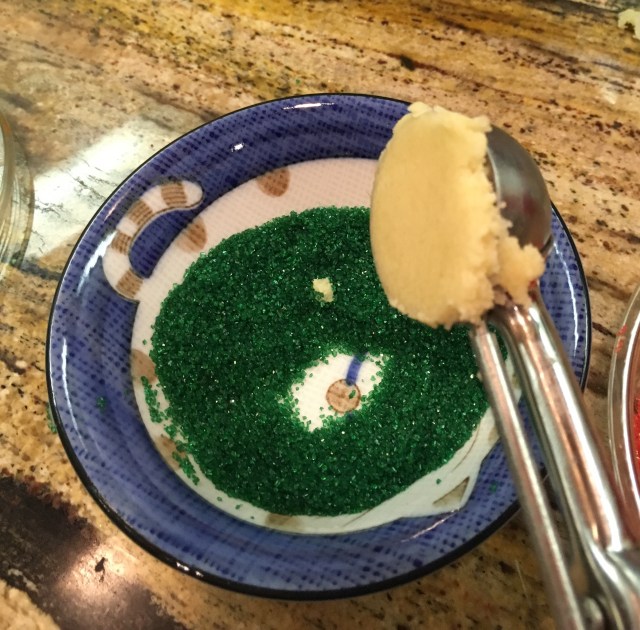
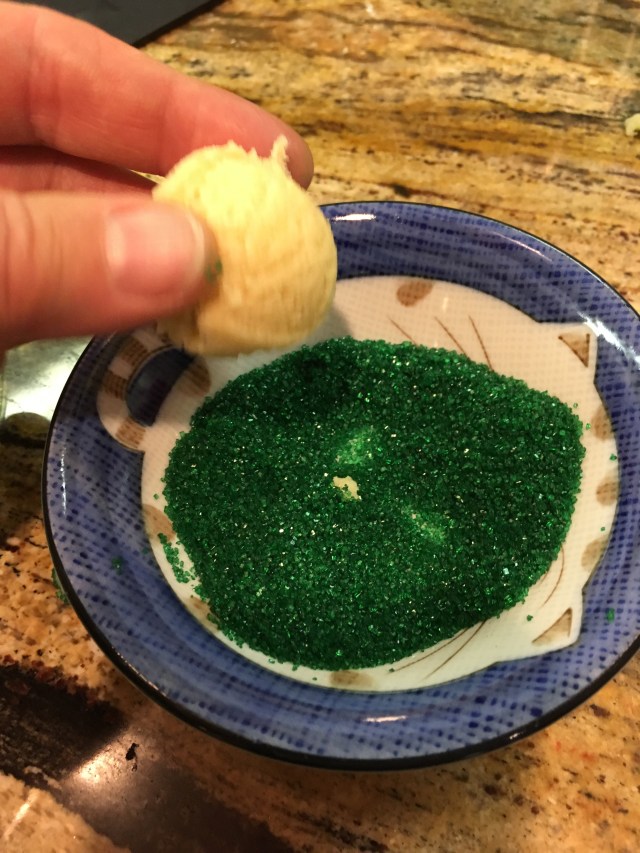
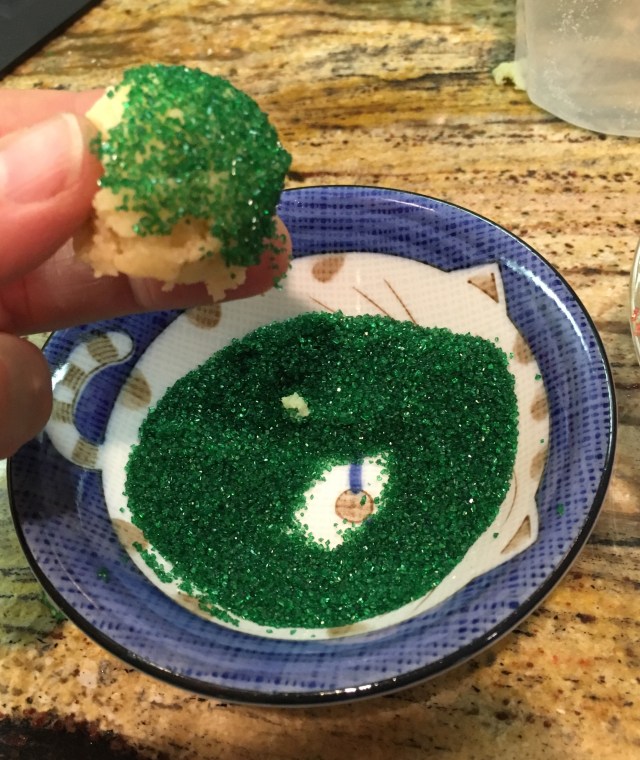
If you want to make them more Christmasy, when you pop the cookie out of the scoop, catch it in your fingers. Roll the round end in red or green sugar crystals. Set each cookie on the cookie sheet covered with parchment paper. Bake as directed above. 

Posted in Baking | Leave a comment

Wearing Someone Else’s Cap or Bags (hat or pants) — a personality test in E.M. Forster’s novel A Room with a View

This is my third or fourth time teaching E.M. Forster’s enlightened novel A Room with a View, which chronicles how Lucy Honeychurch fights the armies of darkness (self-abnegation and sterility) to win her true love, George Emerson.

But first she has to get rid of Cecil Vyse (oh the humor of Forster’s infernally playful names for people and places). 

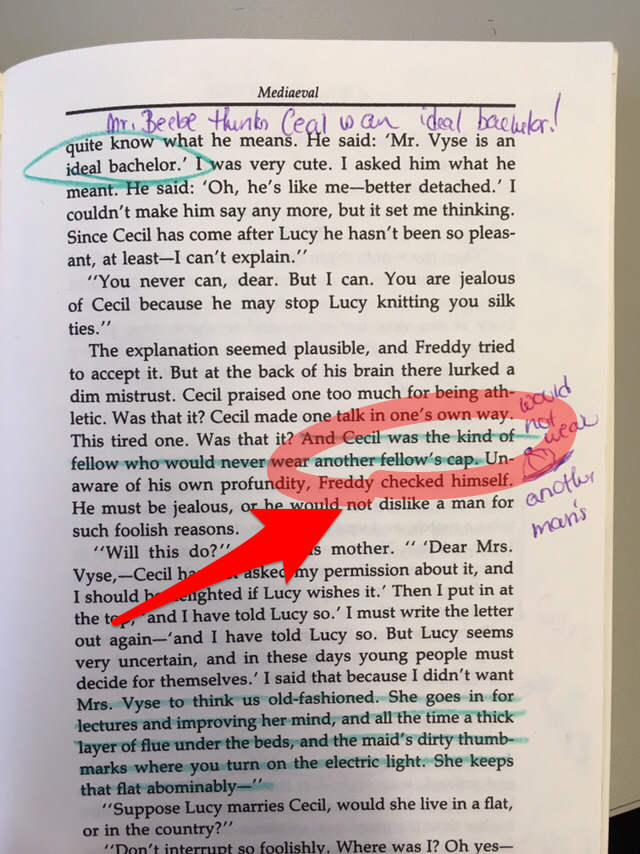
When Cecil first appears, Lucy’s brother tells his mother that he does not really like Cecil, because Cecil would never where someone else’s cap. See image below for textual evidence from Chapter 8:

Now this little aside of Freddy’s merely captures for me Cecil’s stuffiness. He would never ask to borrow another man’s cap. He would never want to wear someone else’s clothing. After all a cap might have dandruff or worse — creepy crawlies. And besides Cecil is more of a top hat sort of guy. 

Freddy’s comment was another way for the narrator to express how Cecil deliberately sets himself apart from ordinary folks. 

But it was not until this reading that I had my Eureka moment! 

George Emerson is the sort who would wear another fellow’s cap. In fact, George Emerson wears someone else’s “bags.”

In the Twelfth Chapter (and so Forster names it), Freddy and Mr. Beebe call upon George and his father who have just moved into Cissie Villa. The father and son have not even finished unpacking, because Freddy and Mr. Beebe have to maneuver around a wardrobe which is standing in the middle of the passage. On impulse, Freddy asks George if he wants to have “a bathe.” This delights Mr. Beebe to no end.

Off the three men go to the “Sacred Pool.” They strip down and George looks “Michelangelesque” and they go swimming and dunking and galumphing in and out of the pool. That is until their exuberant playing is interrupted by the arrival of Lucy and Cecil and Mrs. Honeychurch. A mad scramble ensues to preserve Edwardian standards of modesty.

And here is where I finally make a connection (probably others — and here I include two long retired former colleagues who taught the book many times — have long before connected the dots.)

Forster has Freddy howl at George, “Emerson, you beast, you’ve got on my bags.” And here is the textual evidence to the left. 

Look at the green circle around “bags” which is slang either for pants or men’s underwear. Given the age when Forster is writing, I think it more like to be a reference to pants, but nonetheless, there is a huge contrast symbolically between hat and pants/head and groin.

Cecil is all intellect with no sexuality. Look at what an abysmal failure his first kiss of Lucy is: he asks her permission, drops his nez pince between them, and considers the kiss himself unmanly. Forster calls Cecil an “ascetic” and uses adjectives like “celibate” to describe him. 

George is an intoxicating (but subtle) amalgam of Eros and Philos. He kisses Lucy without her permission in a sea of foaming violets and he reads German philosophers — scaring Freddy whom the narrator says was “appalled a the mass of philosophy that was approaching him” (Twelfth Chapter). For George, Forster invents the word “Michelangelesque.” He uses the adjectives “radiant,” “personable.” He says George is “happy” and describes him as giving “the shout of the morning star.” What more do you want for a hero? Forster associates him with the sun, virility, the naked splendour of the Renaissance. Granted Forster does not call George a Modern David, but he might as well have done so. 

What I find utterly amazing is that the minute detail of Cecil not wearing another fellow’s cap has niggled at my imagination for so many years. And only this year and only at this reading, did I finally connect the two references to clothing to create a new, deeper appreciation for Forster’s art and craft. Here’s to Freddy, Lucy’s delightfully irreverent younger brother, who was the character that helped me make the connection.

 

Posted in Uncategorized | 2 Comments

How about another heirloom cookie? Scotch Toffee Bars

Growing up, my mom and Grandma made Scotch Toffee bars. I loved the crispy caramel base and then the sweet chocolate topping.

But when I tried making them for my husband that first Christmas after we got married, they did not turn out. I could not get them out of the pan because they stuck so horribly.  Later when I tried again,  I could not get them cut before the bottom hardened completely.  

This year, I promised my mother-in-law I would make her cookies. I decided to do a  few things differently. Success!

Follow along with the directions below!

New Step 1
Line a 9 x 13 inch pan with parchment paper. Butter the parchment paper. 
Preheat the oven to 400 degrees

Step 2
Melt 1 stick of butter slowly in a pan. Then add:
1/4 cup of Karo syrup
1/2 cup of brown sugar
2 cups of quick cooking Oatmeal
Stir all until well combined

New Step 3
Spread the oatmeal-butter mixture on the 9 x 13 pan. Spread it out evenly but not to the edges of the pan. Leave about .5 inches all the way around.

Step 4
Bake this in the oven for 12-15 minutes. While this bakes, chop up the walnuts. Take out pan when the edges are brown. Turn off the oven.

Step 5
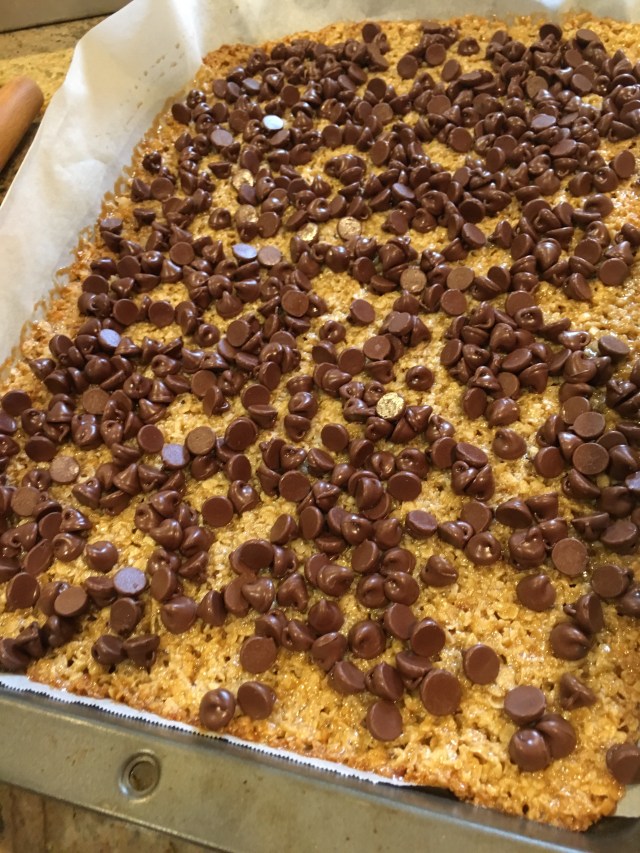
Sprinkle on the chocolate chips. Then return pan to the oven for 2 minutes until chips begin to get shiny.

Step 6
Take pan out of the oven and spread the melted chips to the edges of the toffee base.

Step 7
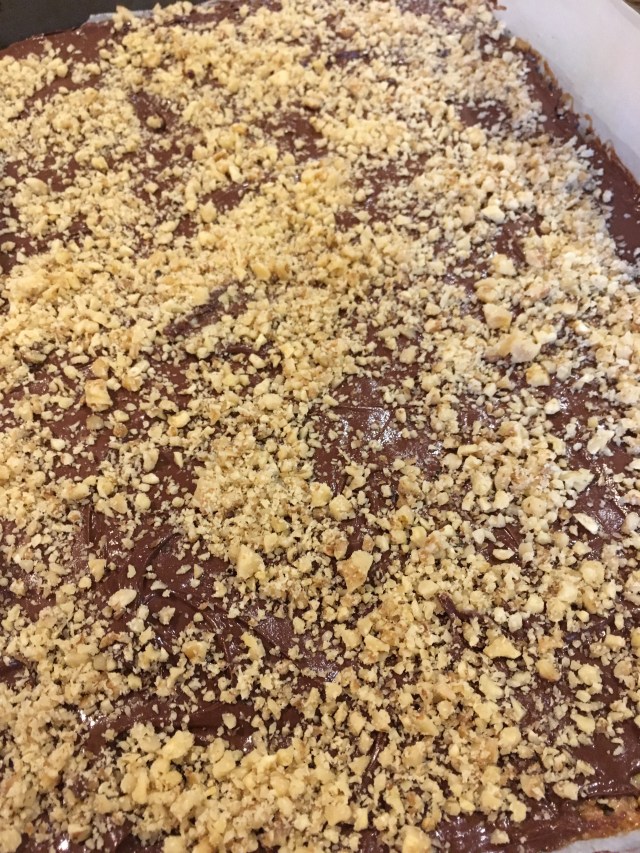
Sprinkle the entire surface with 1/2 cup of chopped walnuts. You might need more chopped walnuts depending on your own preference.

New Step 8
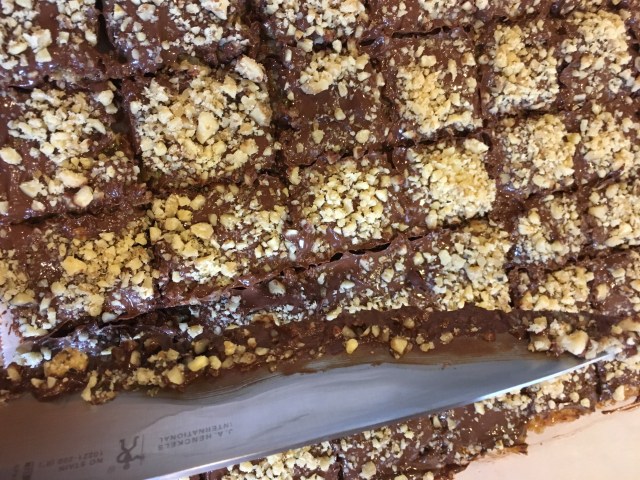
Grasping the edges of the parchment paper, lift the entire thing out of the pan and put on a flat cutting board. Take a long knife and cut into squares. Then let it all cool.

Step 9
When it is cool, break the bars apart and put in a container with waxed paper between the layers. 

Posted in Baking | Leave a comment

Poppy Seed Rolls

Every holiday my family (SH and the three children) eagerly wait for the poppy seed rolls to come out of the oven. I have to swat hands away so some rolls remain for the next day’s Thanksgiving or Christmas feast. But these rolls are divine fresh out of the oven, slathered in butter, or just eaten plain.

My mother made them. My grandmother made them.

My mother and grandmother kneaded their dough by hand and now I use a bread machine.

Here is my recipe for the bread dough (written from memory). Put the ingredients in the bread machine pan in this order: 1 and 1/2 cups of lukewarm milk; 1/3 cups of pumpkin or mashed potatoes (optional); 2 teaspoons salt; 2 tablespoons sugar; 2 tablespoons of soft butter cut up into pieces;  4 cups of flour (King Arthur white bread flour is preferable bo not required); 3 teaspoons of yeast. Push the buttons so the machine makes the dough. while you make the poppy seed filling.

img_0857

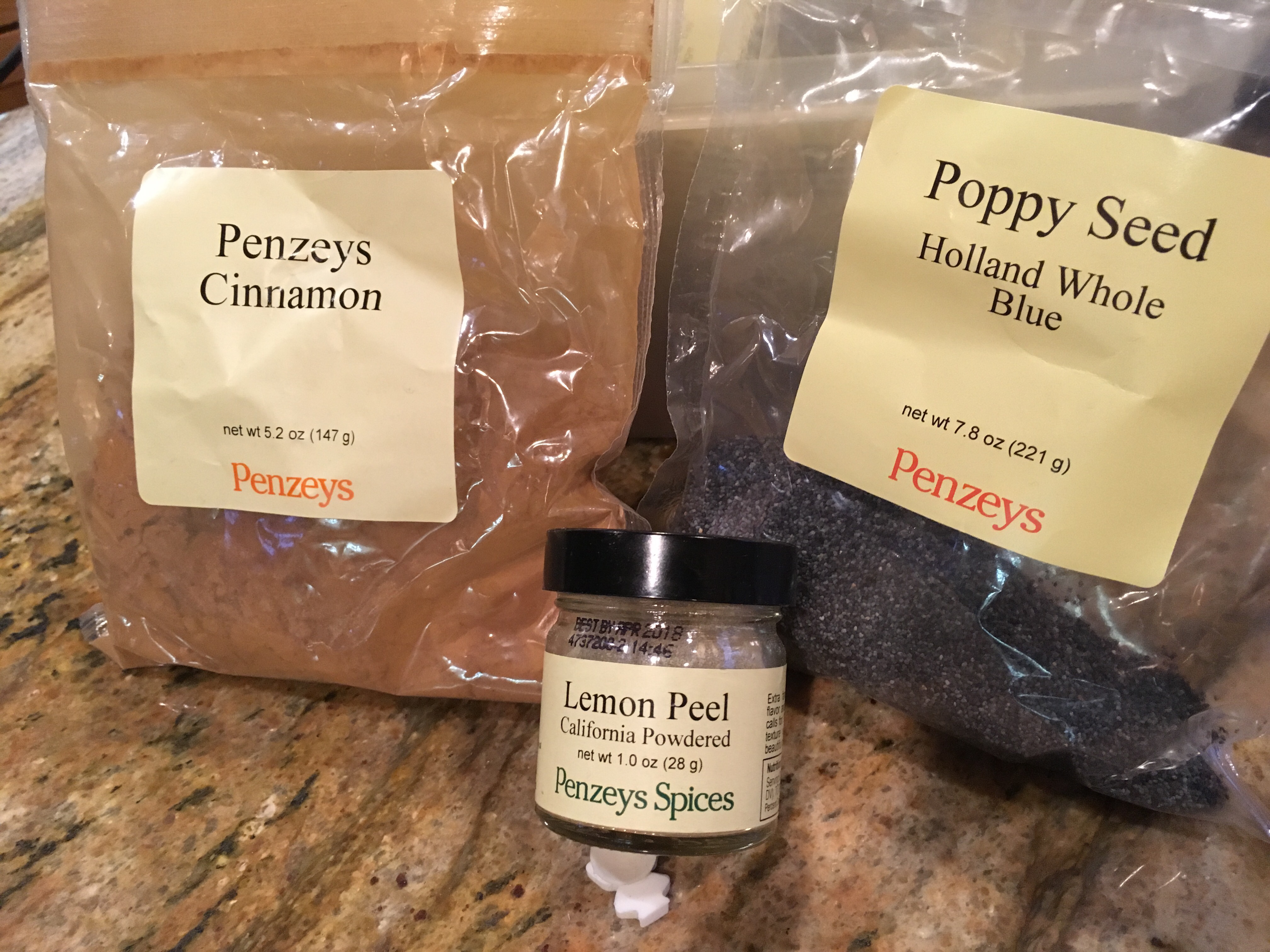
I always used Penzeys Spices. They smell incredibly good. Sometimes I don’t even need to look at the label to know what spice I am using.

In a small sauce pan, put in 3 tablespoons of poppy seeds, 3 tablespoons of sugar; 3 tablespoons of water, 3 teaspoons of cinnamon, and 1 teaspoon of lemon peel. Cook all of these ingredients, stirring until it bubbles. Then set aside to cool.

When the dough is ready, remove it from the bread machine. Place the ball on a floured surface and cut this in half. Now you have two balls of dough. Roll out one ball of dough into a circle.

img_0851

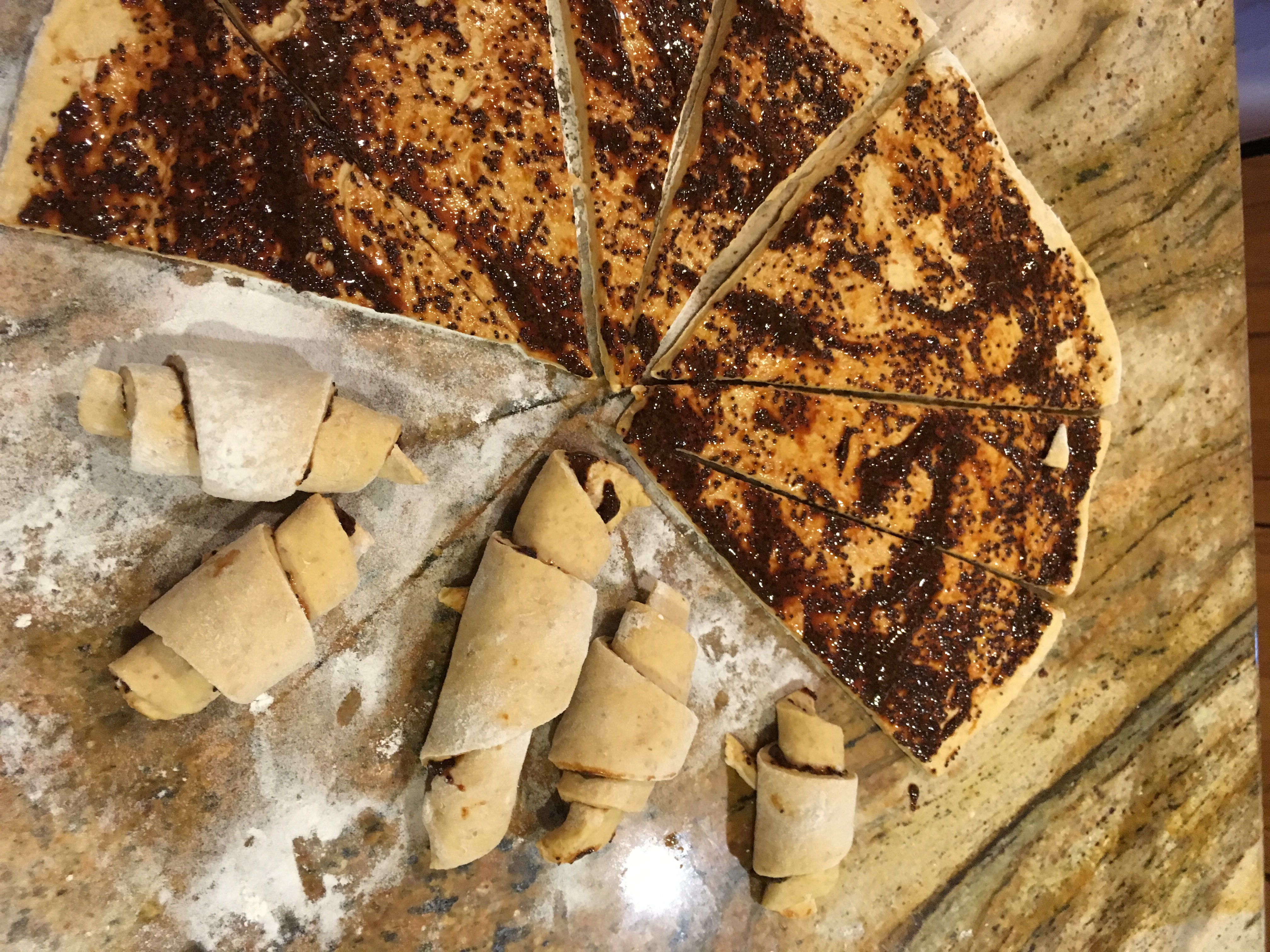
Using the back of a spoon, spread half of the poppyseed mix on the circle of dough. Notice that mine is not perfectly round. Try to get the poppyseed mixture to the edges of the circle.

img_0853

Slice the circle into wedges. I use a pizza cutter for this. I usually make 12 rolls for each circle, but you can make the wedges bigger. Then roll each wedge started with the side end and rolling to the narrow end. The narrow end should be tucked underneath the roll.

img_0854

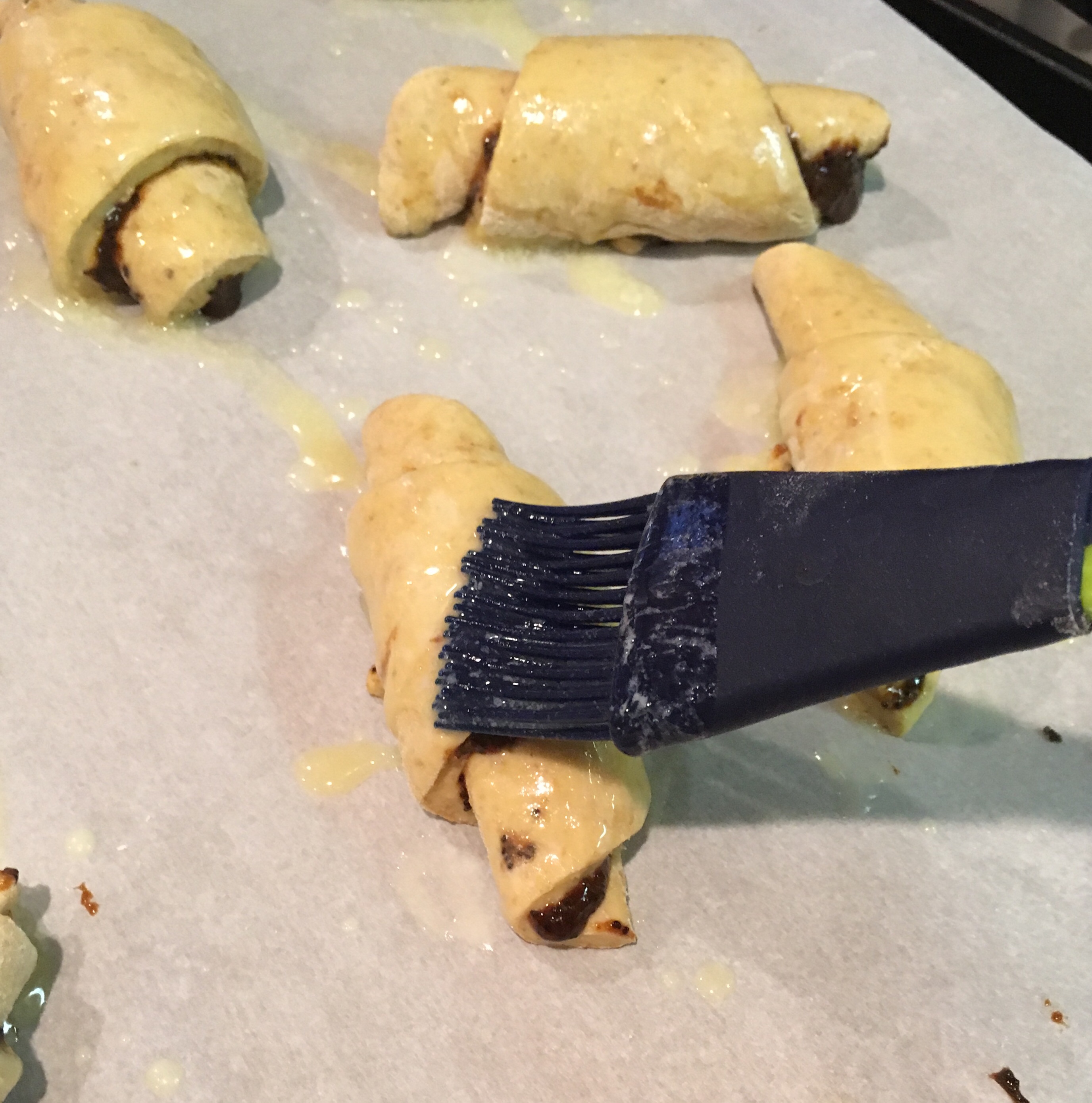
Arrange the rolls on a baking sheet covered with parchment paper. I am a huge convert to parchment paper because then I don’t have to grease the pan and I can reuse the parchment paper for a couple of batches of rolls or cookies. Brush the tops of the rolls with melted butter. Then set the pans in a warm place to rise until they are doubled in size.

img_0862

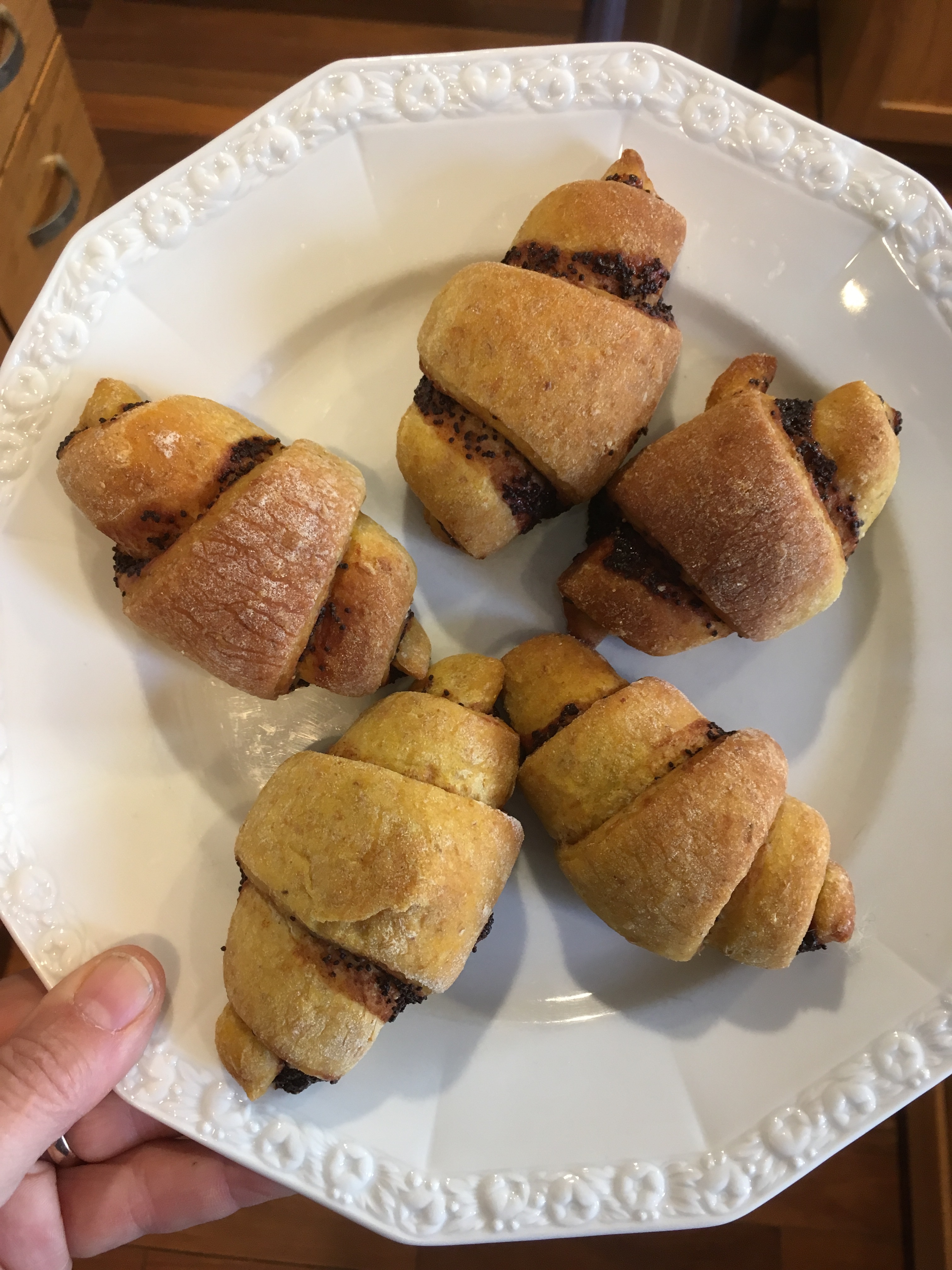
Bake the rolls in a 350 degree oven for about 20 minutes. They should be a light golden brown when you take them out. Mine pictured above look darker because this dough had pumpkin in it. I made a batch of these last night and today (less than 24 hours), there are only 2 rolls left. 

When I was little, I once got in a heap of trouble over poppyseed rolls.

We were at my grandmother’s for Christmas. We had been a day or two and I had discovered a bag of poppyseed rolls in the bread drawer. I snuck them upstairs and ate them (piggishly) on the sly.

Then my grandmother started looking for this bag of rolls for dinner one night. Of course, she could not find them.

I confessed.

My mom was furious. Oh her eyes snapped with anger. I might even have gotten spanked except I was saved by my grandma

My grandma laughed and said I must really like her poppyseed rolls!

Posted in Baking, family, life in general, Uncategorized | Leave a comment