A Mini Count!

On my last day in London, I walked out of the hotel and saw this:

img_5981

I am rather fond of Mini convertibles — being the driver of one. So I decided to keep a Mini count for my last day.

I only got up to 14 Minis in London on Thursday, August 2. But I did see a McLaren in Westminster Square. Those cars have aggressive styling and look like a mechanical cheetah.

Minis look completely different. A friend of mine says the Mini convertible looks like a baby buggy.

I seem to remember seeing more Minis during my time at Oxford.

But when I was in Oxford, I did spot this old Classic Mini parked on the street. My best guess is that it dates back to the 1990s. Apparently in the Mini was voted “European Car of the Century” by a jury of international automotive journalists. Click here for a history of the Mini with pictures.

And here is my personal history of Mini ownership thanks to the generosity of SH who thinks I should have what I want — or what I don’t even know that I want!


Posted in life in general | Leave a comment

Goodbye to London, England, and Oxford

img_5975

St. Paul’s after Evensong

Since July 17 until today August 3, I have been here in the United Kingdom. The trip had three parts. The first week was with SH as we traveled by train around Wales. The second was a week in Oxford at the Oxbridge Teacher program where I participated in the science seminars (strange for a literary person but more on that later). The third was three days in London.

The entire trip has been a gift.

First, from SH that we spent peaceful days together in each other’s company uninterrupted and did the things we loved together: hiking, reading, talking, being quiet together.

Second, from my school which chose me as one of the two people to attend a program at Oxbridge. Other folks also applied, including a good friend who did not begrudge me. But I was the fortunate one.

Third, from no one but myself as I spent a few days alone exploring the city and doing exactly what I wanted to do without consultation with others. I loved being able to decide to visit yesterday the UK’s Supreme Court building, and then Tate Britain Museum, and then attend Evensong at St. Paul’s. I spent as much time as I wanted doing each of these things — such as learning about how the UK’s Supreme Court was founded just a few short years ago or being stunned by the Harry and Carol Djanogly Gallery in the Tate Britain which contained so many paintings I have studied in books or on the web.

So this has been a wonderful trip but now I am eager to walk to the Lancaster Gate tube and board the underground to begin my journey home to my patiently waiting and dearly loved husband.

And the silly dogs.


Posted in life in general, london | 1 Comment

Snarky English Signage

This gallery contains 10 photos.

More Galleries | Leave a comment

A Globe, a River, and an Eye

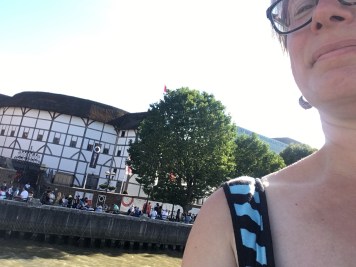
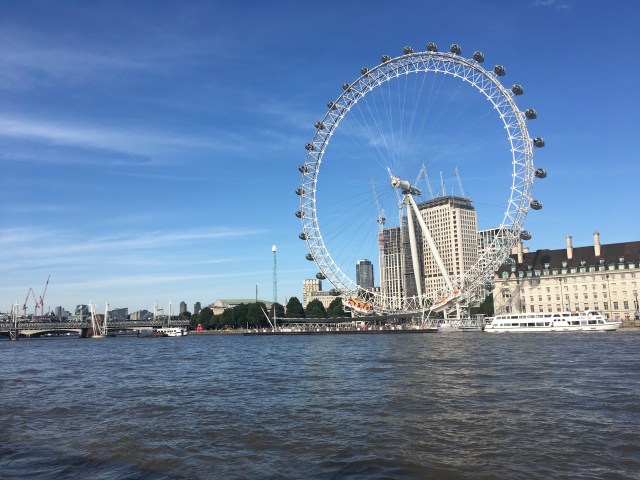
img_5722Yesterday was a full day spent primarily in Southwark, exploring Borough Market and buying tea from Tea 2 You, having a tour of the Globe and then watching their performance of Hamlet, riding a river bus up to Westminster and then walking back to my hotel (3 miles) through St. James and Kensington Parks.

I must say I enjoyed the river bus a great deal because instead of being underground I was out in the open air on the river and seeing both sides of the Thames and it was just lovely! It only took about 20 minutes too. I could use my Oyster card to get on and that cost only about 7 pounds which is only twice as much as the Tube and a sight more pleasant. The evening was beautiful and the sky was a bright blue (Lord, they could use some rain). The breeze was cooling and it was just such a pleasure. SH would have enjoyed it so much I kept thinking.

img_5741


Posted in london | 1 Comment

What does the Groundskeeper read at Oxford?

img_5447

Entrance to the Ashmolean Museum

Yesterday morning I headed to the Ashmolean Museum for an appointment to see Pre-Raphelite drawings in the print room. The museum opened at 10 am so I had about 15 minutes to wait and I went and sat down on a stone bench abutting a garden of flowers and trees. I don’t remember if I was reading or just sitting there but one of the men who tend the grounds came up and was inspecting the bed.

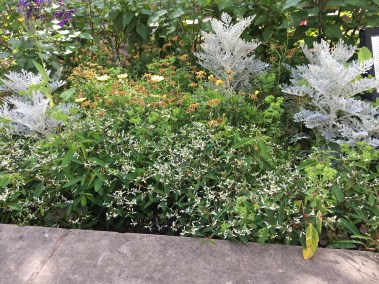
“They are awfully dry,” I commented.

“I was looking at the weeds,” he said. “I need to weed that.”
img_5448

Do you see any weeds?

“It does not look so bad to me.”

“Are you waiting for the Museum to open?”

That was the opening gambit to a 10-minute conversation which moved from my job to his reading and then to poetry and modern prose style. The man was older, maybe in his late 50s, and had the most marvelous silverly beard which curled and looped. He would have been an excellent casting choice for Gandalf.

He told me about his daughter how teaches primary school (that followed after he learned I was a teacher) to his son who works at Blackwell’s in Oxford (the amazingly stocked bookstore) and then to what he reads. Somehow he got onto poetry and he said he loved Basho and his poetry. Then he talked about how his favorite American author is Hemingway because of the spare prose style.

He recommended that I read Cormac McCarthy’s Border Trilogy starting with All the Pretty Horses. He said it was set in the border area between Mexico and the US. I have paused over that book but never picked it up but might have to now.

Funny I looked up Cormac McCarthy and read the summary on Wikipedia on All the Pretty Horses and came across this entry about the style of the book:

All the books of the “Border Trilogy” are written in an unconventional format which omits traditional Western punctuation such as quotation marks and makes use of polysyndetic syntax in a manner similar to that of Ernest Hemingway. (Wikepedia entry)

Now it becomes clear why he connected Hemingway with McCarthy — perhaps.

He also told me that any employee of Oxford University can go to any Oxford library and check out any book they want. He said that he has gone to the library which houses the Japanese books and borrowed translations to read.

It seems that just being in Oxford, being in that atmosphere, in that space which is saturated with learning, that everyone continues an independent, individual scheme of self-education. My vision is so one-sided, but Oxford seems a town of auto-didacts.

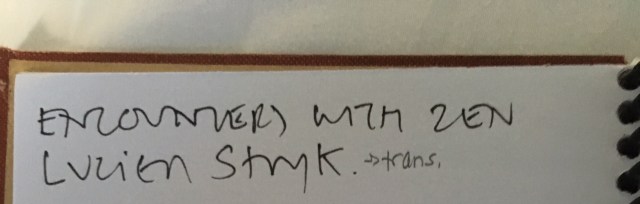
Before he disappeared, he wrote down in my notebook the title of a collection of Japanese poetry and the name of the American translator he likes the best. Look below for visual evidence.
img_5615


Posted in books, cambridge oxbridge | Leave a comment

What is the Night Porter reading?

img_5320Yesterday evening after a Chopin and Beethoven concert at the Sheldonian Theatre, we walked back to Worcester College.

Every college in Oxford (and Cambridge for that matter) has a single entrance for scholars, students and other folks staying at that college. You have to pass through a large wooden door after you gain access by waving your card before the security panel. But once inside the door, you also have to pass by the porter’s lodge where the porters monitor everyone going in and out. They are there for security certainly but also to answer questions and give help.

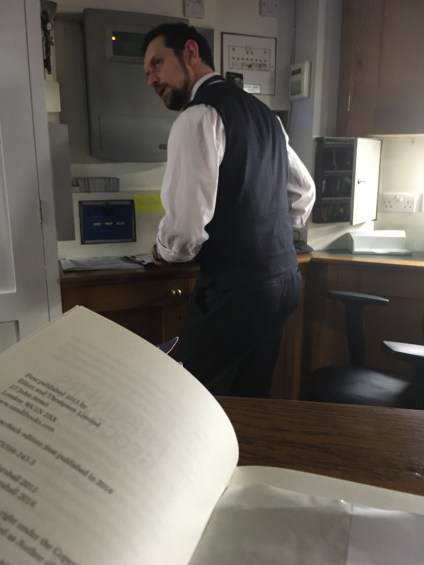
Anyway, as we walked through the door, I waved at the porter and notice he was reading a book. I asked him how long his shift was going to last and learned he was there all night. Then I just impulsively asked him what he was reading to pass his time. That started a ten-minute conversation at least about the book he had in his hands, the book he had set aside, and the book he had just finished which he thought I would like.

The book he had set aside was about quantum mechanics. He showed me the printouts he had made which included the periodic table, a list of the electron shells of all the atoms, and some other pages. He said he had gotten about 60 pages into the book and then just switched to a book about the impact geography has on the potential and power of various world regions.

Then he told me about this other book which a student had given him and showed me the title on his computer screen. Apparently, he and the student had exchanged books.

I am just struck by how people here are still reading hard copy books. But also struck that at Oxford no one stops learning and reading.


Posted in books, cambridge oxbridge | Leave a comment

I was 2 inches away from drawings by DaVinci, Rapheal and Michaelangelo!

img_5113Today the science group of the Oxford Teacher Seminar went by appointment into the print room of the Ashmolean Museum. 
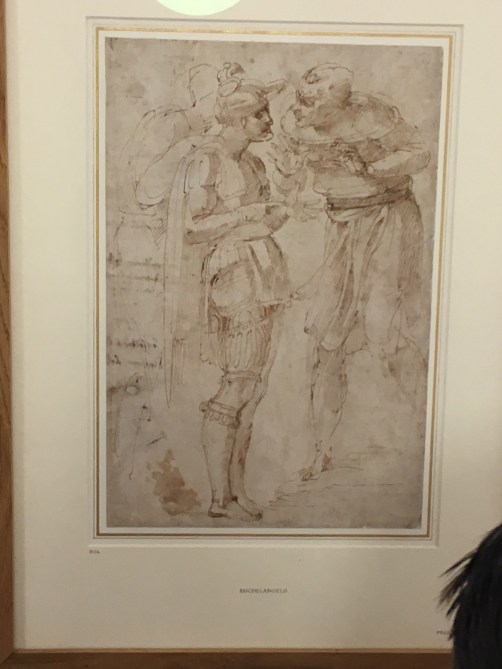
The curator of the print room brought out 5 drawings each by first Michelangelo, then Raphael, and finally Leonardo!

This first by Michelangelo is of three men debating. The facial expressions and hand gestures of the two men are so dramatic. Also note that their clothing is quite layered and detailed and drapey until you get to the feet which are bare.

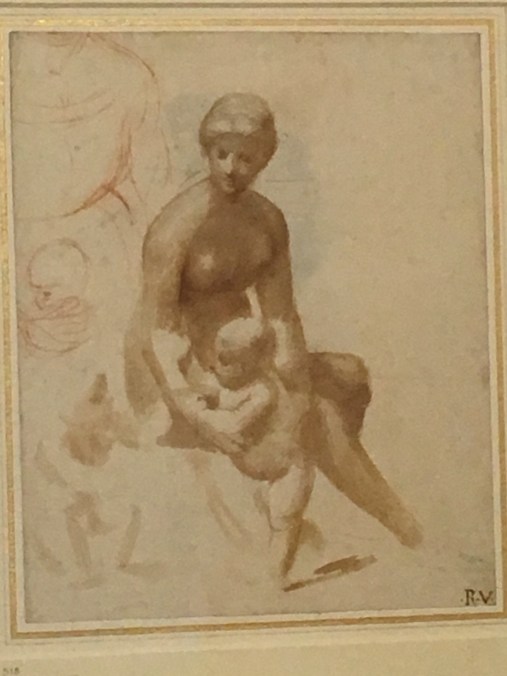
img_5124This second by Raphael is a study for his Madonna im Gruenen. The roundness of Mary’s cheeks, face, hands, body convey protective maternity of the infant Jesus.
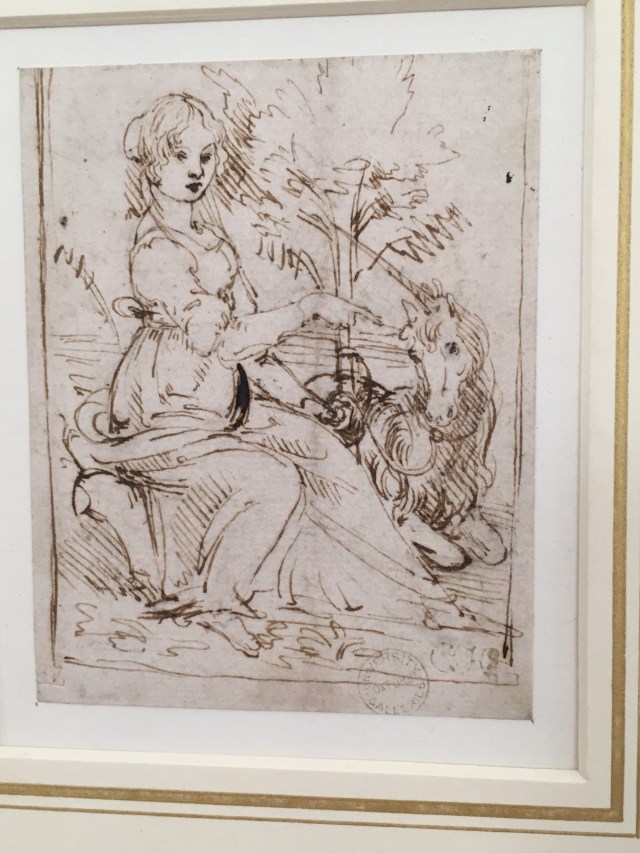

This third by Leonardo is actually two little drawings. When the curator switched from the five Raphael drawings, she told us to sit still so she could bring out the Leonardo drawings which are unframed and not protected by glass. She gave us a catalogue of the drawings and mentioned she was bringing out the unicorn one. I hoped silently that she would put the unicorn drawing in front of me.

And she did!

The bottom drawing of the curled up unicorn looks like it is sleeping (or worse).

The top drawing of the unicorn captured by the maiden has a poignancy and sweetness. The unicorn’s face seems melancholy and the maiden seems to point to the rope looped and tied around the unicorn’s neck. The pen lines are clear and swift — almost like Leonardo was drawing for the entertainment of someone. He makes little flourishes for grass and plants at the bottom. He makes diagonal slashes across the unicorn’s body for shadow. The diagonal lines framing the woman’s face might be a veil which is fluttering in the wind, since it does seem her hair is pinned back into a bun with some strands curling around her face.

img_5140

But what a gift to spend time seeing these drawings with just a few other people in the silent room of the Ashmolean Museum.

I found myself summoning up old knowledge about watermarks, making paper, collector’s stamps. And remembering how I had been taught at Harvard how to study rare books and manuscripts. When we came into the Ashmolean, I saw a bin of pencils on their information desk and took one. Lucky thing, because no pens were allowed! We were allowed to take pictures but only if we signed a form attesting that all the images would be only be used for personal or pedagogic purposes. On the form we had to list each image of which we took a picture. Now that surprised me because generally rare book museums do not allow this.

After we left and we were walking down the street toward the open market to find lunch, one of the other teachers said, “Now, my atoms are part of a Leonardo drawing.” I asked her what she meant. “Every time you breath out, you breath out your own atoms.”

So I guess that means I too am part of that captured little unicorn.

Posted in cambridge oxbridge, learning, life in general | Leave a comment

Gloucester College, Oxford garden on a Friday morning

Posted in Uncategorized | Leave a comment

Oxford and Christopher Ricks

Today was my first full day participating in the Oxbridge program at Oxford. I spent the morning learning about vaccinations from Sarah Loving from the Oxford Vaccine Group. Then there was a lecture about Edward Lear by Jasmine Jagger (lots of clues such as depressions, isolation, alienation and self-hatred that Lear was gay; got that confirmed during a separate conversation with Jagger). Then the last learning event was a lecture by Christopher Ricks entitled “Literary Criticism and Principles, Starting from Dr.Johnson.”

Prof. Ricks talked about interpretation as an exercise of the imagination, arguing that only art and literature can change us — not facts or rationality. But art and other people and if we pay attention to them, really pay attention to them, we can get access to truths/systems/perspectives which are not our own.

Born in 1933, Prof. Ricks has a perspective on literature and life and history which is seasoned by the wisdom gathered from years of study, teaching, learning, and writing. His comments showed that he is acutely attuned to current events and particularly the travesty in the USA as he sprinkled into his hour-long talk references to fake news and lies. He did quote from memory something Benjamine Disraeli said: “Next to knowing when to seize an opportunity, the important thing in life is to know when to forgo an advantage.” That is something politicians in the USA have forgotten entirely in the intense partisan war (I had written bickering but that was too mild a word and could only be used as an instance of litotes). No one is willing to overlook a chance to injure the other side or push a piece of legislation.

But besides the political and the talk was much more than just politics which was really only a side-bar, was that Ricks unashamedly practices close reading of I.A. Richards. He provided us with two poems by the poet William Barnes whom I had never heard of. One was “Sister Gone” and he carefully went over the technique of the rhyme scheme and sound patterns but then elaborated on how the reader’s sensibilities to sound gives the poem a more melancholy message of the inevitability of change. In the case of the poem, one sister marries and leaves another sister behind in the darkness of the lilac.

He asserted that the best critics are poets and not novelists and then proceeded to name as evidence: Eliot, Keat, Shelley, Pound, Coleridge. Then he mentioned that Charlotte Bronte was a brutal critic of Austen whom she despised and that comment made me smile.

Ricks also offered up tidbits of perspective on lines of King Lear and the character of Macbeth. I will return to those later but must get ready now for dinner which is served promptly at 6:30. I am told they get quite irritated if you are late!


Posted in literature | Leave a comment

Llewelwyn’s Castle

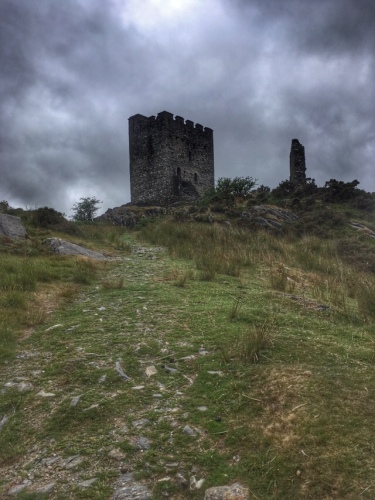
img_4709-1On our last day together of our week long train tour of Wales, SH and I walked to Dolwyddelen to see a castle which Llwelwyn the Great built to oversee and control the valley.
We began our walk in a soft rain, not quite rain but not quite mist. The hills were wreathed in clouds and the air was cool. We followed the road for a while and then a footpath veered off to the right and we starting climbing. Our path took us through a lane roofed by trees whose branches and roots were covered in moss. Trees only look like that when the sun never shines down to kill the moss. We emerged from the trees and came to the somewhat steep hill after walking by some sheep who ambled away from the strangers.

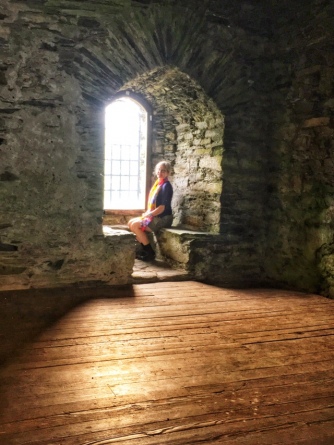
To get into the castle, we had to climb the stone stairs clinging to the outside — steep and uneven. Once up, we entered into the hall maybe 30 feet by 20 feet and certainly not much bigger than our own living room at home. The hall had a huge shallow stone fireplace and two deeply recessed window seats.

Imagine how cold it would be in that room in the winter — no glass on the windows, only one huge fire.

Imagine too the lack of privacy — everyone crowded together to eat, drink, sleep, piss, talk. And forget about sitting down. Only the nobility would have chairs. Only privileged folks would sit in the window recesses where you could have light and a view but at the price of freezing in the wind and cold coming in through the windows.

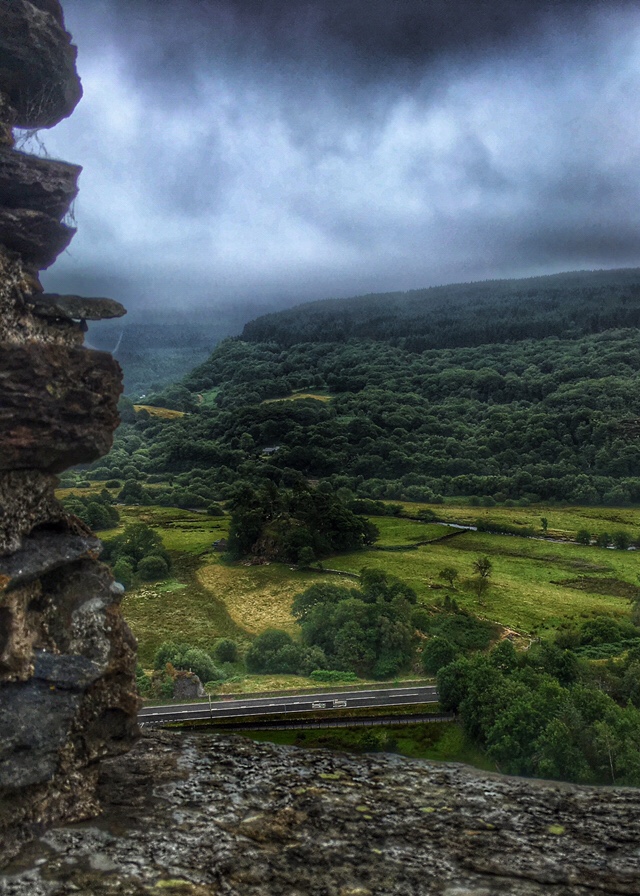
img_4708Before having our picnic lunch in a window seat, we climbed the narrow stairway to the battlements of the tower and looked out over the entire valley. One the one side we could see Tomen Castell, a round mound covered in grass and trees. Archeologists believe this once was another smaller wooden citadel and might even be the place Llewellyn the Great was born in 1173. He died in 1240 after a lifetime spent trying with some success to keep the English out of Wales.
If you ever want to read a good novel about Llewellyn, I would recommend starting with Sharon Kay Penman’s book Here Be Dragons. 

img_4699

Posted in life in general | 1 Comment